Quick Ratio: Measuring Liquidity and Financial Health
Understand the quick ratio, a key metric for assessing a company's short-term financial liquidity.
Quick Ratio: Definition and Overview
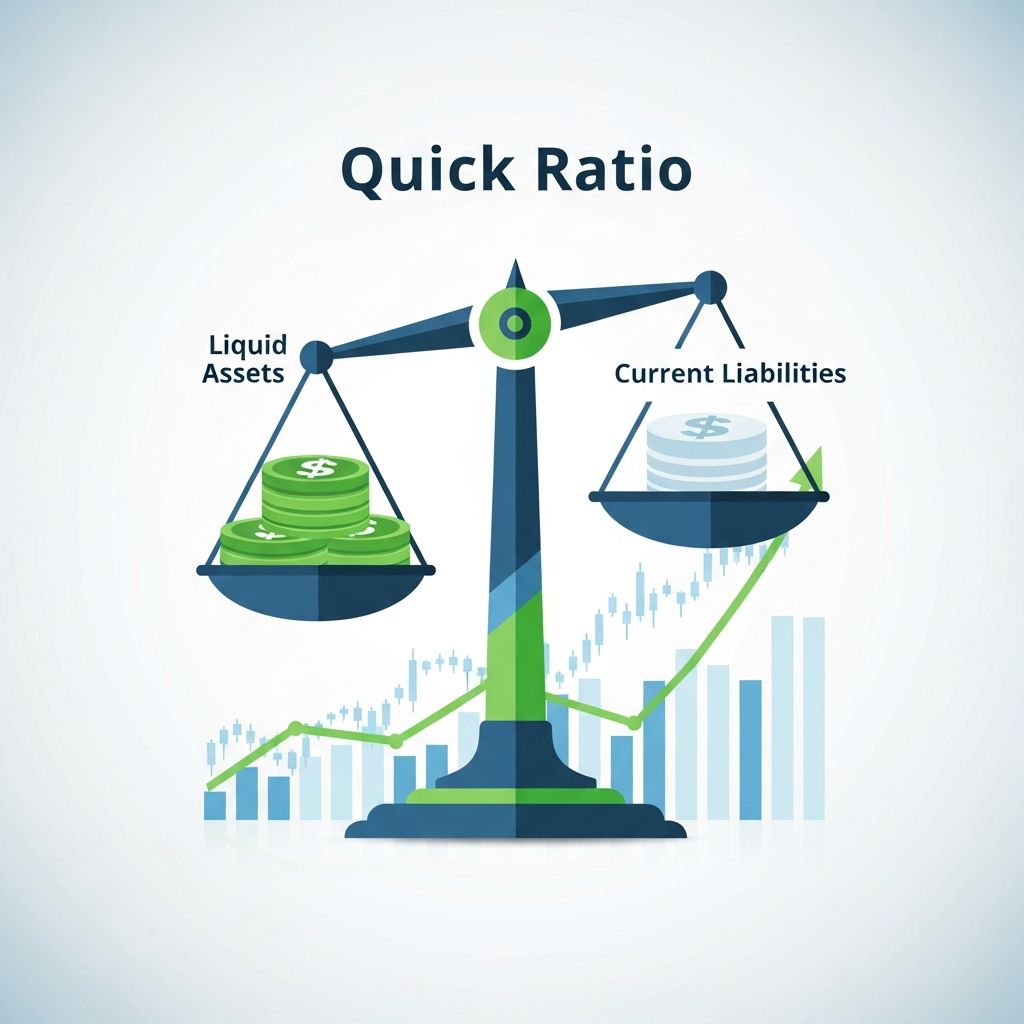
The quick ratio, also known as the acid-test ratio, is a fundamental liquidity metric used by investors, creditors, and financial analysts to assess a company’s ability to meet its short-term financial obligations. This ratio measures whether a business has sufficient liquid assets to cover its current liabilities without relying on the sale of inventory or other less liquid assets. The quick ratio is particularly valuable for understanding a company’s financial health during periods of economic uncertainty or market stress.
Unlike the current ratio, which includes all current assets, the quick ratio takes a more conservative approach by excluding inventory and other assets that may take longer to convert into cash. This makes it a more stringent test of liquidity and provides a clearer picture of a company’s immediate financial position. For stakeholders evaluating investment opportunities or extending credit, the quick ratio offers critical insights into operational efficiency and financial stability.
How the Quick Ratio Works
The quick ratio operates on a straightforward principle: it compares a company’s most liquid assets against its current liabilities. The formula for calculating the quick ratio is:
Quick Ratio = (Current Assets – Inventory – Prepaid Expenses) / Current Liabilities
Alternatively, it can be expressed as:
Quick Ratio = (Cash + Marketable Securities + Accounts Receivable) / Current Liabilities
The numerator includes only the assets that can be quickly converted to cash, typically within 90 days or less. These assets are considered highly liquid because they either already exist in cash form or can be readily sold in the market. The denominator represents all obligations due within one year, including accounts payable, short-term debt, and accrued expenses.
By focusing on the most liquid assets, the quick ratio provides a more realistic assessment of a company’s ability to handle unexpected financial challenges or capitalize on sudden business opportunities. This conservative measurement is particularly important during economic downturns when inventory may become difficult to sell quickly.
Components of the Quick Ratio
Liquid Assets Included
- Cash and Cash Equivalents: Money held in bank accounts, money market funds, and other highly liquid investments that can be accessed immediately.
- Marketable Securities: Stocks, bonds, and other securities that can be sold quickly in the open market with minimal loss of value.
- Accounts Receivable: Money owed to the company by customers for goods or services delivered. This is typically included as it can be collected or factored quickly.
Assets Excluded
- Inventory: Goods held for sale that may take time to convert into cash, especially if demand decreases.
- Prepaid Expenses: Payments made in advance for future services, which cannot be converted to cash.
- Intangible Assets: Patents, trademarks, and goodwill that have no direct cash value.
Quick Ratio Interpretation and Benchmarks
Understanding what the quick ratio means requires knowledge of standard benchmarks across industries. A quick ratio of 1.0 or higher is generally considered healthy, indicating that a company has at least $1 in liquid assets for every $1 of current liabilities. This suggests the company can cover its short-term obligations without selling inventory.
However, the ideal quick ratio varies by industry. Retail companies, which typically maintain higher inventory levels, may have lower quick ratios than technology or professional services firms. A ratio of 0.5 to 1.0 may be acceptable for companies with predictable cash flows, while a ratio below 0.5 could signal potential liquidity problems.
When interpreting results, context is crucial. A very high quick ratio, such as 2.0 or above, might indicate that a company is holding excessive cash that could be invested in growth opportunities. Conversely, a declining quick ratio over time may suggest deteriorating financial health and reduced ability to meet obligations.
Quick Ratio vs. Current Ratio
The quick ratio and current ratio are both important liquidity metrics, but they measure different aspects of financial health. The current ratio includes all current assets, including inventory and prepaid expenses, making it a broader measure of liquidity. The formula for the current ratio is:
Current Ratio = Current Assets / Current Liabilities
The key difference lies in the treatment of inventory. For companies with large inventory holdings, the current ratio can be significantly higher than the quick ratio. This gap reveals how dependent a company is on inventory sales to maintain liquidity. A company with a high current ratio but low quick ratio may struggle if it cannot sell its inventory quickly.
Financial analysts often use both ratios together to gain a complete picture. The quick ratio acts as a reality check on the current ratio, particularly for retail and manufacturing businesses where inventory represents a substantial portion of current assets.
Advantages of Using the Quick Ratio
- Conservative Assessment: By excluding inventory, the quick ratio provides a more cautious view of liquidity, which is useful during economic uncertainty.
- Comparability: The ratio enables meaningful comparisons between companies in the same industry and across different sectors.
- Simplicity: The calculation is straightforward and uses readily available information from financial statements.
- Early Warning System: A declining quick ratio can signal financial distress before other indicators become apparent.
- Investor Confidence: A healthy quick ratio reassures investors and creditors about a company’s financial stability.
Limitations of the Quick Ratio
- Industry Variation: The quick ratio may not be equally relevant for all industries, particularly those relying on inventory turnover.
- Temporal Snapshots: Balance sheet data represents a single point in time and may not reflect average conditions throughout the period.
- Quality of Receivables: The ratio assumes all accounts receivable are collectible, which may not always be true.
- Excludes Operating Context: The quick ratio does not account for a company’s cash flow generation ability or operating efficiency.
- Seasonal Fluctuations: For businesses with significant seasonal variations, the quick ratio can fluctuate considerably throughout the year.
Practical Example: Calculating the Quick Ratio
Consider Company XYZ with the following balance sheet data:
| Item | Amount |
|---|---|
| Cash | $50,000 |
| Marketable Securities | $30,000 |
| Accounts Receivable | $70,000 |
| Inventory | $40,000 |
| Prepaid Expenses | $10,000 |
| Current Liabilities | $100,000 |
Using the quick ratio formula:
Quick Ratio = ($50,000 + $30,000 + $70,000) / $100,000 = 1.50
This result indicates that Company XYZ has $1.50 in liquid assets for every $1.00 of current liabilities, which suggests a strong liquidity position and the ability to meet short-term obligations comfortably.
Improving Your Company’s Quick Ratio
Companies seeking to strengthen their quick ratio can pursue several strategies:
- Accelerate Collections: Implement more aggressive accounts receivable collection processes or offer early payment discounts to customers.
- Reduce Current Liabilities: Pay down short-term debt or negotiate extended payment terms with suppliers.
- Increase Liquid Assets: Build cash reserves through improved operational efficiency and profitability.
- Improve Cash Management: Optimize cash flow timing to ensure sufficient liquidity at all times.
- Refinance Debt: Convert short-term obligations into longer-term debt to reduce current liabilities.
Industry Comparisons and Benchmarks
Different industries have varying quick ratio norms based on their business models. Technology and software companies typically maintain higher quick ratios due to limited inventory requirements, often ranging from 1.5 to 2.0. Retail and manufacturing firms, burdened with inventory, often have lower quick ratios between 0.5 and 1.0. Financial institutions and insurance companies may have different benchmarks altogether.
When evaluating a company, investors should compare its quick ratio against industry peers rather than applying universal standards. This contextualized analysis provides more meaningful insights into competitive positioning and financial health relative to similar businesses.
Frequently Asked Questions (FAQs)
Q: What is a good quick ratio?
A: Generally, a quick ratio of 1.0 or higher is considered good, indicating the company can cover short-term liabilities with liquid assets. However, the ideal ratio varies by industry and business circumstances.
Q: Why is inventory excluded from the quick ratio?
A: Inventory is excluded because it may take time to sell and convert into cash. The quick ratio focuses on the most liquid assets that can be immediately converted to cash.
Q: How does the quick ratio differ from the cash ratio?
A: The cash ratio only includes cash and equivalents, making it even more conservative than the quick ratio. The quick ratio also includes accounts receivable and marketable securities.
Q: Can a quick ratio be too high?
A: A very high quick ratio (above 2.0) may suggest a company is holding excessive cash that could be better invested in growth initiatives or returned to shareholders.
Q: How often should I monitor the quick ratio?
A: Investors and creditors should monitor the quick ratio quarterly or annually, or more frequently if there are significant changes in the business environment or financial performance.
References
- Financial Accounting Standards Board (FASB) — FASB Standards. 2024. https://www.fasb.org/
- U.S. Securities and Exchange Commission: Investor Bulletin on Financial Ratios — U.S. SEC. 2023. https://www.sec.gov/investor
- CFA Institute: Financial Analysis and Valuation — CFA Institute. 2024. https://www.cfainstitute.org/
- Damodaran, A. (2012). Investment Valuation: Tools and Techniques for Determining the Value of Any Asset — Wiley Finance. 2012. ISBN: 978-1118011522
- Federal Reserve: Corporate Financial Health Indicators — Board of Governors of the Federal Reserve System. 2024. https://www.federalreserve.gov/
Similar Articles








Read full bio of medha deb