Quarterly Self-Employment Taxes Explained
Master quarterly tax payments for freelancers and business owners to avoid penalties and stay compliant with IRS rules.

Self-employed individuals face unique tax responsibilities that differ significantly from traditional employees. Unlike W-2 workers whose employers withhold taxes automatically, freelancers, sole proprietors, and independent contractors must proactively manage their federal tax obligations through quarterly estimated payments. These payments cover both income taxes and self-employment taxes, ensuring compliance with IRS requirements and avoiding underpayment penalties.
Why Quarterly Payments Matter for the Self-Employed
Quarterly taxes prevent a large year-end tax bill by spreading payments throughout the year. The IRS mandates these installments if you expect to owe at least $1,000 in federal taxes after credits and withholdings. This threshold applies broadly to self-employment income, including gigs, consulting, or small business profits. Failing to pay can result in penalties of about 0.5% per month on the unpaid amount, plus interest.
Self-employment tax specifically funds Social Security (12.4%) and Medicare (2.9%), totaling 15.3%. Self-employed people pay both the employee and employer shares, unlike traditional employees where employers cover half. For 2026, Social Security applies up to the wage base limit (projected around $168,600, adjusted annually), with Medicare unlimited and an additional 0.9% on high earners.
Who Must Make Quarterly Estimated Tax Payments?
Not everyone needs to pay quarterly, but most self-employed do. Key qualifiers include:
- Sole proprietors and freelancers: Any net earnings over $400 trigger self-employment tax, often exceeding the $1,000 threshold.
- Partners in partnerships: On distributive shares of income.
- S corporation shareholders: Reasonable salaries have withholding, but pass-through profits may require estimates.
- Gig workers and side hustlers: Platforms like Uber or Upwork report via 1099-NEC if over $600.
Exceptions exist if prior-year tax was under $1,000 or you meet ‘safe harbor’ by paying 100% (110% if AGI > $150,000) of last year’s tax. Farmers and fishermen have special rules.
Step-by-Step Guide to Calculating Your Quarterly Taxes
Accurate estimation is crucial. Use IRS Form 1040-ES worksheet or tax software. Here’s a detailed process:
- Project annual gross income: Sum self-employment earnings plus other sources like investments.
- Deduct business expenses: Include home office, mileage (67 cents/mile in 2026), supplies, marketing. Track via apps like QuickBooks.
- Compute net profit: Gross minus expenses. Report on Schedule C.
- Adjust for self-employment tax deduction: Multiply net profit by 92.35% (accounts for employer half deduction), then by 15.3% for SE tax. Deduct half from AGI.
- Apply income tax brackets: For 2026, rates range 10%-37%. Subtract standard deduction ($16,100 single, $32,200 joint) or itemize.
- Add taxes and credits: Include SE tax, income tax, plus any Additional Medicare Tax (0.9% over $200K single/$250K joint). Subtract credits.
- Divide by 4: Equal payments, or annualize for variable income.
Example Calculation Table
| Step | Description | Amount |
|---|---|---|
| 1. Gross Income | Freelance earnings | $80,000 |
| 2. Expenses | Supplies, travel, etc. | -$20,000 |
| 3. Net Profit | $60,000 | |
| 4. SE Income (92.35%) | $60,000 * 0.9235 | $55,410 |
| 5. SE Tax (15.3%) | $55,410 * 0.153 | $8,478 |
| 6. Deductible SE (half) | $8,478 / 2 | -$4,239 |
| 7. AGI (after std ded $16,100) | Approx taxable | $39,661 |
| 8. Income Tax (22% bracket est.) | $6,500 | |
| 9. Total Annual Tax | SE + Income | $14,978 |
| 10. Quarterly Payment | /4 | $3,745 |
This example assumes single filer, no other income. Actuals vary; consult a CPA.
Key Deadlines for 2026 Quarterly Payments
Payments align with fiscal quarters, adjusted for weekends/holidays:
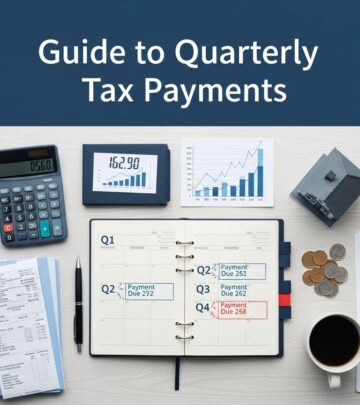
- Q1 (Jan-Mar): April 15, 2026
- Q2 (Apr-May): June 16, 2026
- Q3 (Jun-Aug): September 15, 2026
- Q4 (Sep-Dec): January 15, 2027
Use EFTPS.gov, IRS Direct Pay, or mail Form 1040-ES voucher. State taxes may have different schedules.
Payment Methods and Tools
Federal options:
- Online: IRS Direct Pay (free), EFTPS.
- Debit/credit card via processors (fees apply).
- Check/money order with voucher.
Track with apps like Found or Everlance that set aside 25-30% of income automatically. Separate business bank account recommended.
Common Pitfalls and How to Avoid Penalties
Underpayment penalties accrue if you pay less than 90% of current or 100%/110% prior year tax. Strategies:
- Overestimate slightly: Better safe than penalized.
- Annualize income: Form 2210 for uneven earnings.
- Adjust mid-year: Recalculate after Q1/Q2.
- Maximize deductions: Retirement (SEP-IRA up to 25%), health insurance.
New self-employed? Base on prior W-2 if transitioning.
State and Local Considerations
Many states mirror federal rules but check specifics (e.g., CA, NY require separate estimates). Some have lower thresholds or different forms. Local taxes rare but possible in cities like NYC.
Advanced Strategies for Tax Efficiency
- Entity choice: S-corp can reduce SE tax on distributions post-salary.
- Retirement plans: Solo 401(k) or SEP defer taxes.
- QBI deduction: Up to 20% of qualified income (phaseouts apply).
- Quarterly reviews: Adjust for actuals quarterly.
Frequently Asked Questions (FAQs)
What if my income is irregular?
Use annualized method on Form 2210 to pay based on actual quarterly earnings, avoiding penalties.
Do I need to pay if I have W-2 income too?
Yes, if total underwithheld taxes exceed $1,000. Withholdings count toward safe harbor.
Can I skip payments first year?
No safe harbor without prior return; estimate conservatively.
What about self-employment tax caps?
Social Security caps at ~$168,600 (2026 est.); Medicare unlimited.
Is tax software sufficient?
Yes, TurboTax or H&R Block estimate well, but complex cases need pros.
References
- Self-employed individuals tax center — Internal Revenue Service. 2026. https://www.irs.gov/businesses/small-businesses-self-employed/self-employed-individuals-tax-center
- Self-employment tax (Social Security and Medicare taxes) — Internal Revenue Service. 2026. https://www.irs.gov/businesses/small-businesses-self-employed/self-employment-tax-social-security-and-medicare-taxes
- Quarterly & Estimated Tax Payments 2026 — Paychex. 2026. https://www.paychex.com/articles/payroll-taxes/quarterly-taxes
- Understanding Quarterly Tax Payments If You’re Self-Employed — CPAsok. 2026. https://cpasok.com/understanding-quarterly-tax-payments-if-youre-self-employed/
- A Small Business Owner’s Guide to Quarterly Taxes — Found. 2026. https://found.com/resources/guide-to-quarterly-taxes
- Quarterly Taxes: Self-employed Taxes Explained + Definition — Everlance. 2026. https://www.everlance.com/self-employed-tax-glossary/quarterly-taxes-self-employed-taxes-explained-definition
Similar Articles








Read full bio of medha deb