Qualifying for Private Student Loans
Unlock the steps to secure private student loans amid evolving federal limits and understand key eligibility factors for funding your education.

Private student loans serve as a vital resource for many pursuing higher education, especially as federal loan limits tighten starting July 1, 2026. These loans from banks, credit unions, and online lenders can bridge funding gaps for tuition, housing, and supplies when federal aid falls short. Unlike federal loans, private options hinge on creditworthiness, enrollment verification, and other personal financial factors, making preparation essential for approval.
Core Eligibility Criteria for Approval
To secure a private student loan, lenders evaluate several baseline qualifications to assess repayment risk. Meeting these standards increases your chances of favorable terms, such as lower interest rates or higher borrowing limits.
- Enrollment Status: You must be accepted or currently enrolled at an eligible institution, often at least half-time. Eligible schools include accredited four-year universities, community colleges, and vocational programs. Lenders verify this through your school’s financial aid office.
- U.S. Citizenship or Residency: Applicants typically need to be U.S. citizens, permanent residents, or eligible non-citizens. International students may qualify with a U.S. citizen or permanent resident cosigner.
- Age Requirement: Borrowers must be at least 18 years old (or 19 in some states) and possess a high school diploma, GED, or equivalent.
- Qualified Expenses: Funds must cover education-related costs like tuition, fees, books, room and board, transportation, and supplies. Lenders certify the loan amount with your school to ensure compliance.
These foundational rules apply across most lenders, though specifics vary. Always confirm your school’s eligibility directly with the lender before applying.
Credit and Financial Profile Essentials
Credit history stands as the primary determinant for private student loan approval. Lenders perform a hard credit inquiry to review your debt management, payment history, and overall score.
- Minimum Credit Score: While not always publicly stated, scores in the mid-600s or higher for you or a cosigner boost approval odds and unlock better rates. Students with thin or poor credit often face denials without help.
- Income Verification: Some lenders require proof of income, such as pay stubs or tax returns, especially for independent borrowers. Minimum thresholds differ but emphasize stable earnings.
- Debt-to-Income Ratio: Lenders assess how much debt you carry relative to income, favoring lower ratios for reduced risk.
For undergraduates lacking credit experience, cosigners—often parents or relatives with strong profiles—can significantly improve outcomes. The cosigner’s credit typically weighs more heavily, potentially qualifying you for larger amounts or lower rates.
The Role of Cosigners in Loan Access
A cosigner assumes equal responsibility for repayment, making them a game-changer for those with limited credit. About 90% of private student loans involve cosigners, per industry insights.
| Without Cosigner | With Cosigner |
|---|---|
| Limited options; higher rates | Broader lender choices; better rates |
| May require strong academics or future potential | Cosigner’s credit dominates evaluation |
| Smaller loan amounts | Higher borrowing limits possible |
After graduation, some lenders offer cosigner release options if you meet criteria like 24-48 on-time payments and a solid credit score. Discuss this upfront to plan for independence.
Federal vs. Private Student Loans: Key Comparisons
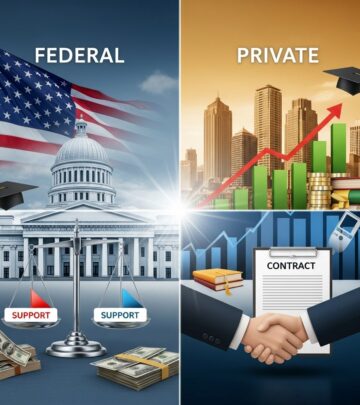
Federal loans offer easier access without credit checks, but upcoming 2026 changes introduce caps that may push more students toward private alternatives.
| Aspect | Federal Loans | Private Loans |
|---|---|---|
| Eligibility | Financial need via FAFSA; no credit check | Credit score, income, cosigner often needed |
| Interest Rates (2026) | Fixed: 6.39%-8.94% | Fixed or variable; often higher |
| Borrowing Limits | Capped (e.g., Grad: $20,500/yr post-2026) | Up to cost of attendance |
| Repayment Options | Income-driven plans, forgiveness potential | Limited flexibility; standard terms |
New federal rules cap Parent PLUS at $20,000/year ($65,000 lifetime) and eliminate Grad PLUS for new borrowers after July 1, 2026, with Direct Unsubsidized at $20,500/year for grads. Existing borrowers in pre-2026 programs may grandfather in higher limits. Private loans fill these gaps but demand stricter personal qualifications.
Navigating 2026 Federal Changes and Private Opportunities
Starting July 1, 2026, the One Big Beautiful Bill Act (OBBBA) reshapes federal aid, potentially increasing private loan reliance. Graduate students face $20,500 annual Direct Unsubsidized limits and $100,000 degree caps, while professionals get up to $50,000/year but $200,000 lifetime. Undergrads see Parent PLUS restrictions, prompting earlier private planning.
- Grandfather Clause: If you borrowed a Direct Loan before July 1, 2026, in your current program, you may access prior limits for up to three years or degree completion.
- Repayment Shifts: New Repayment Assistance Plan (RAP) bases payments on 1-10% of adjusted gross income, with 30-year forgiveness, but excludes Parent PLUS from income-driven options.
Private lenders remain unaffected, offering fixed/variable rates without federal caps, though at the cost of fewer protections. Shop multiple offers via platforms comparing rates pre-approval.
Application Process: Step-by-Step Guide
Applying for private loans mirrors other credit products but ties closely to your education.
- Exhaust Federal Aid: Complete FAFSA for grants, work-study, and subsidized loans first.
- Research Lenders: Compare terms from banks like Sallie Mae, SoFi, or credit unions using eligibility tools.
- Gather Documents: SSN, ID, school details, income proof, tax returns.
- Pre-Qualify: Soft credit checks show rates without impacting your score.
- Submit Application: Lender certifies with school; expect hard inquiry.
- Review Offers: Negotiate or choose based on APR, fees, terms (5-20 years).
Aim for loans covering only unmet needs to minimize debt. Use school calculators for total cost of attendance.
Tips to Strengthen Your Application
Bolster your profile proactively.
- Build credit with secured cards or authorized user status.
- Improve grades; some lenders like Ascent factor GPA and major for no-cosigner loans.
- Save for a larger down payment to reduce borrowing.
- Seek scholarships or part-time work to demonstrate responsibility.
Avoid multiple applications simultaneously to limit credit dings.
Potential Pitfalls and Risk Management
Private loans lack federal perks like deferment or forgiveness, so default risks credit damage for all parties.
- No income-driven plans; fixed payments start post-grace (6-9 months).
- Variable rates may rise, inflating costs.
- Cosigner default impacts their score too.
Mitigate by borrowing conservatively, automating payments, and refinancing post-graduation if rates drop.
Frequently Asked Questions (FAQs)
Can I get a private student loan with bad credit?
Yes, with a creditworthy cosigner; otherwise, explore lenders assessing academics or future income.
Do private loans require a cosigner?
Not always, but they vastly improve approval and terms for most students.
How do 2026 federal caps affect me?
New borrowers face limits; pre-2026 enrollees may qualify under old rules if in the same program.
What’s the average private loan interest rate?
Fixed rates start around 4-15%, variable 5-16%, based on credit; shop aggressively.
Can international students apply?
Typically with a U.S. cosigner meeting all criteria.
Strategic Planning for Long-Term Success
Integrate private loans into a broader financial strategy. Calculate total debt against expected earnings—use tools like College Scorecard for major-specific salaries. Prioritize high-return degrees and pair loans with employer tuition assistance. Regularly review credit and refinance opportunities to optimize costs. With federal shifts accelerating private demand, informed borrowers will navigate 2026 changes effectively, securing education without overwhelming debt.
References
- Private Student Loan Requirements: How To Qualify — Bankrate. 2026 (accessed). https://www.bankrate.com/loans/student-loans/private-student-loan-requirements/
- Complete Student Loan Guide for College 2026 — TuitionHero. 2026 (accessed). https://www.tuitionhero.org/student-loans/private-student-loans-complete-guide
- Student Loans in 2026: What Borrowers Need to Know — NerdWallet. 2026 (accessed). https://www.nerdwallet.com/student-loans/news/student-loan-changes-2026
- One Big Beautiful Bill Act (OBBBA) — Southern Connecticut State University. 2026 (accessed). https://www.southernct.edu/onestop/financial-aid/obbba
- Changes to 2026-2027 Federal Student Loans — Columbia University Student Financial Services. 2026 (accessed). https://sfs.columbia.edu/content/changes-2026-2027-federal-student-loans
Similar Articles








Read full bio of Sneha Tete