Jumbo Mortgages: 5 Steps To Qualify In 2026
Unlock the keys to securing jumbo mortgages with strict credit, down payment, and income standards for high-value homes in 2026.

Jumbo mortgages finance homes priced beyond standard conforming loan thresholds, set at $832,750 for most U.S. areas in 2026 by the Federal Housing Finance Agency (FHFA). These loans demand stronger financial profiles due to their size and lender risk.
Defining Jumbo Mortgages and 2026 Limits
A jumbo mortgage surpasses FHFA’s annual conforming limits for single-family homes, which stand at $832,750 nationwide in 2026 except in high-cost regions where limits reach up to $1,249,125. Properties in most states trigger jumbo status above this baseline, while multi-unit homes have adjusted higher caps. Unlike government-backed options, jumbos rely on private underwriting with rigorous standards.
High-cost designations apply to select metro areas, allowing larger conforming loans before jumbo rules apply. Borrowers targeting luxury markets must verify local limits via FHFA data.
Financial Benchmarks for Approval
Lenders scrutinize applicants for jumbo mortgages through key metrics emphasizing stability and capacity.
- Credit Score: Minimums start at 680-700, with optimal rates for 720+; scores below 700 often face denials or penalties.
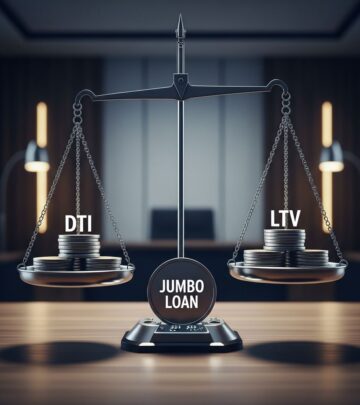
- Debt-to-Income (DTI) Ratio: Targets below 43%, ideally under 36%, factoring in the new mortgage; higher ratios limit options.
- Down Payment: Typically 10-20% minimum, sometimes 25% for best terms; a $1 million home might require $200,000 upfront.
- Loan-to-Value (LTV) Ratio: Capped near 80% to reduce exposure.
- Cash Reserves: 6-12 months of mortgage payments post-closing, verifying liquidity.
| Requirement | Typical Minimum | Ideal Range |
|---|---|---|
| Credit Score | 680-700 | 720+ |
| DTI Ratio | 43% | <36% |
| Down Payment | 10% | 20-25% |
| Reserves | 6 months | 12 months |
Income Verification and Employment Stability
Steady income proof is essential, including two years of W-2s, tax returns, and pay stubs for salaried workers. Self-employed applicants submit profit/loss statements alongside returns, facing extra review for volatility. Lenders assess total debt against verifiable earnings to ensure payment affordability amid large balances.
Property and Appraisal Standards
Jumbo financing mandates thorough property evaluations, often requiring dual appraisals to confirm value alignment with loan amounts. Homes must meet lender criteria for condition and marketability, with discrepancies potentially derailing approvals.
Interest Rates and Loan Variations
Jumbo rates exceed conforming loans due to risk, though fixed and adjustable-rate mortgages (ARMs) exist. Shop multiple lenders, as maximum loan sizes vary—up to $5 million at some institutions. Private mortgage insurance may apply if LTV exceeds 80%.
Steps to Prepare Your Application
Strengthen candidacy systematically:
- Review credit reports for errors and elevate scores via timely payments.
- Reduce debts to lower DTI before applying.
- Save aggressively for down payments and reserves.
- Gather documentation early, including bank statements.
- Compare lender terms for best fits.
Pre-approval clarifies budget and boosts offers.
High-Cost Area Exceptions
In designated zones, conforming limits rise, delaying jumbo needs. For instance, certain urban markets permit up to $1,249,125 without nonconforming status. Confirm via FHFA tools for precise county data.
Risks and Monthly Payment Considerations
Larger principals yield hefty payments; a $900,000 jumbo at 20% down means $720,000 financed, demanding robust cash flow. Stress-test budgets for rate hikes, especially ARMs. Reserves buffer job loss or emergencies.
Alternatives if Jumbo Criteria Fall Short
- Co-signers with strong profiles.
- Asset-based loans leveraging investments.
- Conforming loans in limit-friendly areas.
- Piggyback seconds for down payments.
Common Pitfalls to Avoid
Overlooking reserves, underestimating closing costs (2-5% of loan), or recent credit inquiries can sabotage efforts. Time applications post-major life changes like job shifts.
Future Outlook for Jumbo Markets
As home prices climb, jumbo demand persists in luxury segments. FHFA annually adjusts limits; monitor for 2027 shifts. Economic stability influences rates and availability.
Frequently Asked Questions
What credit score is needed for a jumbo mortgage?
Most require 700+, with 720+ unlocking favorable rates.
How much down payment for jumbo loans?
Expect 10-20% minimum, varying by lender and profile.
What’s the 2026 conforming limit?
$832,750 baseline, higher in high-cost areas up to $1,249,125.
Do jumbos need cash reserves?
Yes, typically 6-12 months of payments.
Can self-employed qualify?
Yes, with 2+ years tax returns and stable income proof.
Final Preparation Checklist
- Assess Finances: Calculate DTI, reserves.
- Boost Credit: Pay down balances.
- Document Income: Compile 2-year history.
- Research Limits: Check local FHFA caps.
- Shop Lenders: Compare 3+ offers.
Jumbo mortgages enable premium homeownership for qualified buyers meeting elevated standards.
References
- Jumbo loan limits and requirements for 2026 — Rocket Mortgage. 2026. https://www.rocketmortgage.com/learn/jumbo-loan-limits
- 2026 jumbo loan limits by state — Bankrate. 2026. https://www.bankrate.com/mortgages/jumbo-loan-limits/
- What Is a Jumbo Loan: Limits & Requirements — Freedom Mortgage. 2026. https://www.freedommortgage.com/learning-center/articles/jumbo-loans
- What is the Jumbo Loan Limit in 2026? — SoFi. 2026. https://www.sofi.com/learn/content/jumbo-loan-limits/
- FHFA Conforming Loan Limit Values — FHFA. 2026. https://www.fhfa.gov/data/conforming-loan-limit
- What is a Jumbo Loan: The Complete 2026 Guide — Fifth Third Bank. 2026. https://www.53.com/content/fifth-third/en/financial-insights/personal/home-ownership/what-is-a-jumbo-loan.html
Similar Articles








Read full bio of Sneha Tete