Purchasing Power Parity: Definition, Theory, and Examples
Understanding how PPP measures currency value and compares economic strength across nations.
Understanding Purchasing Power Parity
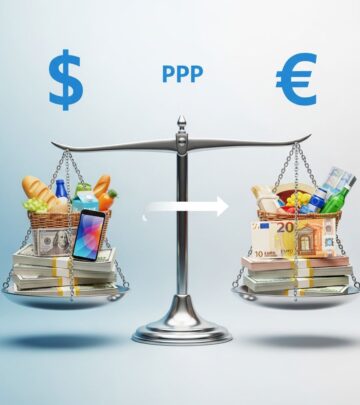
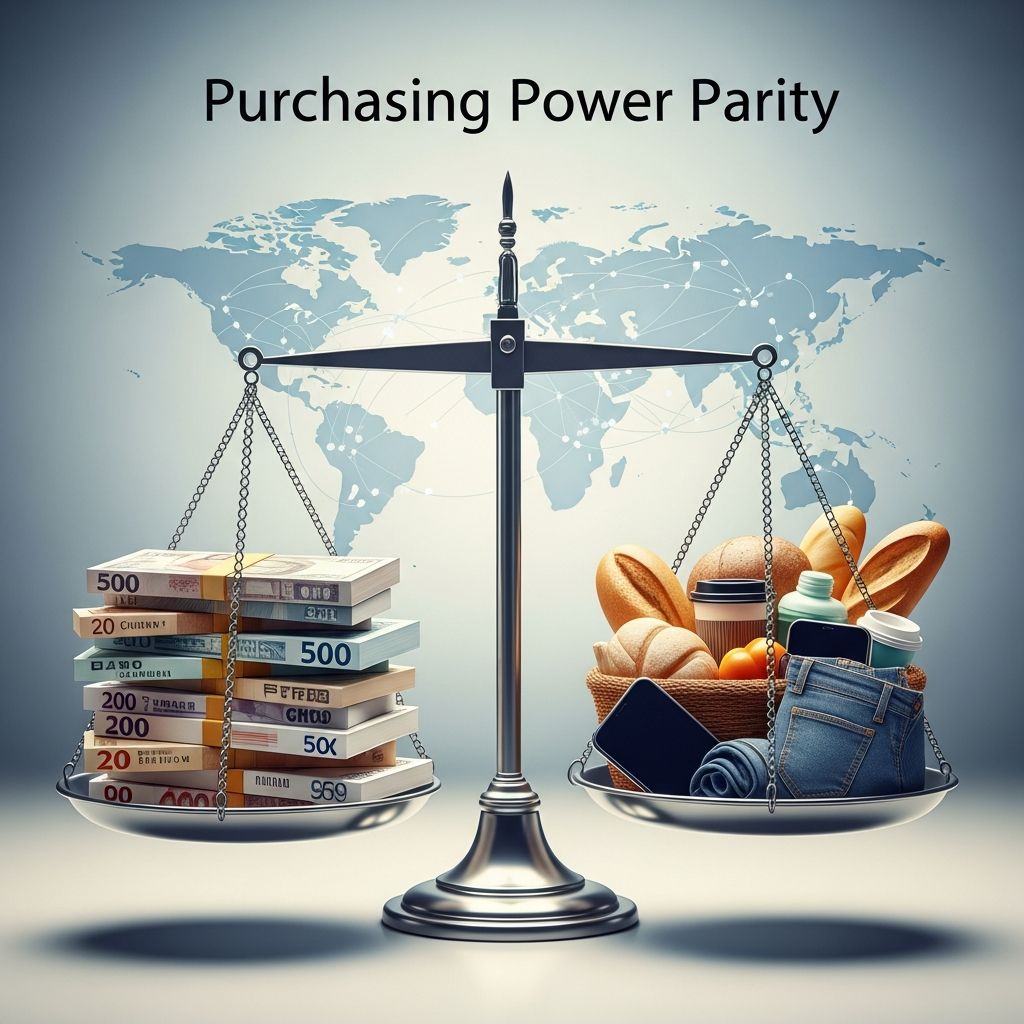
Purchasing Power Parity (PPP) is an economic theory that allows for meaningful comparisons of the purchasing power of various countries’ currencies through a market-based approach. At its core, PPP suggests that in the long term, exchange rates should adjust so that identical goods cost the same in different countries when expressed in a common currency. This concept is essential for understanding how different economies are measured and compared, particularly when evaluating levels of development and economic health across nations.
The fundamental principle underlying PPP is known as the law of one price, which states that if there are no transaction costs or trade barriers for a particular good, then the price for that good should be the same at every location. For example, a computer in New York and in Hong Kong should theoretically have the same price. If a computer costs 500 US dollars in New York and the same computer costs 2000 HK dollars in Hong Kong, PPP theory suggests the exchange rate should be 4 HK dollars for every 1 US dollar.
How Purchasing Power Parity Works
PPP operates by comparing the prices of a fixed basket of goods and services in different countries. Rather than relying solely on market exchange rates, PPP provides a more accurate measure of the relative value of currencies by considering what consumers can actually purchase with their money in different locations. The OECD calculates PPP using a comprehensive basket of goods that contains a final product list covering around 3,000 consumer goods and services, 30 occupations in government, 200 types of equipment goods, and about 15 construction projects.
This basket-of-goods method is similar to how economists estimate inflation and is designed to account for the fact that not all goods and services are traded internationally. A haircut in the United States may be more expensive than a haircut in India because the United States is a relatively wealthier country where people tend to be paid more for their labor. By using a comprehensive basket, PPP provides a more nuanced understanding of actual purchasing power across different economies.
The Calculation Process
PPP is calculated by dividing the cost of a basket of goods in one country by the cost of the same basket in another country. Organizations that compute PPP exchange rates use different baskets of goods and can come up with different values, as the value of the PPP exchange rate is very dependent on the basket of goods chosen. Organizations typically select goods that closely obey the law of one price, attempting to choose goods which are traded easily and are commonly available in both locations.
PPP Versus Market Exchange Rates
A crucial distinction exists between PPP exchange rates and market exchange rates. Market exchange rates are based solely on the value of internationally traded goods, while PPP attempts to measure the local spending power of currencies more accurately by comparing the relative purchasing power of the currencies more directly. These dramatic differences stem from the fact that many goods and services cannot be traded on international markets.
When making comparisons between rich countries and developing countries, GDP based on PPP can dramatically increase the estimated size of developing economies, usually by two to four times. For instance, using the market exchange rate, India’s GDP in 2019 was estimated to be about $2.8 trillion, just 13 percent of the United States’ $21.4 trillion. However, when adjusted for PPP, these figures paint a much different picture of relative economic sizes.
For many countries, the difference between exchange rates and PPP estimates is relatively small. However, for nations with significant differences in wage levels and cost of living, PPP provides more realistic comparisons. Norway’s GDP per capita is $98,000, but when adjusted for PPP it falls to $62,000, reflecting the fact that wages are very high but living costs are also high. Conversely, India’s GDP per capita is $1,489, but because living costs are very low, the PPP is considerably higher.
The Basket of Goods Methodology
The basket of goods is the foundation of all PPP calculations. The World Bank and OECD establish common baskets of well-defined regional and global goods and services and subsequently price them in different countries. Price relatives, or ratios of prices in national currencies of the same good or service in two countries, are calculated for individual items such as white rice, brown rice, and hundreds of other products and services.
The basket of goods and services priced represents a sample of all those included in final consumption expenditure, actual consumption, gross fixed capital formation, and total goods and services. In the 2017 cycle, organizations gathered prices on hundreds of goods and services from 176 different economies, with data then analyzed based on the percentage of spending allocated to a specific item in a given economy.
Applications and Uses of PPP
PPP indicators can be used to compare economies regarding their gross domestic product (GDP), labor productivity, and actual individual consumption. In some cases, PPP can analyze price convergence and compare the cost of living between places. PPPs are often expressed in terms of the U.S. dollar, making international comparisons more straightforward.
The primary advantage of using PPP is that it provides more consistent and accurate comparisons between different countries’ GDP, cost of living, and other quality of life measures than using market exchange rates of currencies. This makes PPP particularly valuable for development economists, international organizations, and policymakers who need to understand relative economic sizes and standards of living.
Economic Comparisons
PPPs are particularly useful when comparing developed nations with emerging and developing economies. The adjustments can reveal that economies are substantially larger or smaller than market exchange rates suggest. PPP gives a better indication of what you can actually buy in different countries, making it a more useful metric for understanding real living standards and economic strength.
The Big Mac Index: A Simplified PPP Example
The Economist magazine offers a different, much less rigorous approach to PPP calculations by simplifying comparisons to focus on a single good—the Big Mac hamburger from the fast-food chain McDonald’s. The Big Mac index is simply the price of a McDonald’s hamburger around the world, serving as an amusing approximation of a PPP estimate.
Using this approach, if a hamburger is selling in London for £2 and in New York for $4, this would imply a PPP exchange rate of 1 pound to 2 U.S. dollars. This PPP exchange rate may well be different from that prevailing in financial markets, so that the actual dollar cost of a hamburger in London may be either more or less than the $4 it sells for in New York.
Limitations and Considerations of PPP
While PPP provides valuable insights, it has several limitations. Poverty, tariffs, transportation, and other frictions prevent the trading and purchasing of various goods, so measuring a single good can cause a large error. The PPP term accounts for this by using a basket of goods with many items and different quantities, computing inflation and exchange rates as the ratio of the price of the basket in one location to the price of the basket in another location.
PPP inflation and exchange rates may differ from market exchange rates because of tariffs and other transaction costs. Additionally, product differentiation and segmented markets result in violations of the law of one price and absolute PPP. Over time, shifts in market structure and demand will occur, which may invalidate relative PPP.
The relationship between PPP and market exchange rates also depends on the type of goods being analyzed. The more that a product is non-tradable and services-based, the further its price will be from the currency exchange rate, moving towards the PPP exchange rate. Conversely, highly tradable products tend to trade close to the currency exchange rate.
PPP in Economic Theory
In neoclassical economic theory, the purchasing power parity theory assumes that the exchange rate between two currencies observed in different international markets is the one used in the purchasing power parity comparisons, so that the same amount of goods could actually be purchased in either currency with the same beginning amount of funds.
Depending on the particular theory, PPP is assumed to hold either in the long run or, more strongly, in the short run. Theories that invoke PPP assume that in some circumstances a fall in either currency’s purchasing power (a rise in its price level) would lead to a proportional decrease in that currency’s valuation on the foreign exchange market.
PPP is the extension of the law of one price from a single good to a broad collection of goods and services that economists use to track inflation and make meaningful international economic comparisons.
Comparing PPP with Other Economic Measures
PPP differs significantly from the Consumer Price Index (CPI), though both are used to measure price differences. According to D. S. Prasada Rao, an economics professor at the University of New England (Australia), “The CPI measures differences in levels of prices of goods and services over time within a country, whereas PPPs measure the change in levels of prices across regions within a country.”
Frequently Asked Questions
Q: Why is Purchasing Power Parity important?
A: PPP is important because it provides a more accurate comparison of economic sizes and living standards between countries than market exchange rates alone. It accounts for the fact that not all goods and services are traded internationally and that price levels vary significantly between nations.
Q: How does PPP differ from market exchange rates?
A: Market exchange rates reflect only the value of internationally traded goods, while PPP considers the actual purchasing power of currencies by examining a comprehensive basket of domestic and international goods and services, providing a more realistic picture of real living standards.
Q: What is the Big Mac Index?
A: The Big Mac Index is a simplified, informal version of PPP that compares the price of a McDonald’s Big Mac hamburger across different countries. While not scientifically rigorous, it provides an amusing and easy-to-understand approximation of PPP principles.
Q: How does PPP affect GDP comparisons?
A: When comparing developing countries to developed nations, GDP based on PPP can dramatically increase the estimated size of developing economies, usually by two to four times compared to market exchange rate calculations, revealing a more accurate picture of economic scale.
Q: Which organizations calculate PPP?
A: Major organizations like the OECD, World Bank, and IMF calculate PPP using comprehensive baskets of goods and services. These organizations gather price data from numerous countries and analyze it to create PPP exchange rates and comparisons.
References
- Purchasing Power Parity (PPP) – (AP Human Geography) — Fiveable. Accessed 2025. https://fiveable.me/key-terms/ap-hug/purchasing-power-parity-ppp
- Purchasing power parity — Wikipedia. Accessed 2025. https://en.wikipedia.org/wiki/Purchasing_power_parity
- Purchasing power parity | Definition, Theory, Example, & Meaning — Britannica. Accessed 2025. https://www.britannica.com/money/purchasing-power-parity
- Purchasing Power Parity (PPP) – Economics Help — Economics Help. Accessed 2025. https://www.economicshelp.org/blog/1000/economics/purchasing-power-parity-ppp-for-exchange-rates/
- Purchasing Power Parities — The World Bank. 2017. https://thedocs.worldbank.org/en/doc/332341517441011666-0050022018/original/PPPbrochure2017webformatrev.pdf
- Purchasing power parities (PPP) — OECD. Accessed 2025. https://www.oecd.org/en/data/indicators/purchasing-power-parities-ppp.html
- Purchasing Power Parity: Weights Matter — International Monetary Fund. Accessed 2025. https://www.imf.org/en/publications/fandd/issues/series/back-to-basics/purchasing-power-parity-ppp
- Explaining Purchasing Power Parity and the Law of One Price — Federal Reserve Bank of St. Louis. January 2025. https://www.stlouisfed.org/open-vault/2025/jan/explaining-purchasing-power-parity-law-one-price
Similar Articles








Read full bio of medha deb