Public Records: 7 Types That Can Hurt Your Credit
Understanding how public records impact your credit score and financial future.
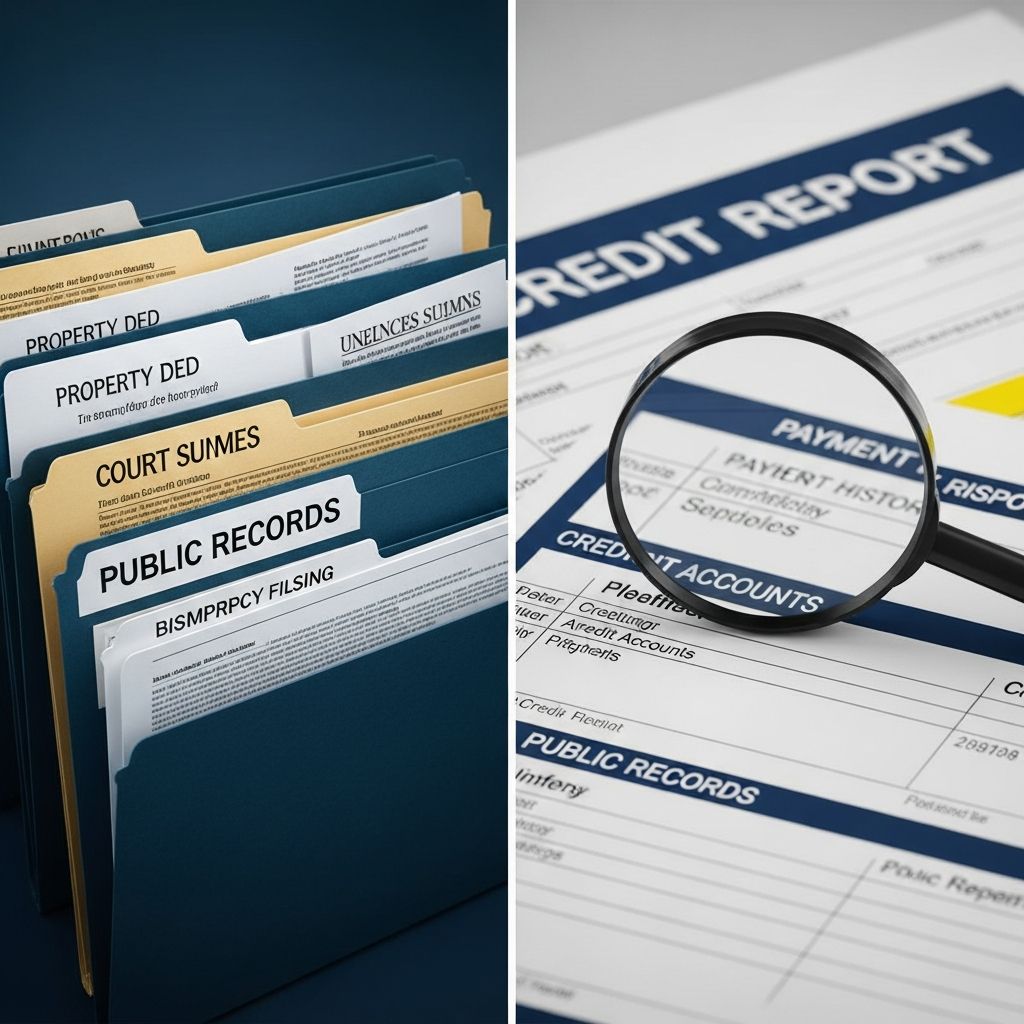
What Are Public Records?
Public records are legal documents filed with federal, state, and local courts and government agencies that are available for public viewing. These records include various types of legal matters that become part of the public domain, regardless of whether you want them to be. Unlike private financial information, public records exist in the public realm, and you have no legal right to privacy regarding this information.
Common types of public records that could potentially affect your credit include:
- Bankruptcies
- Civil judgments
- Tax liens
- Foreclosures
- Arrest records
- Divorce records
- Liens and levies
These documents are typically filed at courthouses or with government agencies and become accessible to the public through various means, including online databases and electronic public records services.
How Do Public Records Impact Your Credit?
When public records appear on your credit report, they are considered negative information by credit scoring models. This negative status can significantly damage your credit scores and make it considerably more difficult to obtain new credit, qualify for favorable interest rates, or even secure housing or employment.
The impact of public records on your credit score depends on several factors, including the type of record, when it was filed, and your overall credit profile. Consumers with public records on their credit reports typically face:
- Lower credit scores
- Higher interest rates on loans and credit cards
- Difficulty obtaining new credit
- Challenges renting an apartment
- Potential employment complications
- Reduced access to competitive financing options
The Severity of the Impact
The severity of impact varies by public record type. Foreclosures can lower your credit score by up to 30 percent, with the largest potential impact reaching approximately 300 points. While the most significant damage typically occurs immediately, most credit scores begin recovering after the first two years following the adverse event.
Types of Public Records and Their Impact
Bankruptcy
Bankruptcy remains one of the most damaging public records that can appear on your credit report. When you file for bankruptcy, it becomes a matter of public record and can stay on your credit report for an extended period.
The duration bankruptcy appears on your credit report depends on the chapter filed:
- Chapter 7 Bankruptcy: Remains on your credit report for 10 years from the filing date
- Chapter 13 Bankruptcy: Stays on your credit report for 7 years from the filing date
Bankruptcy is currently the only public record that consistently appears on credit reports after recent policy changes by major credit bureaus.
Civil Judgments
Civil judgments occur when a creditor sues you for an unpaid debt and wins the case in court. Historically, these judgments appeared on credit reports and significantly damaged credit scores. However, significant changes have occurred in how judgments are reported.
Thanks to a settlement known as the National Consumer Assistance Plan (NCAP), civil judgments no longer appear on credit reports. This represents a major shift in credit reporting practices that has provided relief to many consumers with negative court judgments.
Tax Liens
When you fail to pay federal or state taxes, government agencies can file a lien against your property. Tax liens were previously included on credit reports and could remain indefinitely if unpaid, creating a long-term credit problem.
Under the FCRA guidelines, a paid tax lien must be removed from your credit report 7 years after it’s paid and released. Unpaid tax liens could theoretically remain on your reports indefinitely under federal law.
However, due to changes implemented through the NCAP settlement, tax liens no longer appear on credit reports maintained by the three major credit bureaus. This policy change has had a significant positive effect for consumers who previously had tax liens reported on their credit histories.
Foreclosures
A foreclosure occurs when you fail to make mortgage payments and the lender takes back the property. This negative public record can remain on your credit report for 7 years from the date of the first court filing.
Foreclosures are particularly damaging because they represent a failure to meet a major financial obligation and indicate to future lenders that you may default on significant debts.
The National Consumer Assistance Plan (NCAP) Settlement
In 2015, the three major credit bureaus—Equifax, Experian, and TransUnion—entered into a settlement with 31 state attorneys general over accuracy concerns in credit reporting. This settlement created the National Consumer Assistance Plan (NCAP), which fundamentally changed how public records are reported on credit reports.
What Triggered the NCAP?
State attorneys general became concerned that too many consumers had inaccurate or misidentified public record data appearing on their credit reports. They recognized that credit bureaus had implemented insufficient standards for verifying that public records actually belonged to the individual whose credit file they were being added to. This led to the demand for more stringent verification requirements.
Key NCAP Requirements
As of July 1, 2017, the NCAP implemented strict new requirements for public records to appear on credit reports. These requirements include:
- Public records must include a name, address, and either a Social Security number or date of birth
- Credit bureaus must verify this identifying information before reporting the record
- Credit bureaus must refresh public record information at least every 90 days
- Increased accuracy standards for matching public records to individual credit files
Results of the NCAP Implementation
The implementation of NCAP resulted in dramatic changes to credit reporting. By April 2018, all previously reported tax liens and civil judgments were removed from credit reports, and new ones would not be added. In June 2017, approximately 6 percent of consumers had civil judgments or tax liens on their reports. After NCAP implementation, only 1.4 percent of consumers had tax liens, and none had civil judgments.
How Public Records Are Added to Credit Reports
Many consumers assume that their creditors or lenders submit public record information to credit bureaus. However, this is not typically how the process works.
Instead, credit bureaus actively seek out public record information themselves through electronic public records services, such as Public Access to Court Electronic Records (PACER). The credit bureaus use automated systems to search court databases and government records to identify public records that may match individuals in their databases.
This proactive search approach means that even if a creditor doesn’t report your information, a public record could still appear on your credit report if the credit bureaus’ systems locate it and can verify that it matches your identity.
The Federal Credit Reporting Act (FCRA) and Public Records
It’s important to understand that the FCRA—the federal law governing credit reporting—has not been amended regarding public records policy. While the FCRA technically permits credit bureaus to report public records like tax liens and judgments, the NCAP settlement created a separate agreement that currently prevents them from doing so.
This distinction is significant because it means the NCAP restrictions are not enshrined in federal law. In theory, if circumstances change or the settlement terms are modified, credit bureaus could potentially resume reporting tax liens and judgments. However, this would likely face significant legal and political opposition given consumer advocacy and regulatory scrutiny.
Impact of NCAP on Consumer Credit Scores
While the removal of judgments and tax liens from credit reports has been beneficial to many consumers, research has shown that the actual impact on credit scores has been modest in most cases.
According to the Consumer Finance Protection Bureau (CFPB), only about 4 percent of consumers who had civil judgments or tax liens removed experienced a significant enough increase in their credit score to move into a higher credit score band (such as from subprime to near prime). This relatively small percentage may seem surprising given the dramatic removal of negative items.
Why Was the Impact Limited?
The CFPB identified a likely explanation: consumers with civil judgments and tax liens typically also had other delinquencies and derogatory information on their credit reports, such as late payments, charge-offs, and collections accounts. These other negative items continued to harm their credit scores even after the public records were removed.
Additionally, approximately 11 percent of credit records that had a public record removed lost a credit score altogether, making them unscorable. This could actually reduce access to credit in some cases.
How Long Do Public Records Stay on Your Credit Report?
The duration that public records remain on your credit report varies by type:
| Public Record Type | Duration on Credit Report | Current Status |
|---|---|---|
| Chapter 7 Bankruptcy | 10 years from filing date | Still reported |
| Chapter 13 Bankruptcy | 7 years from filing date | Still reported |
| Foreclosure | 7 years from first filing | May still appear in some cases |
| Civil Judgments | Historically 7 years | No longer reported (NCAP) |
| Paid Tax Liens | 7 years after payment | No longer reported (NCAP) |
| Unpaid Tax Liens | No federal limit | No longer reported (NCAP) |
When a public record item finally falls off your credit report, it will no longer impact your credit score or creditworthiness.
What You Can Do About Public Records
Verify Accuracy
If you believe a public record on your credit report is inaccurate, incorrect, or doesn’t belong to you, you have the right to dispute it. Under FCRA rules, credit bureaus must investigate disputes within 30 days.
Request Removal
Even if a public record is accurate, you can request that credit bureaus verify it meets NCAP requirements (name, address, and SSN or DOB). If the record doesn’t include all required identifying information or if the information is outdated, it may be removed.
Monitor Your Credit Report
Regularly check your credit reports from all three major bureaus (Equifax, Experian, and TransUnion) for errors or inaccuracies. You’re entitled to one free credit report annually from each bureau through AnnualCreditReport.com.
Address the Underlying Issues
Work to resolve the underlying issues that created the public records. Paying off tax liens, satisfying judgments (if they still exist in court records), and avoiding foreclosure will prevent future public records from appearing.
Frequently Asked Questions
Q: Can I remove a bankruptcy from my credit report early?
A: No, bankruptcy will remain on your credit report for the full duration (7 or 10 years depending on chapter) as it’s a public record. However, lenders typically consider your credit less damaged after 2-3 years when you begin rebuilding.
Q: Will a paid judgment still appear on my credit report?
A: Civil judgments no longer appear on credit reports due to NCAP, regardless of whether they’re paid or unpaid. However, they still exist in court records and other lenders may discover them through court searches.
Q: Do tax liens still show up on credit reports?
A: Tax liens are no longer reported by the three major credit bureaus due to NCAP policy changes. However, they remain as public records in government databases and can be discovered through public records searches.
Q: How can I improve my credit if I have a public record?
A: Focus on paying bills on time, reducing credit card balances, avoiding new delinquencies, and building positive credit history. As negative items age, their impact on your score diminishes.
Q: What’s the difference between a judgment and a lien?
A: A judgment is a court order to pay a debt, while a lien is a claim against your property to secure a debt. Tax liens are commonly filed against property when taxes aren’t paid.
Q: Can public records prevent me from getting a job?
A: While public records don’t appear on standard credit reports, potential employers may conduct background checks that reveal court records like bankruptcies or foreclosures, which could affect employment decisions.
References
- How Do Public Records Impact My Credit? Bankruptcy, Tax Liens, and Judgments — MoneyTips. Retrieved from https://moneytips.com/credit/credit-scores-reports/how-do-public-records-impact-my-credit-bankruptcy-judgments-and-tax-liens/
- Removal of public records has little effect on consumers’ credit scores — Consumer Finance Protection Bureau. Retrieved from https://www.consumerfinance.gov/about-us/blog/removal-public-records-has-little-effect-consumers-credit-scores/
- How Long Public Records Stay on Your Credit Report — Steven Grace Law. 2024. Retrieved from https://www.stevengracelaw.com/2024/public-records-on-credit-reports/
- The Equilibrium Effect of Information in Consumer Credit Markets — Federal Deposit Insurance Corporation. 2024. Retrieved from https://www.fdic.gov/system/files/2024-09/2020-fulford.pdf
- How Can Public Records Affect My Credit Score — Transitions Spokane. 2021. Retrieved from https://transitionsspokane.org/wp-content/uploads/2021/06/How-Can-Public-Records-Affect-My-Credit-Score1.pdf
- Public Records That Can Appear on Your Credit Report — Experian. Retrieved from https://www.experian.com/blogs/ask-experian/public-records-that-appear-on-your-report/
- Credit Reporting Information — Massachusetts Bankruptcy Court. Retrieved from https://www.mab.uscourts.gov/credit-reporting-information
Similar Articles








Read full bio of medha deb