Proportional Tax: Definition, Examples & How It Works
Understand proportional taxes: A flat-rate tax system where everyone pays the same percentage regardless of income.
What Is a Proportional Tax?
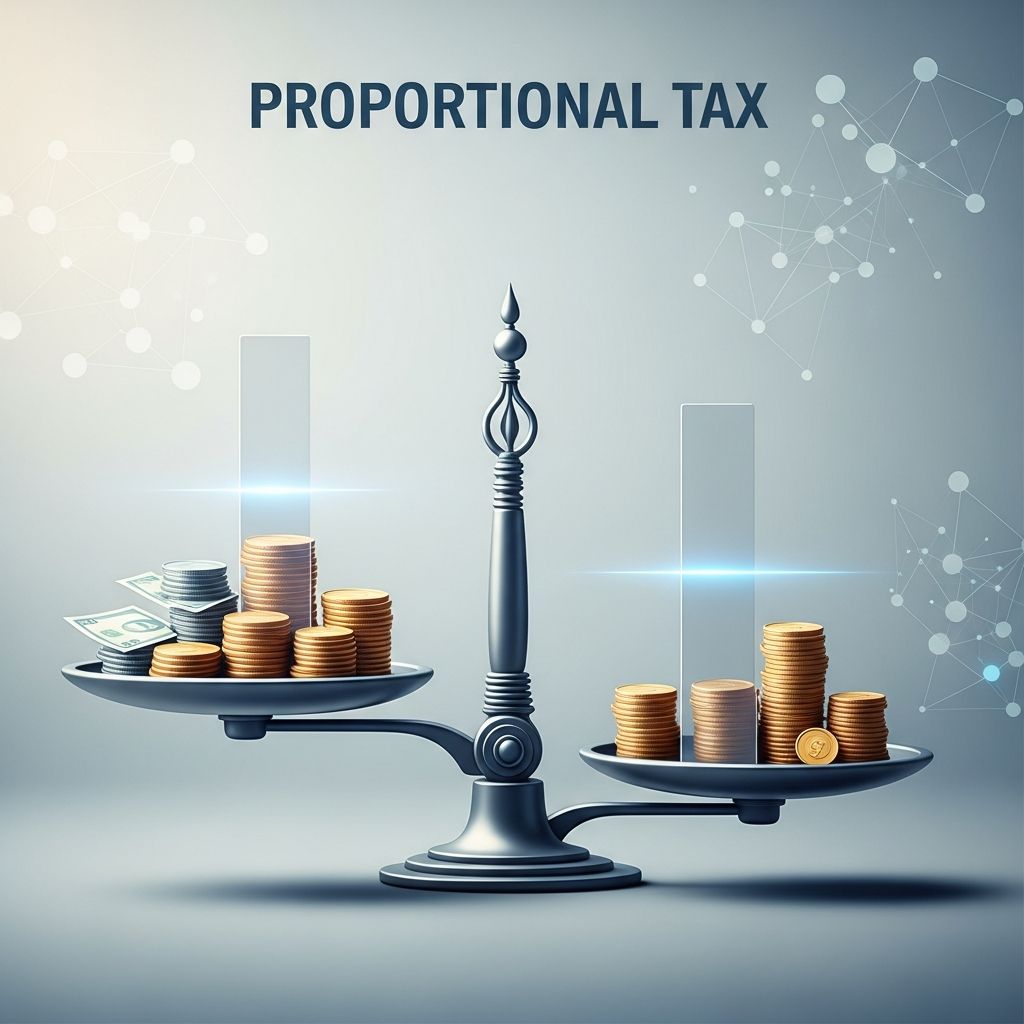
A proportional tax is a tax system in which the tax rate remains constant regardless of the taxpayer’s income or the taxable base amount. This means that whether an individual earns $10,000 or $100,000 annually, they pay the same percentage of their income in taxes. The defining characteristic of proportional taxation is that the marginal tax rate equals the average tax rate, creating a uniform distribution of the tax burden across all income levels.
The amount of tax paid is directly proportional to the taxable amount. If a jurisdiction implements a 20% proportional tax, a person earning $50,000 pays $10,000 in taxes, while someone earning $100,000 pays $20,000. The percentage remains constant, even though the absolute dollar amount increases with income.
How Proportional Taxes Work
Proportional taxes operate on a straightforward principle: apply the same tax rate uniformly across all taxpayers. This system maintains consistent tax incidence regardless of an individual’s ability to pay and does not shift the burden disproportionately toward those with higher or lower economic well-being.
The key distinction in a proportional tax system is that it differs fundamentally from both progressive and regressive taxation. Unlike progressive taxes, which increase rates as income rises, proportional taxes maintain the same percentage regardless of earnings. This creates a system where vertical equity—the concept that people in different income groups should pay different rates—is not a primary concern.
Proportional Tax vs. Progressive Tax vs. Regressive Tax
Understanding the differences between these three tax systems is essential for comprehending how tax burdens distribute across society:
Progressive Tax
A progressive tax increases in rate as the taxable base amount increases. In this system, the average tax rate is less than the marginal tax rate. For example, under a progressive tax system, someone earning $10,000 might pay 10% in taxes ($1,000), while someone earning $100,000 pays 30% ($30,000). Progressive taxes are designed to place a larger burden on those with greater ability to pay.
Regressive Tax
A regressive tax decreases as the taxable base amount increases. These taxes place a greater burden on lower-income individuals relative to their resources. For instance, a $10,000 earner might pay 20% in taxes ($2,000), while a $100,000 earner pays only 2% ($2,000). Regressive taxes create an inverse relationship between tax rates and the taxpayer’s ability to pay, as determined by assets, consumption, or income.
Proportional Tax
As established, proportional taxes maintain a consistent rate across all income levels. A $10,000 earner, a $50,000 earner, and a $100,000 earner all pay the same percentage, ensuring equal tax incidence.
Real-World Examples of Proportional Taxes
Flat Tax Systems
Although often confused with proportional taxes, flat taxes are actually a specific type of proportional tax that offers particular deductions. A flat tax imposes a fixed percentage rate on taxable income after accounting for exemptions or deductions. Estonia provides a prominent international example, employing a proportional tax rate of 20% on personal income, corporate income, and consumption. Individuals in Estonia pay this flat rate on wages, business profits, and capital gains, while a 20% value-added tax (VAT) applies to most goods and services.
Sales Tax
Conventional or retail sales taxes are charged to the end user of goods or services. Since all customers pay the same fixed rate of sales tax regardless of their income, the tax is regarded as proportional. The sales tax rate applies uniformly to both goods and services; the buyer’s income plays no role in determining the rate applied. This makes sales taxes proportional in their application, though their effect on lower-income earners may be regressive relative to their income.
Occupational Tax
An occupational tax is a form of excise tax imposed on persons or business entities for engaging in a profession, trade, or business. Some jurisdictions classify business and occupation taxes according to sectors such as wholesaling, services, retailing, or manufacturing. Within each sector, the tax rate remains the same, though it may vary among different classes. Occupational taxes maintain a consistent rate for everyone in a specific occupation or industry, making them proportional in nature.
Property Tax
In property tax systems, taxes are imposed in proportion to each property’s monetary value, determined by government appraisal or other assessment methods. Property taxes can be considered proportional when applied uniformly based on assessed property value. However, property tax rates can vary significantly across countries based on factors such as location, value, and local regulations. Consequently, property taxes are often viewed as regressive because they consume a larger percentage of income from lower-income earners.
Relationship Between Flat Tax and Proportional Tax
While the terms are sometimes used interchangeably, flat taxes and proportional taxes are not identical. Flat taxes are one specific type of proportional tax that typically offers particular deductions. A flat tax imposes a fixed fraction of taxable income after accounting for any deductions or exemptions from the tax base.
However, flat taxes are not necessarily fully proportional. Most flat tax systems exempt household income below a statutorily determined level, which is often a function of household type and size. As a result, such a flat marginal rate is consistent with a progressive average tax rate. This means that while the rate applied to taxable income is flat, the overall effective tax burden may progress with income when exemptions are considered.
Historical Perspective on Proportional Taxation
The concept of proportional taxation has deep historical roots. The French Declaration of the Rights of Man and of the Citizen of 1789 proclaims: “A common contribution is essential for the maintenance of the public forces and for the cost of administration. This should be equitably distributed among all the citizens in proportion to their means.” This foundational principle reflects Enlightenment ideals about fairness and equitable distribution of tax burdens.
The Role of Proportional Taxation in Modern Tax Systems
Progressive tax rates and marginal taxation remain more common worldwide than proportional systems, particularly in developed countries where those with lower incomes pay a smaller share of taxes overall. However, the calculation of tax burden is complex and depends on how taxes are measured.
When tax paid is divided by income rather than the tax base (the amount spent), an arguably arbitrary relationship emerges. The income tax rate itself may be proportional, with people with higher incomes paying more tax but at the same rate. If a consumption tax is to be related to income, unspent income can be treated as tax-deferred (representing savings spent at a later point in time), at which time it is taxed, creating a proportional rate using an income base.
Considerations and Criticisms of Proportional Taxes
While proportional taxes offer simplicity and uniformity, they face several considerations and criticisms:
Fairness Debates: Critics argue that proportional taxes may not account for differences in ability to pay. A 20% tax represents a more significant burden for someone earning $30,000 than for someone earning $300,000, even though the percentage is identical.
Combined Tax Effects: In the United States, the combination of progressive income taxes and regressive Social Security and property taxes, along with somewhat regressive excise taxes and user fees, results in taxpayers paying roughly the same percentage of their incomes in taxes, effectively creating a proportional system overall.
Administrative Simplicity: A key advantage of proportional taxes is their administrative simplicity. With no brackets, phase-outs, or complex calculations, proportional tax systems are generally easier to implement and understand.
Frequently Asked Questions (FAQs)
Q: Is a flat tax the same as a proportional tax?
A: While related, they are not identical. A flat tax is a type of proportional tax that applies a fixed percentage rate to taxable income after deductions. Flat taxes may include exemptions that create a progressive average tax rate despite maintaining a flat marginal rate.
Q: What is an example of a proportional tax?
A: Sales taxes are common examples of proportional taxes. All customers pay the same percentage regardless of income. Estonia’s 20% flat income tax and occupational taxes are also proportional tax examples.
Q: How does a proportional tax differ from a progressive tax?
A: In a proportional tax, the rate remains constant across all income levels. In a progressive tax, the rate increases as income rises, meaning higher earners pay a larger percentage of their income in taxes.
Q: Is sales tax proportional or regressive?
A: Sales taxes are proportional in their application—everyone pays the same rate. However, they may have a regressive effect because lower-income earners spend a larger percentage of their income on taxable goods.
Q: Why might a government choose a proportional tax system?
A: Proportional tax systems are administratively simple, easy to understand, and can be implemented consistently across taxpayers. They also avoid the complexity of progressive brackets and calculations.
Q: Can property taxes be considered proportional?
A: Property taxes can be considered proportional when applied uniformly based on assessed property value. However, they are often regressive because lower-income earners pay a larger percentage of their income for housing.
References
- Proportional tax — Wikipedia. Accessed 2025-11-29. https://en.wikipedia.org/wiki/Proportional_tax
- Comparing Regressive, Progressive, and Proportional Taxes — Internal Revenue Service (IRS). U.S. Department of the Treasury. https://apps.irs.gov/app/understandingTaxes/whys/thm03/les05/media/ws_ans_thm03_les05.pdf
- Understanding Taxes: Tax Systems — Internal Revenue Service (IRS). U.S. Department of the Treasury. https://apps.irs.gov/app/understandingTaxes/
Similar Articles








Read full bio of medha deb