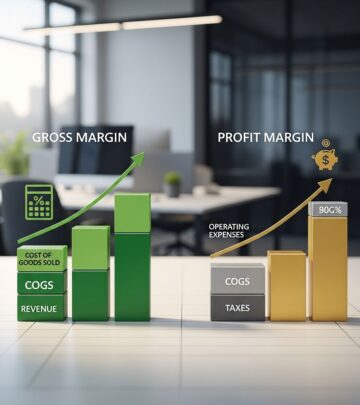
Profit vs. Profitability: Key Differences Explained
Understand the critical distinctions between profit and profitability in business financial analysis.

Understanding Profit vs. Profitability: A Comprehensive Guide
When analyzing a company’s financial health, investors and business owners often use the terms “profit” and “profitability” interchangeably. However, these two concepts represent fundamentally different metrics that provide distinct insights into a business’s financial performance. Understanding the differences between profit and profitability is essential for making informed investment decisions, evaluating business performance, and assessing a company’s overall financial strength.
While both metrics are derived from a company’s financial statements and relate to earnings, they measure different aspects of financial success. Profit represents an absolute figure—the actual dollar amount remaining after expenses are subtracted from revenue. Profitability, on the other hand, is a relative measure that indicates how efficiently a company generates earnings from its resources. This distinction is crucial because a company can be highly profitable while generating modest profits, or it can generate substantial profits while maintaining poor profitability ratios.
What Is Profit?
Profit is the financial gain obtained when revenue exceeds expenses. It is an absolute measure expressed in currency units, typically dollars, and represents the bottom-line earnings of a business after all costs, expenses, taxes, and interest have been deducted from total revenue. Profit is often referred to as the “net income” or “earnings” of a company and appears directly on the income statement.
There are several types of profit that businesses and analysts consider:
- Gross Profit: The profit calculated after subtracting the cost of goods sold (COGS) from total revenue, representing earnings before operating expenses are deducted.
- Operating Profit: The profit remaining after operating expenses such as salaries, rent, and utilities are subtracted from gross profit, reflecting earnings from core business operations.
- Net Profit: The final profit after all expenses, taxes, and interest have been deducted from revenue, representing the company’s true bottom-line earnings.
Profit is crucial for business survival and growth, as it provides the capital necessary for reinvestment, debt repayment, dividend distribution to shareholders, and expansion into new markets. However, profit alone does not provide a complete picture of business performance because it doesn’t account for the company’s size or the resources used to generate those earnings.
What Is Profitability?
Profitability is a relative measure that describes a company’s ability to generate earnings in relation to its revenue, assets, equity, or other financial resources. Unlike profit, which is expressed as an absolute amount, profitability is typically expressed as a percentage or ratio and provides insight into how efficiently management utilizes company resources to generate income. Profitability measures the company’s performance on a relative basis, making it possible to compare companies of different sizes or operating in different industries.
Several profitability ratios are commonly used by analysts and investors:
- Gross Profit Margin: Calculated by dividing gross profit by revenue, showing what percentage of sales remains as profit after accounting for the cost of goods sold.
- Operating Profit Margin: Calculated by dividing operating profit by revenue, indicating the percentage of revenue that remains as profit after operating expenses.
- Net Profit Margin: Calculated by dividing net profit by revenue, representing the percentage of sales that becomes profit after all expenses are deducted.
- Return on Assets (ROA): Calculated by dividing net income by total assets, measuring how effectively the company uses its assets to generate profit.
- Return on Equity (ROE): Calculated by dividing net income by shareholder equity, showing how efficiently the company uses shareholders’ investment to generate profit.
Key Differences Between Profit and Profitability
Understanding the distinctions between profit and profitability is fundamental to comprehensive financial analysis. Here are the primary differences:
| Aspect | Profit | Profitability |
|---|---|---|
| Type of Measure | Absolute measure | Relative measure |
| Expression | Stated in currency (dollars) | Expressed as percentage or ratio |
| Focus | Actual dollar earnings | Efficiency and performance |
| Comparability | Difficult to compare different sized companies | Easy to compare across companies and industries |
| Scale Dependence | Directly influenced by company size | Independent of company size |
Practical Examples: Profit vs. Profitability
Consider two hypothetical retail companies to illustrate the difference between profit and profitability:
Company A generates $1,000,000 in annual revenue with $800,000 in expenses, resulting in a net profit of $200,000. This is the company’s profit expressed in absolute dollars.
Company B generates $100,000 in annual revenue with $70,000 in expenses, resulting in a net profit of $30,000.
While Company A has higher absolute profit ($200,000 versus $30,000), comparing profitability reveals a different picture. Company A’s net profit margin is 20% ($200,000 ÷ $1,000,000), while Company B’s net profit margin is 30% ($30,000 ÷ $100,000). Despite Company B’s lower absolute profit, it is actually more profitable because it generates 30 cents of profit for every dollar of revenue, compared to Company A’s 20 cents. This demonstrates why profitability ratios are essential for meaningful performance analysis.
Why Both Metrics Matter
Successful business analysis requires consideration of both profit and profitability metrics, as each provides unique and valuable information:
The Importance of Profit
Profit is essential because it represents the actual cash available for distribution to shareholders, reinvestment in the business, or debt repayment. A company must generate sufficient profit to fund operations, support growth initiatives, and weather economic downturns. Without profit, a business cannot survive long-term. For investors, understanding a company’s profit trends can indicate whether management is effectively controlling costs and growing revenues over time.
The Importance of Profitability
Profitability metrics are equally important because they reveal operational efficiency and management quality. A highly profitable company demonstrates that management effectively allocates resources and controls costs relative to revenue. Profitability ratios are particularly valuable when comparing companies of different sizes or operating in different industries. They answer fundamental questions: How well is the company performing relative to its resources? How efficient is management? Is the company competitive within its industry?
Using Profit and Profitability in Investment Decisions
Investors must evaluate both metrics when assessing potential investments. A company with growing profits might seem attractive, but if profitability margins are declining, it could indicate deteriorating operational efficiency or increasing competitive pressure. Conversely, a small company with exceptional profitability margins might represent an excellent investment opportunity if it has growth potential.
Financial analysts typically examine profitability trends over multiple periods to identify whether a company’s operational efficiency is improving or declining. They also compare a company’s profitability ratios to industry benchmarks and competitors’ ratios to determine relative performance and competitive positioning.
Common Profitability Metrics and Calculations
Net Profit Margin: Net Income ÷ Total Revenue × 100. This shows what percentage of each dollar of sales becomes profit.
Gross Profit Margin: Gross Profit ÷ Total Revenue × 100. This indicates the percentage of revenue remaining after direct production costs.
Return on Assets (ROA): Net Income ÷ Total Assets × 100. This measures how efficiently assets generate income.
Return on Equity (ROE): Net Income ÷ Shareholder Equity × 100. This shows how much profit is generated from shareholder investments.
Operating Profit Margin: Operating Income ÷ Total Revenue × 100. This reflects profitability from core operations.
Limitations of Each Metric
While profit and profitability are valuable metrics, each has limitations. Profit can be influenced by one-time events, accounting policies, and non-recurring items that don’t reflect ongoing operational performance. Additionally, comparing absolute profits between companies of vastly different sizes can be misleading without considering scale.
Profitability ratios, while useful for comparative analysis, can be influenced by accounting methods and may not account for capital intensity differences between companies. A capital-intensive business might have lower profitability ratios than a service-based company, even if both are financially healthy. Furthermore, profitability metrics are typically backward-looking, based on historical financial data, and may not predict future performance.
Frequently Asked Questions
Q: Can a company be profitable but not make a profit?
A: This is theoretically possible but unlikely. If a company is profitable, meaning it has positive profitability ratios, it should generate profit. However, a company might have high profitability ratios on paper while facing liquidity challenges due to working capital management or high capital expenditures, resulting in insufficient actual profit cash flow.
Q: Which metric should investors prioritize?
A: Both metrics are important and should be evaluated together. Growing profit indicates business expansion, while strong profitability indicates efficient management and operational excellence. Investors should consider both absolute profit trends and relative profitability metrics for comprehensive analysis.
Q: How do profitability ratios compare across industries?
A: Profitability ratios vary significantly across industries due to different business models, capital requirements, and cost structures. Technology companies typically have higher profit margins than retail companies. Investors should compare companies within the same industry for meaningful analysis.
Q: What does a declining profitability ratio indicate?
A: Declining profitability ratios can indicate increased competition, rising input costs, pricing pressure, or inefficient cost management. It suggests that the company is generating fewer earnings from its revenue or resources, which requires investigation into underlying causes.
Q: How often should profitability metrics be reviewed?
A: Investors should review profitability metrics quarterly when companies release earnings reports and annually for comprehensive analysis. Comparing metrics over multiple years helps identify trends and assess whether operational efficiency is improving or deteriorating.
References
- Financial Accounting Standards Board (FASB) – Accounting Standards Codification — FASB. 2024. https://www.fasb.org/
- U.S. Securities and Exchange Commission – Investor Education — SEC. 2024. https://www.sec.gov/investor/
- Investopedia – Financial Analysis and Metrics — Investopedia Editorial. 2024. https://www.investopedia.com/terms/
- CFA Institute – Profitability Analysis Framework — CFA Institute. 2023. https://www.cfainstitute.org/
- Harvard Business School – Financial Statement Analysis — Harvard Business Publishing. 2023. https://www.hbs.edu/
Similar Articles








Read full bio of medha deb