Profit Margin vs. Markup: Key Differences
Master the critical distinction between profit margin and markup to optimize pricing and profitability strategies.
In business and finance, two metrics are frequently used to measure profitability and pricing strategy: profit margin and markup. While these terms are often confused or used interchangeably, they represent fundamentally different concepts that serve distinct purposes in financial analysis and business planning. Understanding the difference between profit margin and markup is crucial for entrepreneurs, accountants, and business managers who need to make informed decisions about pricing, profitability, and overall business performance.
The confusion between these two metrics is understandable, as both involve the relationship between cost and profit. However, the key distinction lies in what each metric measures and how it’s calculated. Profit margin addresses profit as it relates to the selling price, whereas markup addresses profit as it relates to the cost price. This fundamental difference has significant implications for how businesses set prices and analyze their financial health.
Understanding Profit Margin
Profit margin is a financial metric that measures how much profit a company makes on every dollar of revenue. It expresses profit as a percentage of the selling price rather than the cost price. In other words, profit margin tells you what percentage of your sales revenue becomes actual profit after covering the cost of goods sold.
The formula for calculating profit margin is straightforward:
Profit Margin (%) = (Selling Price – Cost) ÷ Selling Price × 100
Let’s consider a practical example to illustrate this concept. Suppose you sell a product for $100, and the cost to produce or acquire that product is $60. Using the profit margin formula:
Profit Margin = ($100 – $60) ÷ $100 × 100 = 40%
This calculation shows that you’re keeping 40% of the sale price as profit. The remaining 60% represents your cost. This metric is particularly useful for understanding what percentage of revenue translates into actual profit, making it an excellent indicator of operational efficiency and profitability.
Profit margin is generally considered the more important metric for assessing overall business profitability. It directly reflects how well a company is managing its costs relative to its revenue. A higher profit margin indicates better profitability, while a lower margin suggests that the company needs to either reduce costs or increase prices to improve profitability.
Understanding Markup
Markup, by contrast, measures the percentage increase added to the cost price to arrive at the selling price. It answers the question: “How much more am I charging above my cost?” This metric is particularly useful for setting initial prices and determining the price increase needed to achieve a desired profit level.
The formula for calculating markup is:
Markup (%) = (Selling Price – Cost Price) ÷ Cost Price × 100
Using the same example as before: a product that costs $60 and sells for $100 would have a markup of:
Markup = ($100 – $60) ÷ $60 × 100 = 66.67%
This means you’re adding a 66.67% markup to your cost price to arrive at the selling price. While this percentage sounds more impressive than the 40% profit margin from the same transaction, both calculations are correct—they’re simply measuring different things.
Markup is invaluable for setting initial prices and is often the starting point when a business determines what price it needs to charge to achieve a certain profit level. However, it’s important to note that markup alone doesn’t tell the complete story about profitability, which is why both metrics are important.
The Critical Difference Between Profit Margin and Markup
The fundamental difference between profit margin and markup can be summarized as follows:
- Profit Margin: Expresses profit as a percentage of the selling price (denominator is the selling price)
- Markup: Expresses profit as a percentage of the cost price (denominator is the cost price)
This difference in denominators means that markup percentages will always be higher than profit margin percentages when calculated from the same cost and selling price. In the example above, the 66.67% markup corresponds to a 40% profit margin—the markup is significantly higher because the denominator (cost) is smaller than the denominator in the profit margin calculation (selling price).
To illustrate this relationship further, consider a $150 selling price with a $100 cost:
Markup: ($150 – $100) ÷ $100 × 100 = 50%
Profit Margin: ($150 – $100) ÷ $150 × 100 = 33.33%
Again, the markup (50%) is higher than the profit margin (33.33%), even though both are derived from the same transaction. Understanding this relationship is crucial because it prevents confusion when analyzing pricing strategies and profitability.
Comparing Profit Margin and Markup
| Aspect | Profit Margin | Markup |
|---|---|---|
| Definition | Profit as a percentage of selling price | Profit as a percentage of cost price |
| Formula | (Selling Price – Cost) ÷ Selling Price × 100 | (Selling Price – Cost) ÷ Cost × 100 |
| Primary Use | Measuring profitability and financial health | Setting initial prices and pricing strategy |
| Typical Value | Lower percentage | Higher percentage |
| Best For | Profit analysis and performance assessment | Price setting and cost-plus pricing |
| Industry Example | Retail: 20-30% margin typical | Retail: 50-100% markup typical |
When to Use Each Metric
Use Profit Margin When: You want to assess your company’s actual profitability and financial performance. Profit margin is the best choice for calculating a company’s profits and is critical for profit analysis. It helps you understand what percentage of each sales dollar becomes profit, which is essential for evaluating your business’s efficiency and comparing performance across different time periods or against competitors.
Use Markup When: You’re setting prices for products or services. Markup is invaluable for determining how much you need to charge above your cost to achieve a desired profit level. When a business aims to achieve a certain profit level from the sale of its products or services, markup should be used to guide initial pricing decisions.
Practical Examples and Calculations
Let’s work through several examples to solidify your understanding of these concepts:
Example 1: Product with $50 Cost and $75 Selling Price
Markup: ($75 – $50) ÷ $50 × 100 = 50%
Profit Margin: ($75 – $50) ÷ $75 × 100 = 33.33%
Example 2: Product with $100 Cost and $150 Selling Price
Markup: ($150 – $100) ÷ $100 × 100 = 50%
Profit Margin: ($150 – $100) ÷ $150 × 100 = 33.33%
Example 3: Product with $80 Cost and $200 Selling Price
Markup: ($200 – $80) ÷ $80 × 100 = 150%
Profit Margin: ($200 – $80) ÷ $200 × 100 = 60%
These examples demonstrate that the same markup percentage can exist at different price points, and they also show how dramatically markup percentages can exceed profit margins.
Understanding Gross Margin
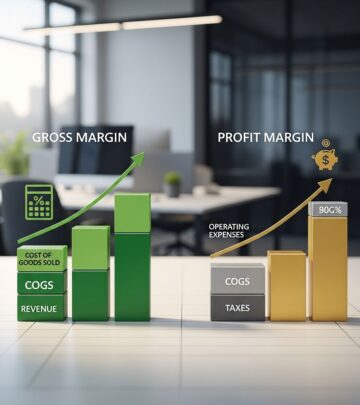
Related to profit margin is another important metric called gross margin or gross profit margin. Gross margin percentage is calculated as (Profit ÷ Revenue) × 100. While it’s similar to profit margin in concept, gross margin is based on the total revenue rather than the selling price of a specific item. For example, if a product sells for $200 and costs $120 to produce, the gross profit is $80, resulting in a 40% profit margin. Gross margin helps businesses understand their overall profitability by considering all revenue and all costs of goods sold.
Factors Influencing Markup Percentages
Markup percentages are influenced by several factors that businesses must consider when setting prices:
- Industry Type: Different industries have established norms for markup. Luxury goods may have higher markups, while commodities typically have lower ones.
- Competitive Pricing: The pricing strategies of competitors play a crucial role in determining what markup a business can realistically apply.
- Product Nature: Whether a product is perishable, seasonal, or a standard commodity affects the appropriate markup.
- Operational Costs: Beyond the direct cost of goods, businesses must account for overhead, labor, and other operational expenses.
- Market Demand: High-demand products may support higher markups, while low-demand items may require lower ones to remain competitive.
Why This Distinction Matters for Business Success
Understanding the difference between profit margin and markup is essential for several reasons. First, it prevents misinterpretation of financial data. A business owner who confuses these metrics might believe they’re more profitable than they actually are, leading to poor financial decisions. Second, it enables more accurate pricing strategies. By understanding markup, businesses can set prices that will ultimately achieve desired profit margins. Third, it facilitates meaningful financial analysis and comparison with industry benchmarks and competitors.
Frequently Asked Questions
Q: What’s a good profit margin percentage?
A: Good profit margin percentages vary by industry. Retail typically ranges from 20-30%, while manufacturing might see 15-25%. Technology and software companies often achieve higher margins of 40-60% or more. Compare your profit margin to industry benchmarks to assess your performance.
Q: Can markup and profit margin be the same percentage?
A: No, markup and profit margin will never be the same percentage when calculated from the same transaction. Markup is always a higher percentage than profit margin because it uses the smaller cost as the denominator, while profit margin uses the larger selling price as the denominator.
Q: How do I convert markup to profit margin?
A: You can use conversion tables or formulas to convert between markup and profit margin. For example, a 50% markup equals approximately a 33.33% profit margin. The relationship is: Profit Margin = Markup ÷ (1 + Markup).
Q: Which metric should I use for financial reporting?
A: Profit margin is the standard metric used in financial reporting and analysis. It’s what accountants, investors, and financial analysts rely on to assess profitability. Markup is more of an operational metric used for pricing decisions.
Q: How does discounting affect profit margin vs. markup?
A: Discounts directly reduce selling price, which significantly impacts profit margin. A 10% discount might seem manageable, but it dramatically reduces profit margin percentage. Markup is unaffected by actual discounts applied, as it’s calculated on the theoretical selling price.
References
- What’s the difference between profit margin and markup? — African Financials Helpdesk. Accessed November 29, 2025. https://helpdesk.africanfinancials.com/support/solutions/articles/234019-what-s-the-difference-between-profit-margin-and-markup-
- Margin vs. Markup: The Difference + Easy Formulas & Examples — Orders In Seconds. Accessed November 29, 2025. https://ordersinseconds.com/calculate-margin-vs-markup-for-better-pricing/
- Profit Margin vs. Markup: What’s the Difference? — Walk Construction. Accessed November 29, 2025. https://walkconstruction.com/blog/profit-margin-vs-markup-whats-the-difference/
Similar Articles








Read full bio of Sneha Tete