Profit Margin Types and Calculation Guide
Master profit margins: Learn types, formulas, and calculation methods for business success.

Profit margin is one of the most fundamental metrics in business finance. It measures how much profit a company generates for every dollar of revenue earned. Understanding profit margins is essential for business owners, investors, and financial analysts who want to assess a company’s financial health and operational efficiency. Rather than looking at profit in absolute dollars, profit margin provides a percentage that makes it easy to compare profitability across different time periods or between companies of different sizes.
There are several types of profit margins that measure different aspects of a business’s financial performance. Each margin type tells a unique story about where money is being spent and how efficiently the company is operating. By analyzing these different margins, stakeholders can gain valuable insights into pricing strategies, cost management, and overall business viability.
What Is Profit Margin?
Profit margin represents the percentage of revenue that remains as profit after accounting for various business expenses. In its simplest form, profit margin answers the question: “For every dollar of sales, how many cents does the company keep as profit?” A 30% profit margin, for example, means that for every dollar of revenue, the company retains 30 cents as profit after paying all expenses, while the remaining 70 cents covers business costs.
The importance of profit margin extends beyond simple profitability measurement. It serves as a barometer for business health, efficiency, and competitive positioning. Companies with higher profit margins relative to their industry peers are typically managing costs more effectively or commanding premium prices for their products or services.
The Four Primary Types of Profit Margins
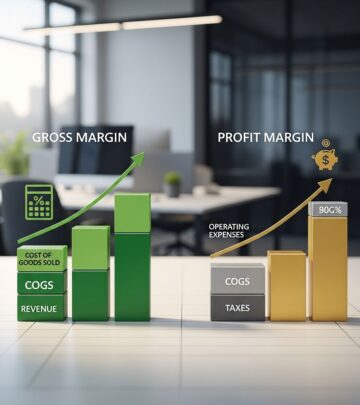
Businesses calculate and analyze four primary profit margins to gain a comprehensive understanding of their financial performance. Each margin progressively includes more types of expenses, creating a layered view of profitability from production-level efficiency to bottom-line net income.
1. Gross Profit Margin
Gross profit margin is the most basic profit margin calculation. It measures profitability after accounting only for the direct costs of producing goods or services, known as the cost of goods sold (COGS). This includes expenses such as raw materials, direct labor, and manufacturing overhead directly tied to production.
Formula: Gross Profit Margin = [(Revenue – COGS) / Revenue] × 100
Gross profit margin is particularly useful for assessing production efficiency and evaluating pricing strategies. A high gross profit margin indicates that a company is generating strong profits from its core business operations before considering overhead costs like rent, utilities, and administrative salaries. This metric helps identify whether the fundamental business model is economically sound.
Example: If a business generates $20,000 in revenue and the cost of goods sold is $8,000, the gross profit is $12,000. The gross profit margin would be ($12,000 / $20,000) × 100 = 60%.
2. Operating Profit Margin
Operating profit margin builds upon gross profit by also accounting for operating expenses. These are indirect costs necessary to run the business but not directly tied to production, such as rent, salaries for administrative staff, marketing expenses, utilities, and office supplies.
Formula: Operating Profit Margin = [(Gross Profit – Operating Expenses) / Revenue] × 100
This metric provides insight into how efficiently management is controlling operational costs. A declining operating margin despite stable or growing gross margins might indicate that administrative or marketing expenses are rising faster than revenue, which could signal operational inefficiency or strategic shifts in spending.
Example: Continuing the previous example with $12,000 in gross profit, if operating expenses total $3,000, the operating profit would be $9,000. The operating profit margin would be ($9,000 / $20,000) × 100 = 45%.
3. Pretax Profit Margin
Pretax profit margin includes all gains, expenses, losses, and revenues from both operating and non-operating business activities, but excludes tax obligations. This captures the full picture of business profitability before government taxes are deducted.
Formula: Pretax Profit Margin = [(Revenue – Net of All Nontax Expenses, Gains, and Losses) / Revenue] × 100
Non-operating items included in this calculation might include interest income or expense from financing activities, gains or losses from investments, or one-time gains or losses from asset sales. This metric is valuable for understanding overall profitability independent of tax considerations, which can vary significantly based on jurisdiction and tax planning strategies.
4. Net Profit Margin
Net profit margin is the bottom-line profitability measure. It accounts for all expenses, gains, losses, and importantly, tax obligations. This is often called the “net margin” or simply “profit margin” in casual business discussions.
Formula: Net Profit Margin = [(Revenue – Net Income of All Expenses, Gains, and Losses) / Revenue] × 100
Net profit margin tells you exactly what percentage of revenue the company keeps after all expenses have been paid. It’s the most comprehensive profitability metric and is frequently used by investors to evaluate overall business performance.
Example: If the business has $9,000 in operating profit, pays $4,000 in taxes, the net income would be $5,000. The net profit margin would be ($5,000 / $20,000) × 100 = 25%.
Comparison Table of Profit Margin Types
| Margin Type | What It Includes | Formula | Primary Use |
|---|---|---|---|
| Gross Margin | Direct costs of production | [(Revenue – COGS) / Revenue] × 100 | Pricing and production efficiency |
| Operating Margin | Direct and indirect operating costs | [(Gross Profit – Operating Expenses) / Revenue] × 100 | Operational efficiency |
| Pretax Margin | All expenses except taxes | [(Revenue – All Nontax Expenses) / Revenue] × 100 | Overall profitability before taxes |
| Net Margin | All expenses including taxes | [(Revenue – All Expenses) / Revenue] × 100 | Bottom-line profitability |
How to Calculate Each Profit Margin Type
Calculating Gross Profit Margin
To calculate gross margin, follow these steps:
- Find the value of gross profit by subtracting COGS from total sales revenue
- Divide that value by revenue
- Multiply the result by 100 to express the margin as a percentage
For instance, if your business makes $20,000 by providing services and it costs $8,000 to provide those services, your gross profit is $12,000. Therefore: $12,000 / $20,000 × 100 = 60% gross profit margin.
Calculating Operating Profit Margin
To calculate operating profit margin:
- Find operating profit by subtracting operating expenses from gross profit
- Divide the operating profit by revenue
- Multiply the result by 100 to express as a percentage
In our example, if the operating expenses are $3,000, operating profit is $9,000 (from $12,000 gross profit). Therefore: $9,000 / $20,000 × 100 = 45% operating profit margin.
Calculating Pretax Profit Margin
To calculate pretax profit margin:
- Find the pretax profit by summing all gains, expenses, and losses, except for taxes, and subtracting from revenue
- Divide the pretax profit by revenue
- Multiply the result by 100 to convert to a percentage
Calculating Net Profit Margin
To calculate net profit margin:
- Find net income by summing all gains, expenses, and losses, including taxes, and subtracting from revenue
- Divide net income by revenue
- Multiply the result by 100 to express as a percentage
Using our example: If the business pays $4,000 in taxes, net income is $5,000. Therefore: $5,000 / $20,000 × 100 = 25% net profit margin.
Industry Benchmarks and Profit Margin Interpretation
Interpreting profit margins requires understanding what constitutes healthy performance within a specific industry. Profit margin benchmarks vary significantly across sectors due to differences in business models, capital intensity, and competition levels.
As a general guideline, a 5% profit margin is considered low, a 10% profit margin is considered average, and a 20% profit margin is considered high. However, these are rough estimates. Retail businesses typically operate with lower margins (3-5%), while software companies might maintain 20-30% or higher margins. Manufacturing businesses often fall in the 10-15% range.
Comparing your company’s profit margins against industry benchmarks provides context for performance evaluation. A company with a 15% net profit margin might be exceptional in retail but below average in software. Tracking your profit margins over time reveals whether your business financial health is improving or declining.
Using Profit Margins for Business Decision-Making
Profit margins serve multiple strategic purposes beyond simple performance measurement. They help identify operational inefficiencies, guide pricing strategies, reveal competitive positioning, and inform investment decisions.
When gross margin declines while operating margins remain stable, it suggests rising production costs. When operating margin declines despite stable gross margin, it indicates rising overhead expenses. These insights help management identify where corrective action is needed.
Additionally, profit margins help businesses set realistic pricing. Understanding your gross margin helps determine the minimum price point needed to sustain operations, while analyzing net margins helps ensure pricing covers all expenses including taxes.
Frequently Asked Questions
Q: What does a 30% profit margin mean?
A: A 30% profit margin means you keep 30 cents as profit for every dollar of revenue after paying all expenses. The remaining 70 cents covers your business costs.
Q: How do I calculate a 20% profit margin?
A: To achieve a 20% profit margin, your net profit must equal 20% of total revenue. For example, if your business generates $100,000 in revenue, you need a net profit of $20,000 to achieve a 20% profit margin ($20,000 / $100,000 × 100 = 20%).
Q: Why are there different types of profit margins?
A: Different profit margin types reveal profitability at different stages of the business. Gross margin shows production efficiency, operating margin shows operational efficiency, and net margin shows overall profitability. This layered approach helps identify where expenses are rising or where efficiency improvements are needed.
Q: Which profit margin is most important?
A: Net profit margin is generally considered most important for investors and stakeholders since it represents the bottom-line profitability. However, business managers often focus on gross and operating margins to identify operational improvements before net profit is determined.
Q: How can I improve my profit margins?
A: Improve profit margins by increasing revenue through higher prices or sales volume, reducing cost of goods sold through better supplier negotiations or production efficiency, or decreasing operating expenses through overhead reduction or process optimization.
Q: Can profit margins be negative?
A: Yes, profit margins can be negative when expenses exceed revenue. This indicates the business is operating at a loss. While acceptable temporarily for startups or during growth phases, negative margins are unsustainable long-term.
Q: How do I compare profit margins between companies?
A: When comparing profit margins between companies, ensure you’re comparing similar margin types and consider industry context. Companies in different industries have naturally different margin ranges, so comparisons are most meaningful within the same sector.
References
- Profit Margin Defined: How to Calculate, Types and Uses — NetSuite. https://www.netsuite.com/portal/resource/articles/financial-management/profit-margin.shtml
- Profit Margin Formula: How to Calculate and Improve Your Margins — Xero. https://www.xero.com/us/guides/what-is-profit-margin/
- Profit Margin: Types, Definitions and Formulas — Credibly. https://www.credibly.com/incredibly/profit-margin/
- Profit Margin: What It Is, Types, and How To Calculate It — Bill.com. https://www.bill.com/learning/profit-margin
- Profit Margin Definition, Types & Calculation Formulas — Tipalti. https://tipalti.com/resources/learn/profit-margin/
- How to Use Profitability & Margin Ratios — Harvard Business School Online. https://online.hbs.edu/blog/post/margin-ratios
Similar Articles








Read full bio of Sneha Tete