Profit Margin: Definition, Types, Formula & Examples
Master profit margins: Learn how to calculate and analyze business profitability metrics.
What Is a Profit Margin?
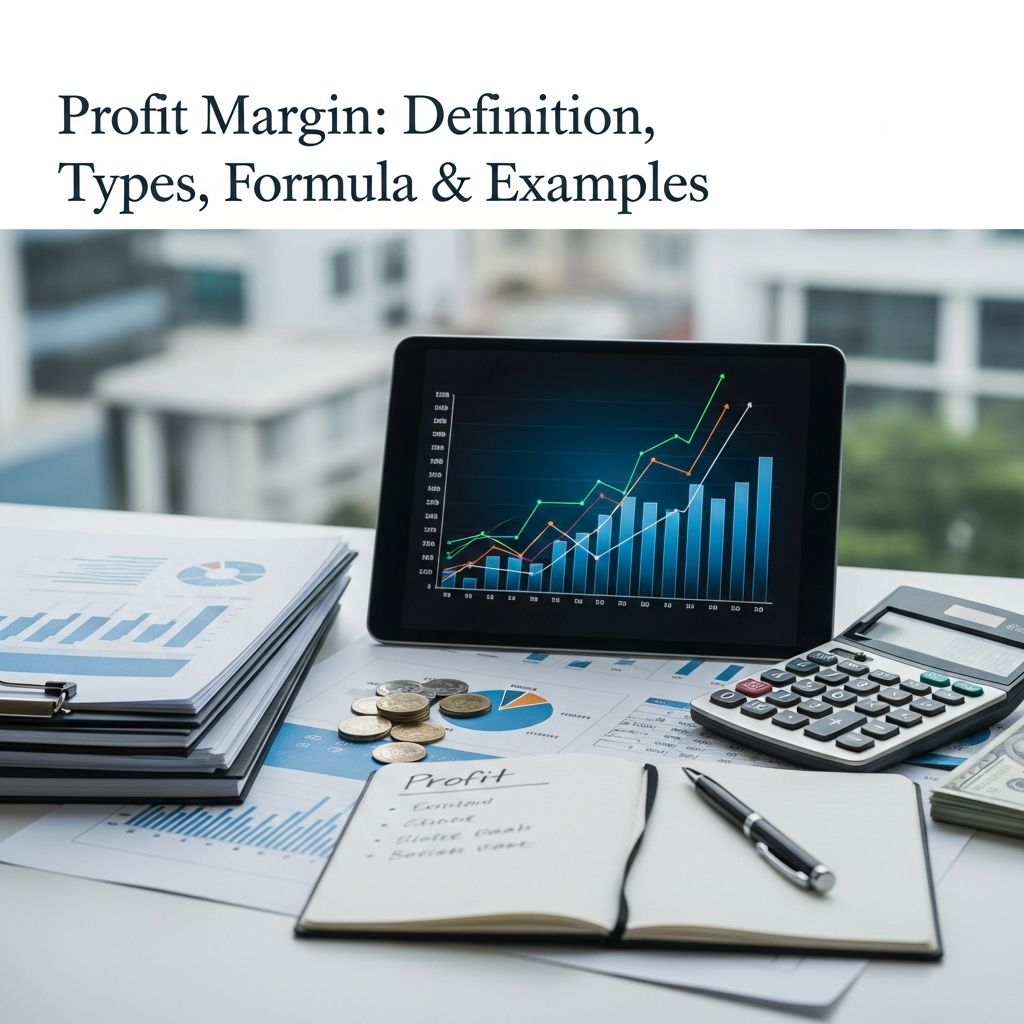
A profit margin is a financial metric that measures how much profit a company makes for every dollar of revenue it generates. It represents the percentage of sales that has turned into profits. In essence, profit margin shows the efficiency of a company’s operations and its ability to convert revenue into actual earnings. Investors, creditors, and business analysts use profit margins as a key performance indicator to assess whether a company is generating adequate profits relative to its sales volume.
Profit margin is expressed as a percentage and is calculated by dividing profit by revenue and multiplying by 100. The higher the profit margin, the more profitable the company is considered to be. However, profit margins vary significantly across different industries, making it important to compare companies within the same sector for meaningful analysis.
Why Profit Margin Matters
Profit margins serve several critical functions in financial analysis and business decision-making:
- Performance Evaluation: Profit margins help determine whether a company is operating efficiently and managing its costs effectively.
- Investment Decisions: Investors use profit margins to compare companies and identify which businesses generate better returns on sales.
- Pricing Strategy: Companies use margin analysis to set appropriate prices for products and services.
- Competitive Analysis: Profit margins reveal how competitive a company is within its industry.
- Trend Analysis: Tracking profit margins over time reveals whether a company’s operational efficiency is improving or deteriorating.
The Three Main Types of Profit Margin
1. Gross Profit Margin
Gross profit margin measures the percentage of revenue remaining after deducting the cost of goods sold (COGS). This is the most basic profit margin calculation and reflects the efficiency of a company’s production process.
Formula: Gross Profit Margin = (Revenue – Cost of Goods Sold) / Revenue × 100
The gross profit margin focuses solely on production-related costs and doesn’t account for operating expenses, taxes, or interest payments. A high gross profit margin indicates that a company purchases raw materials efficiently or charges premium prices for its products. However, a high gross margin doesn’t guarantee overall profitability if the company has substantial operating expenses.
2. Operating Profit Margin
Operating profit margin measures the percentage of revenue remaining after deducting both COGS and operating expenses such as salaries, rent, utilities, and depreciation. This metric provides insight into how efficiently a company manages its day-to-day operations.
Formula: Operating Profit Margin = Operating Income / Revenue × 100
Operating profit margin is more comprehensive than gross profit margin because it includes all costs associated with running the business operations except for taxes and interest. This metric is particularly useful for comparing the operational efficiency of companies in the same industry, as it isolates the impact of capital structure and tax situations.
3. Net Profit Margin
Net profit margin is the most comprehensive profitability metric, measuring the percentage of revenue remaining after deducting all expenses, including COGS, operating expenses, interest, and taxes. This represents the bottom line profitability of a company.
Formula: Net Profit Margin = Net Income / Revenue × 100
Net profit margin reflects the true profitability of a business because it accounts for all costs and obligations. This metric is what most investors focus on when assessing a company’s overall profitability and is the most important figure for bottom-line analysis.
How to Calculate Profit Margin
Calculating profit margin requires accessing financial data from a company’s income statement. Here’s a step-by-step guide:
Step 1: Identify Revenue
Find the total revenue (also called net sales or top-line revenue) from the income statement. This is the total amount of money the company received from selling its products or services.
Step 2: Determine the Appropriate Profit Figure
Depending on which margin you’re calculating, identify the corresponding profit figure:
- For gross margin: Calculate gross profit (revenue minus COGS)
- For operating margin: Use operating income
- For net margin: Use net income
Step 3: Divide and Multiply
Divide the profit figure by revenue and multiply by 100 to express as a percentage.
Profit Margin Comparison Table
| Margin Type | Formula | What It Measures | Typical Range |
|---|---|---|---|
| Gross Profit Margin | (Revenue – COGS) / Revenue × 100 | Production efficiency | 20% – 50%+ (varies by industry) |
| Operating Profit Margin | Operating Income / Revenue × 100 | Operational efficiency | 5% – 20% (varies by industry) |
| Net Profit Margin | Net Income / Revenue × 100 | Overall profitability | 2% – 15% (varies by industry) |
Industry-Specific Profit Margins
Profit margins vary dramatically across industries due to differences in business models, capital requirements, and competitive dynamics:
- Software and Technology: Often have high margins (15-25% net margin) due to scalable business models and low marginal costs.
- Retail and E-commerce: Typically have lower margins (2-5% net margin) due to competitive pricing and high operational costs.
- Manufacturing: Generally have moderate margins (5-15%) depending on product specialization.
- Financial Services: Often have higher margins (15-25%) due to asset-based revenue models.
- Utilities: Tend to have stable, moderate margins (8-12%) due to regulated pricing structures.
When analyzing profit margins, it’s crucial to compare companies within the same industry, as comparing a software company’s margin to a grocery store’s margin would provide misleading insights about relative profitability.
What Is a Good Profit Margin?
Determining what constitutes a “good” profit margin depends entirely on the industry context. A 3% net profit margin might be excellent for a grocery retailer but concerning for a software company. Generally:
- 10% or higher: Generally considered strong profitability
- 5% – 10%: Considered moderate profitability
- Below 5%: May indicate thin margins or competitive pressures
Rather than focusing on absolute numbers, investors should analyze trends in profit margins over time and compare them against competitors and industry benchmarks.
Limitations of Profit Margin Analysis
While profit margins are valuable metrics, they have several limitations:
- Industry Variations: Different industries have inherently different margin structures, making cross-sector comparisons problematic.
- Accounting Differences: Companies may use different accounting methods, affecting reported profits and margins.
- One-Time Items: Unusual income or expenses can distort profit margins in a particular period.
- Size and Scale: Larger companies may have different margin structures than smaller competitors due to economies of scale.
- Capital Intensity: Capital-intensive businesses naturally have different margin profiles than asset-light businesses.
- Geographic Variations: Companies operating in different regions may have different cost structures affecting margins.
How Businesses Use Profit Margins
Companies use profit margin analysis for multiple strategic purposes:
- Cost Control: Identifying areas where expenses can be reduced to improve margins.
- Pricing Decisions: Setting prices that ensure adequate margins while remaining competitive.
- Product Mix Analysis: Determining which products or services are most profitable.
- Performance Measurement: Evaluating management effectiveness in generating profits.
- Forecasting: Predicting future profitability based on historical margin trends.
- Benchmarking: Comparing performance against competitors and industry standards.
Improving Profit Margins
Companies can improve profit margins through several strategies:
- Increase Prices: Raising prices if market conditions allow without losing significant market share.
- Reduce COGS: Negotiating better prices with suppliers or improving production efficiency.
- Control Operating Expenses: Streamlining operations and eliminating inefficiencies.
- Increase Revenue: Growing sales volume, particularly high-margin products or services.
- Improve Efficiency: Implementing better processes, technology, and automation.
- Product Mix Optimization: Focusing on higher-margin products while reducing low-margin offerings.
Frequently Asked Questions
Q: What’s the difference between profit margin and markup?
A: While often confused, these are different metrics. Profit margin is calculated as profit divided by revenue, while markup is calculated as profit divided by cost. For example, a 50% markup on a $100 cost results in a $150 price, which yields a 33% profit margin ($50 profit ÷ $150 revenue).
Q: Why do some profitable companies have low profit margins?
A: Companies in capital-intensive industries, such as retail or manufacturing, often have low profit margins but still generate substantial absolute profits through high sales volumes. A grocery store with a 2% margin on $10 million in sales generates $200,000 in profit.
Q: How often should I review profit margins?
A: Profit margins should be reviewed regularly—at least quarterly for most businesses. This allows management to identify trends, spot problems early, and make timely adjustments to pricing and cost management strategies.
Q: Can a company have positive revenue but negative profit margin?
A: Yes. If total expenses exceed revenue, a company will have a negative profit margin despite generating sales. This often occurs during startup phases or during periods of significant business struggles.
Q: What’s a better indicator of financial health—profit margin or absolute profit?
A: Both are important. Profit margin shows efficiency (profitability relative to sales), while absolute profit shows the actual dollars generated. A comprehensive analysis should examine both metrics along with other financial indicators.
Q: How do seasonal variations affect profit margin analysis?
A: Seasonal businesses experience margin fluctuations throughout the year. To properly analyze trends, compare margins across the same seasons in different years or use annualized figures rather than single quarters.
References
- Financial Accounting Standards Board (FASB) Accounting Standards Codification — FASB. 2024. https://www.fasb.org
- U.S. Securities and Exchange Commission: Financial Statements and Related Disclosures — U.S. SEC. 2024. https://www.sec.gov/cgi-bin/browse-edgar
- Standard Industrial Classification System: Industry Profitability Analysis — U.S. Bureau of Labor Statistics. 2024. https://www.bls.gov
- Corporate Finance Institute: Profit Margin Analysis and Benchmarking — CFI. 2024. https://corporatefinanceinstitute.com
- International Financial Reporting Standards (IFRS) Foundation — IFRS Foundation. 2024. https://www.ifrs.org
Similar Articles








Read full bio of Sneha Tete