Profit: Definition, Types, and Importance
Understanding profit: Learn how businesses measure financial success and growth.

What Is Profit?
Profit represents the financial benefit a business realizes when revenues exceed the costs, expenses, and taxes incurred during an accounting period. It is the bottom-line measure of a company’s financial success and serves as a critical indicator of profitability and operational efficiency. Whether a company generates profit or operates at a loss fundamentally determines its viability, ability to reinvest in growth, and capacity to reward shareholders. Understanding profit is essential for entrepreneurs, investors, and stakeholders who need to assess business performance and make informed financial decisions.
Profit is calculated by subtracting total business expenses from total revenues. However, the calculation can vary depending on which expenses are included, leading to different types of profit measurements that reveal distinct aspects of business performance. These varying profit metrics help stakeholders understand not only whether a company is making money, but also how efficiently it is operating at different levels of its business.
Types of Profit
There are several types of profit that businesses and investors track, each providing unique insights into financial performance:
Gross Profit
Gross profit is the most basic measure of profitability, calculated as revenue minus the cost of goods sold (COGS). It represents the profit a company makes after accounting for the direct costs of producing goods or services. Gross profit does not account for operating expenses, taxes, or other indirect costs. The gross profit margin, expressed as a percentage, shows what percentage of revenue remains as gross profit and is widely used to compare efficiency across industries and competitors.
- Calculated as: Revenue – Cost of Goods Sold
- Reflects production efficiency
- Helps assess pricing strategy effectiveness
- Used to benchmark against industry standards
Operating Profit
Operating profit, also known as earnings before interest and taxes (EBIT), is calculated by subtracting operating expenses from gross profit. Operating expenses include salaries, rent, utilities, marketing, depreciation, and other costs required to run the business daily. This metric reveals how much profit a company generates from its core operations, excluding the effects of financing decisions and tax considerations. It provides a clearer picture of operational efficiency compared to gross profit.
- Calculated as: Gross Profit – Operating Expenses
- Excludes interest and taxes
- Shows core business profitability
- Useful for comparing operational efficiency
Net Profit
Net profit, commonly referred to as the bottom line, is the ultimate measure of profitability after all expenses, interest, and taxes have been deducted from revenue. It represents the actual profit a company keeps after meeting all its financial obligations. Net profit is the most widely used profit metric because it provides the complete picture of a company’s financial performance. The net profit margin, expressed as a percentage of revenue, helps investors understand how much of each dollar in sales becomes actual profit.
- Calculated as: Operating Profit – Interest and Taxes
- Represents true bottom-line profitability
- Determines funds available for dividends and reinvestment
- Most critical metric for shareholders
How Profit Is Calculated
Understanding the calculation methods for different profit types helps businesses and investors analyze financial statements accurately. The general formula structure remains consistent, but the components vary:
| Profit Type | Formula | Key Purpose |
|---|---|---|
| Gross Profit | Revenue – COGS | Assess production efficiency |
| Operating Profit | Gross Profit – Operating Expenses | Evaluate operational performance |
| Net Profit | Operating Profit – Interest – Taxes | Measure total profitability |
| Pretax Profit | Operating Profit – Interest | Assess profit before tax impact |
To calculate gross profit, subtract the cost of goods sold from total revenue. This includes all direct materials and labor used to produce goods or deliver services. For a retail business, COGS includes inventory purchases; for a manufacturing company, it includes raw materials, direct labor, and manufacturing overhead.
To calculate operating profit, take gross profit and subtract all operating expenses. These expenses include employee salaries, rent, office supplies, insurance, utilities, marketing costs, and depreciation of equipment. Operating profit shows how much money the business makes from its daily operations before considering how it is financed or taxed.
To calculate net profit, subtract interest payments on debt and income taxes from operating profit. This provides the final figure of profit available to shareholders or for reinvestment in the business. Net profit can be divided by total revenue to calculate the net profit margin, a key profitability ratio.
Why Profit Matters
Profit is fundamental to business success and economic growth for multiple reasons:
- Business Viability: Consistent profit indicates a company can sustain operations and grow over time.
- Investor Returns: Profit determines dividend payments and stock appreciation potential for shareholders.
- Reinvestment Capacity: Profitable companies can fund research, development, and expansion without excessive external financing.
- Employee Compensation: Healthy profit margins allow companies to offer competitive wages and benefits.
- Economic Health: Overall business profitability reflects economic conditions and consumer demand.
- Credit Availability: Profitable companies have better access to financing from banks and investors.
Profit vs. Revenue
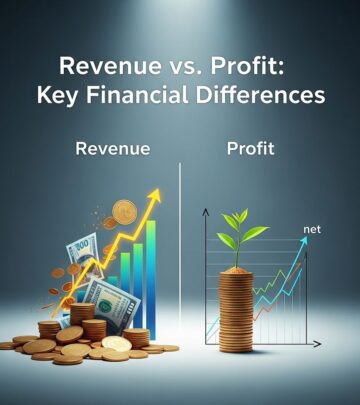
A common misconception is that revenue and profit are the same. However, they represent fundamentally different aspects of business finances. Revenue is the total income generated from sales of goods or services, while profit is what remains after all expenses are deducted from revenue. A company can have high revenue but low or negative profit if its expenses exceed its revenue. For example, a retail company might generate $10 million in revenue but only $500,000 in net profit if operating costs are high.
Profit Margin Analysis
Profit margins are expressed as percentages and provide normalized metrics for comparing profitability across companies of different sizes and industries. The three primary profit margins are:
- Gross Profit Margin: (Gross Profit ÷ Revenue) × 100 – Indicates production efficiency
- Operating Profit Margin: (Operating Profit ÷ Revenue) × 100 – Shows operational efficiency
- Net Profit Margin: (Net Profit ÷ Revenue) × 100 – Reveals overall profitability
Comparing profit margins across years helps identify trends in business performance. Declining margins may indicate increasing costs, competitive pressures, or operational inefficiencies requiring management attention.
Factors Affecting Profit
Multiple internal and external factors influence a company’s profit:
- Pricing Strategy: Higher prices increase revenue but may reduce sales volume and customer demand.
- Cost Management: Controlling production and operating costs directly improves profit margins.
- Production Efficiency: Streamlined operations reduce COGS and improve gross profit.
- Market Conditions: Economic cycles, consumer demand, and competition affect both revenue and expenses.
- Tax Policy: Changes in tax rates directly impact net profit.
- Interest Rates: Higher debt interest payments reduce net profit.
- Supply Chain Disruptions: Unexpected cost increases can compress profit margins.
Profit and Business Strategy
Understanding profit dynamics helps businesses develop effective strategies. High-margin businesses prioritize product quality and brand positioning, while high-volume, low-margin businesses focus on operational efficiency and cost control. Some companies intentionally operate with lower margins to capture market share, while others prioritize margin expansion to maximize shareholder value.
Investors use profit analysis to evaluate management effectiveness, competitive positioning, and growth prospects. Consistently improving profit margins suggest strong management and sustainable competitive advantages, while declining margins may indicate challenges requiring strategic adjustments.
Frequently Asked Questions
Q: What is the difference between profit and earnings?
A: Profit and earnings are often used interchangeably, but earnings typically refers to net income from continuing operations, while profit can refer to gross, operating, or net profit depending on context.
Q: How can a company have revenue but no profit?
A: A company has revenue but no profit when expenses exceed revenue. This occurs when COGS and operating expenses are very high relative to sales, resulting in a loss rather than profit.
Q: Why do some profitable companies still fail?
A: Profitable companies can fail due to cash flow problems, excessive debt, poor management decisions, rapid market changes, or inability to adapt to technological disruption, even with positive accounting profits.
Q: How do taxes affect profit?
A: Taxes reduce net profit by requiring companies to pay a percentage of pretax profit to government authorities. The tax rate varies by jurisdiction and company structure, directly impacting bottom-line profitability.
Q: What is a healthy profit margin?
A: Healthy profit margins vary by industry. Retail typically operates at 2-5% net margins, technology at 10-20%, and luxury goods at 30%+. Comparing margins to industry peers provides better context than absolute figures.
Q: How do depreciation and amortization affect profit?
A: Depreciation and amortization are non-cash charges that reduce operating and net profit without affecting cash flow directly. They represent the allocation of asset costs over their useful lives.
Key Takeaways
- Profit is revenue minus all expenses, taxes, and interest, representing true business financial success.
- Gross profit measures production efficiency, operating profit shows operational performance, and net profit indicates overall profitability.
- Profit margins expressed as percentages allow meaningful comparison across companies and industries.
- Understanding profit dynamics is essential for investors evaluating company performance and management quality.
- Multiple factors including pricing, costs, market conditions, and taxes influence profit outcomes.
References
- Financial Accounting Standards Board (FASB) Accounting Standards Codification — FASB. 2024. https://asc.fasb.org/
- Corporate Finance Institute: Net Profit Margin — CFI Education Inc. 2024. https://corporatefinanceinstitute.com/resources/accounting/net-profit-margin/
- U.S. Securities and Exchange Commission: Beginners’ Guide to Financial Statements — SEC. 2024. https://www.sec.gov/investor/basics/basics-financial-statements.html
- International Financial Reporting Standards (IFRS) — IFRS Foundation. 2024. https://www.ifrs.org/
- American Institute of Certified Public Accountants (AICPA) Resources — AICPA. 2024. https://www.aicpa.org/
Similar Articles








Read full bio of Sneha Tete