Production Possibility Frontier: Definition and Examples
Understanding economic trade-offs and resource allocation through the production possibilities frontier.
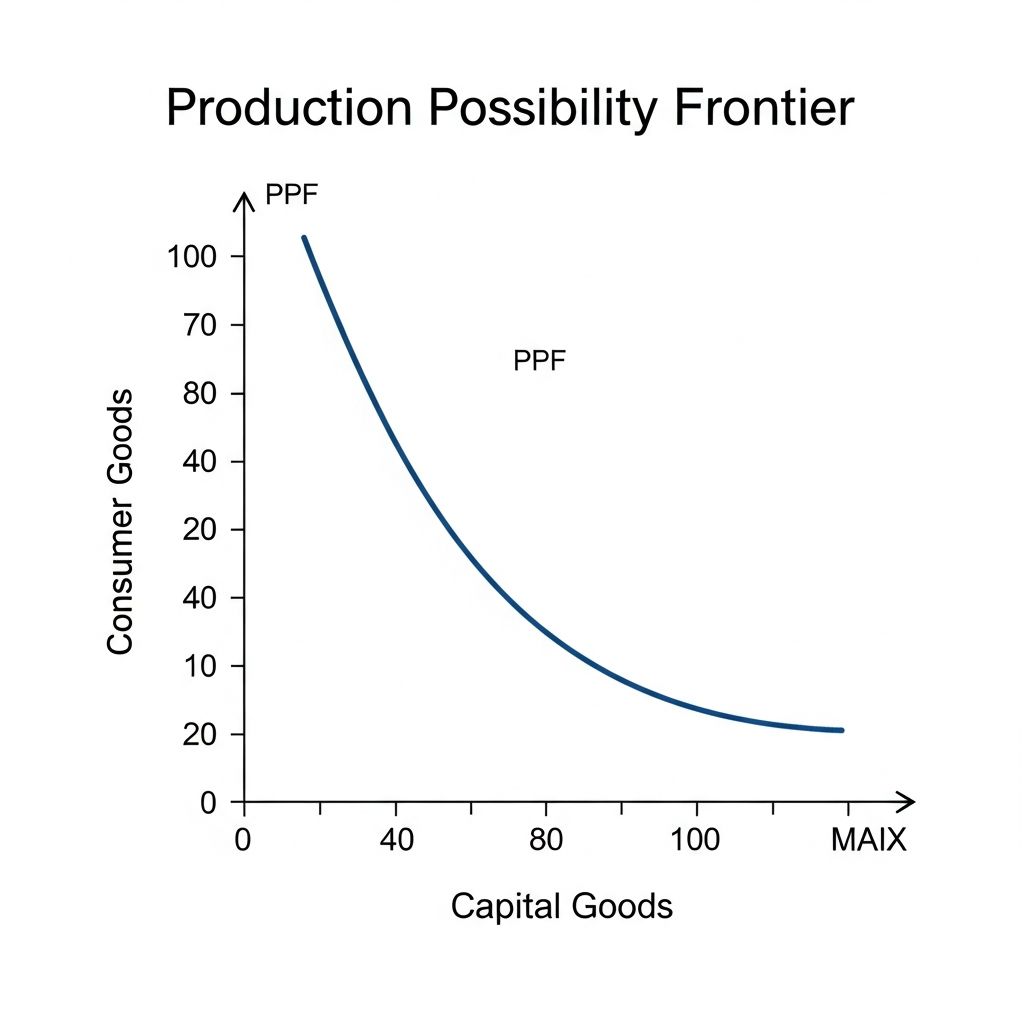
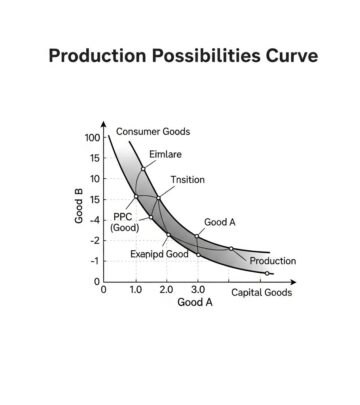
The production possibility frontier (PPF), also known as the production possibility curve (PPC) or production possibility boundary (PPB), is a fundamental concept in microeconomics that illustrates the maximum combinations of two goods or services an economy can produce given its available resources and current technology. This graphical representation serves as a powerful tool for understanding how societies face the persistent challenge of scarcity and must make strategic decisions about resource allocation.
In essence, the PPF demonstrates that every economy has finite resources—including labor, capital, land, and raw materials—and these resources can be allocated in various ways to produce different goods and services. The frontier line itself represents all the possible combinations of two products that can be produced when an economy operates at maximum efficiency, utilizing all available resources effectively.
Understanding the Production Possibilities Frontier
At its core, the PPF concept recognizes a fundamental economic truth: scarcity is inescapable. Because resources are limited, no economy can produce unlimited quantities of every good or service. Instead, decision-makers—whether they are businesses, households, or entire nations—must make choices about what to produce and in what quantities.
The PPF visually displays these choices on a two-dimensional graph, typically with one good represented on the horizontal axis and another on the vertical axis. Points along the frontier itself represent combinations of goods that can be produced when all resources are fully employed and utilized efficiently. This assumes what economists call “full employment,” where no resources remain idle and no inefficiencies exist in the production process.
Consider a simplified economy that produces only two goods: carrots and potatoes. If the economy dedicates 100% of its labor and capital to carrot production, it might manufacture 500 units. Similarly, if it devotes all resources to potato production, it could produce 500 units. However, if the economy wishes to produce both goods—as most real-world economies do—it must operate somewhere along the PPF, making trade-offs between carrot and potato production.
Key Economic Concepts Illustrated by the PPF
The production possibilities frontier effectively demonstrates several important economic principles that are central to understanding how modern economies function:
Opportunity Cost
One of the most significant concepts the PPF illustrates is opportunity cost—the value of the next best alternative foregone when making a choice. When an economy produces more of one good, it must necessarily reduce production of another good, assuming resources remain constant. For instance, if an economy increases carrot production by one unit, it must sacrifice the production of one unit of potatoes due to limited resources. This direct trade-off is visibly represented by the slope of the PPF curve, demonstrating that every production decision has a measurable cost in terms of foregone alternatives.
Resource Scarcity
The PPF fundamentally acknowledges that resources are scarce relative to unlimited wants and needs. This scarcity is the foundation of all economic problems and necessitates difficult choices about allocation. The curve itself represents the boundary between what is possible and what is impossible given current constraints. Resources cannot simply be increased at will; they are limited, and this limitation shapes all economic decisions.
Allocative Efficiency
Allocative efficiency refers to the optimal distribution of resources among different producers or goods, ensuring that society produces the combination of goods most valued by consumers. Points on the PPF represent allocatively efficient outcomes when the production mix aligns with consumer preferences and societal priorities. When an economy produces on the frontier, it achieves this balance, though the specific point depends on what society values most.
Productive Efficiency
Productive efficiency occurs when an economy cannot increase output of one good without decreasing output of another good, given current resources and technology. All points on the PPF frontier represent productive efficiency because no more of any good can be produced without sacrificing production of another good. In contrast, points inside the frontier represent productive inefficiency, where resources are underutilized or used wastefully.
Interpreting Points on and Around the PPF
Understanding what different points on a PPF graph represent is crucial for economic analysis:
Attainable Points
Points that lie on or below the production possibilities frontier are considered attainable or achievable. These combinations of goods can actually be produced with the currently available resources and existing technology. If an economy is operating on the frontier itself, it is producing efficiently. If it operates inside the frontier, the combination is attainable but represents inefficient production—the economy is not making full use of its available resources.
Unattainable Points
Points that lie above or to the right of the PPF are unattainable, meaning these combinations cannot be produced with current resources and technology. They represent production levels that exceed the economy’s current capacity. While these points are impossible under present conditions, they can become attainable through economic growth, technological advancement, or increases in available resources over time.
Inefficient Production
When an economy produces at a point strictly inside the frontier, it is operating inefficiently. This might occur due to unemployment, underutilized capital, or wasteful production methods. In such cases, the economy could produce more of at least one good without sacrificing production of any other good. Efficiency improvements would shift production toward the frontier line.
How the PPF Shifts Over Time
The PPF is not static; it changes over time in response to various economic factors. Understanding what causes these shifts is essential for analyzing long-term economic growth and development.
Outward Shifts (Economic Growth)
An outward or rightward shift of the PPF represents economic growth—the economy’s increased capacity to produce both goods. Several factors can cause this positive shift:
- Increased Production Factors: Growth in the labor force (population increase or increased workforce participation), accumulation of capital (machinery, factories, infrastructure), or discovery of new natural resources expands productive capacity. When an economy has more inputs available, it can produce greater quantities of output at any point along the frontier.
- Technological Progress: Advances in technology that allow goods to be produced with fewer inputs or greater efficiency shift the PPF outward. When new production methods, tools, or innovations are developed, the economy’s effective resources increase. The same amount of labor and capital can now produce more output, effectively enhancing purchasing power and productive capability.
- Improved Infrastructure and Education: Better infrastructure and a more educated workforce enhance productivity and can shift the frontier outward by enabling more efficient production.
Inward Shifts (Economic Contraction)
Conversely, the PPF can shift inward or leftward, representing a decrease in the economy’s productive capacity. This occurs when:
- Resource Depletion: A decrease in available production factors—such as high unemployment reducing effective labor, depletion of natural resources, or destruction of capital through natural disasters—causes the frontier to retreat inward. When earthquakes, wars, or other catastrophic events destroy productive infrastructure and capital, the economy’s maximum output capacity diminishes.
- Technological Regression: While rare in modern history since technology generally improves over time, theoretical declines in technological knowledge could cause inward PPF shifts. However, such regressions are extremely unlikely in practice due to the cumulative nature of technological progress.
- Economic Downturns: During periods of high unemployment and limited money supply, the frontier may retreat inward as productive resources are not fully utilized or become damaged.
Real-World Applications of the PPF
While the PPF is a simplified economic model typically representing just two goods, its principles extend to real-world economic decision-making:
Government Policy
Governments use PPF concepts when deciding how to allocate budgets between defense and social services, infrastructure and education, or environmental protection and economic development. These choices reflect movement along or between different PPF curves as priorities shift.
Business Resource Allocation
Companies face PPF-like constraints when deciding how to allocate capital between different product lines, research and development, or current production versus future expansion. Every resource devoted to one product means fewer resources available for another.
International Trade
Nations can transcend their individual PPF constraints through international trade. By specializing in goods where they have comparative advantage and trading with other nations, countries can collectively achieve consumption combinations that lie beyond what any single nation could produce alone. This is a powerful demonstration of how trade creates mutual benefits.
Assumptions and Limitations of the PPF Model
While the production possibilities frontier is a valuable analytical tool, it operates under specific assumptions that limit its real-world applicability:
- The model assumes only two goods are produced, though real economies produce countless products
- It assumes resources are perfectly divisible and can be easily shifted between production of different goods
- The model assumes technology and resources remain constant during the period analyzed
- It assumes full employment of all resources
- The model does not account for transaction costs or inefficiencies in resource reallocation
Despite these limitations, the PPF remains invaluable for teaching fundamental economic concepts and analyzing how economies allocate scarce resources.
Frequently Asked Questions (FAQs)
Q: What does a point inside the PPF curve represent?
A: A point inside the PPF curve represents an attainable but inefficient combination of goods. The economy can produce this combination, but it is not utilizing all available resources efficiently. The economy could produce more of at least one good without sacrificing production of any other good by moving toward the frontier.
Q: How does technological advancement affect the PPF?
A: Technological advancement shifts the PPF outward (to the right), allowing the economy to produce more of both goods. New technologies enable production with fewer inputs or greater efficiency, effectively increasing the economy’s productive capacity and economic growth potential.
Q: Can an economy operate outside its PPF?
A: No, an economy cannot operate at production levels above its PPF with current resources and technology. However, through international trade, an economy can consume combinations of goods that lie outside its individual PPF by specializing in production where it has comparative advantage and trading for other goods.
Q: Why is the PPF curve typically curved rather than straight?
A: The PPF is usually curved because resources are not equally suited to producing all goods. As an economy shifts resources from producing one good to another, it must use increasingly less-suited resources, requiring greater sacrifice. This creates an increasing opportunity cost, resulting in a curved rather than straight frontier.
Q: What is the difference between productive efficiency and allocative efficiency?
A: Productive efficiency means producing the maximum output from available resources, represented by points on the PPF. Allocative efficiency means producing the specific combination of goods that best satisfies consumer preferences and societal needs. A point on the PPF can be productively efficient but not allocatively efficient if it doesn’t match what society actually wants to consume.
References
- Production Possibilities Frontier (PPF) – Purpose, Uses — Corporate Finance Institute. Accessed November 2025. https://corporatefinanceinstitute.com/resources/economics/production-possibilities-frontier/
- Production–possibility frontier — Wikimedia Foundation (referencing peer-reviewed economics sources). Accessed November 2025. https://en.wikipedia.org/wiki/Production%E2%80%93possibility_frontier
- Production Possibilities Frontier (PPF) – Introduction and Productive Efficiency — Pearson Education. Accessed November 2025. https://www.pearson.com/channels/microeconomics/learn/brian/ch-2-introductory-economic-models/production-possibilities-frontier-ppf-introduction-and-productive-efficiency
- The Production Possibilities Frontier and Social Choices — Khan Academy. Accessed November 2025. https://www.khanacademy.org/economics-finance-domain/microeconomics/basic-economic-concepts-gen-micro/production-possibilities/a/the-production-possibilities-frontier-and-social-choices-cnx-2
- Economics 101: What Is the Production Possibility Frontier? — MasterClass. Last updated October 12, 2022. https://www.masterclass.com/articles/economics-101-what-is-the-production-possibility-frontier
Similar Articles








Read full bio of medha deb