Production Possibilities Curve: Definition, Explanation & Examples
Master the Production Possibilities Curve: Learn how economies allocate scarce resources efficiently.
What Is the Production Possibilities Curve?
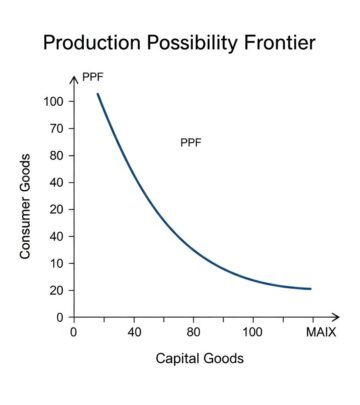
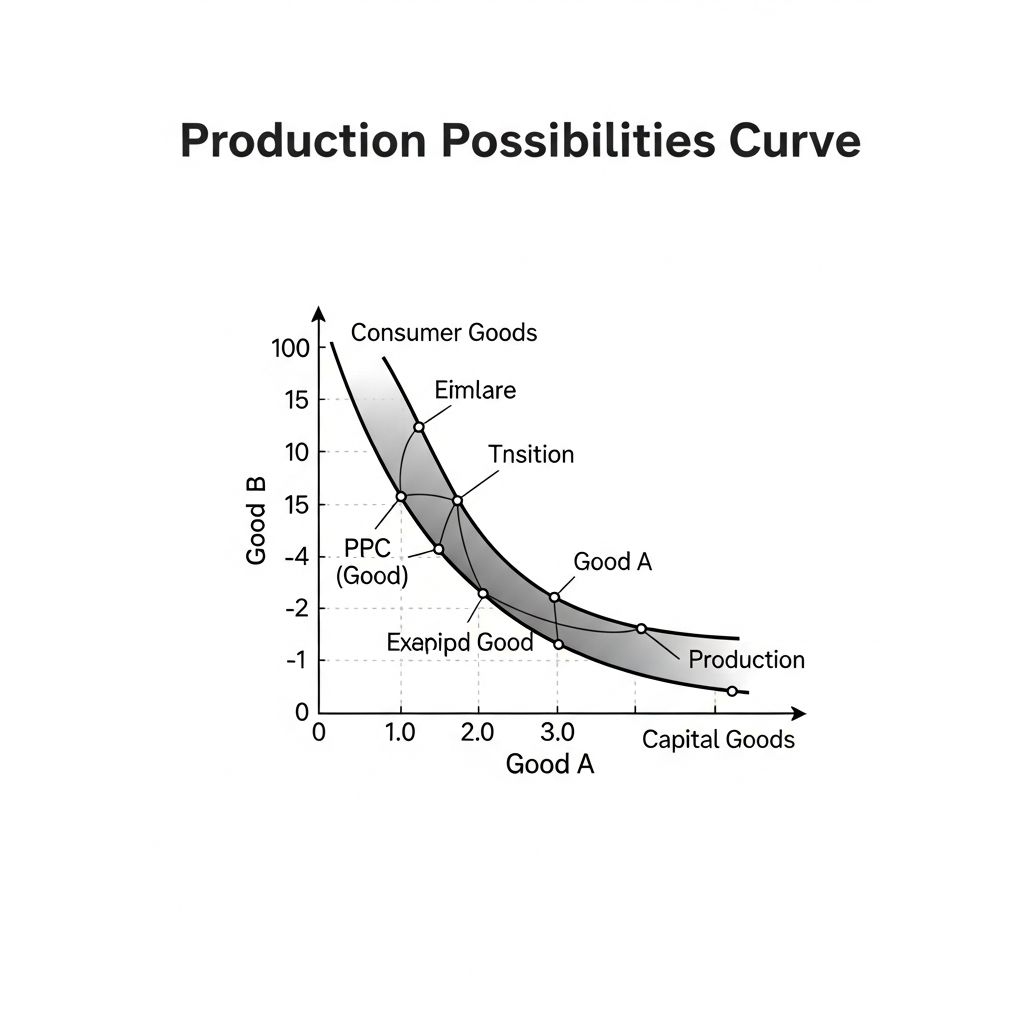
The Production Possibilities Curve, often abbreviated as PPC or PPF (Production Possibilities Frontier), is a fundamental economic model that graphically represents the maximum combinations of two goods or services an economy can produce when all available resources are fully and efficiently utilized. This essential tool in microeconomics helps policymakers, economists, and students understand the critical concept of scarcity and the tradeoffs that every society must make when allocating limited resources.
At its core, the Production Possibilities Curve illustrates a critical economic reality: because resources are finite, an economy cannot produce unlimited quantities of goods and services. Instead, economies must make strategic choices about how to allocate labor, capital, natural resources, and entrepreneurship to maximize production efficiency. The curve shows every possible combination of two goods that an economy could theoretically produce given its current level of technology and resource availability.
Understanding the Basics of PPC
To fully grasp the Production Possibilities Curve, it’s important to understand the fundamental assumptions economists make when constructing this model. First, the model assumes an economy produces only two goods or categories of goods—for example, consumer goods versus capital goods, or food versus clothing. While real economies produce thousands of products, this simplified two-good framework makes the concept easier to visualize and understand.
Second, the model assumes that the quantities of factors of production and the available technology remain constant during the time period being analyzed. This means that the labor force, capital stock, natural resources, and technological knowledge are fixed. Under these conditions, the curve represents the maximum sustainable production level for any combination of the two goods.
Third, the model assumes that all resources are being used fully and efficiently. This is a crucial assumption because it establishes the theoretical maximum production frontier. If resources are idle or inefficiently allocated, the economy would operate inside the curve rather than on it.
The Shape and Characteristics of the Production Possibilities Curve
The Production Possibilities Curve typically has a distinctive bowed-out or concave shape when viewed from the origin. This curved shape, rather than a straight line, reflects an important economic principle known as the law of increasing opportunity costs. Understanding why the curve has this shape is essential to grasping how real economies function.
The curve slopes downward from left to right, which visually represents the fundamental economic principle of scarcity. As you move along the curve from one endpoint to the other, producing more of one good requires producing less of the other. The downward slope illustrates that tradeoffs are inevitable in any economic system.
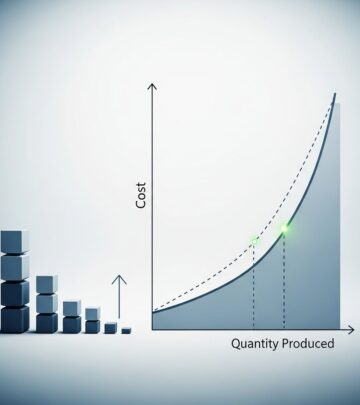
The bowed-out shape occurs because resources are not equally suited to producing both goods. Some labor, capital, and natural resources are better adapted for producing one good, while other resources are better suited for the other good. As an economy specializes based on comparative advantage, it can allocate its most efficient resources to each good. However, as production of one good increases, the economy must eventually shift less efficient resources away from the other good, causing opportunity costs to increase.
Key Economic Concepts Demonstrated by the PPC
The Production Possibilities Curve is a powerful educational tool because it illustrates several fundamental economic concepts simultaneously:
Opportunity Cost
Every point on the Production Possibilities Curve demonstrates opportunity cost—the value of the next best alternative foregone when making a choice. If an economy decides to produce more food, it must accept producing less clothing. The amount of clothing that must be given up to produce additional food represents the opportunity cost of that food production. Because of increasing opportunity costs, this tradeoff becomes more pronounced as the economy specializes further in one good.
Productive Efficiency
Points located directly on the Production Possibilities Curve represent productive efficiency. When an economy operates on the curve, it is using its resources in the most effective way possible—it cannot produce more of one good without producing less of another. This is the hallmark of productive efficiency and represents the economy’s best performance given current constraints.
Resource Scarcity
The very existence of the Production Possibilities Curve demonstrates the fundamental economic problem of scarcity. The curve’s boundary shows that resources are limited and that choices must be made. An economy cannot exist at a point beyond the curve because resources simply don’t exist to support such production levels.
Allocative Efficiency
The Production Possibilities Curve helps illustrate allocative efficiency—the optimal distribution of resources among different goods and services based on consumer preferences and societal priorities. Different points along the curve represent different allocation choices, each potentially optimal depending on what society values most.
Interpreting Points on, Inside, and Outside the Curve
The Production Possibilities Curve divides production possibilities into three distinct regions, each with important economic implications:
Points on the Curve
Any point located directly on the Production Possibilities Curve represents an efficient and attainable production combination. At these points, the economy is achieving productive efficiency—all resources are being fully utilized, and no resources are sitting idle or being wasted. Moving from one point on the curve to another represents a shift in production priorities, such as a shift from producing more consumer goods to producing more capital goods. This movement demonstrates the tradeoff between the two goods.
Points Inside the Curve
Points located inside the Production Possibilities Curve represent inefficient production combinations. When an economy operates inside the curve, it means that some resources are either idle or being inefficiently allocated. Perhaps there is unemployment, underemployment, or resources are being wasted. Importantly, an economy operating inside the curve could produce more of both goods without acquiring additional resources by simply using existing resources more efficiently. This represents a clear waste of productive potential.
Points Outside the Curve
Points located outside the Production Possibilities Curve represent production combinations that are currently impossible to achieve. With the existing quantity and quality of resources and current technology, an economy simply cannot reach these production levels. These unattainable points represent the constraint that scarcity imposes on economic activity. However, points outside the curve can become attainable in the future if the economy experiences economic growth through increased resources or technological advancement.
Economic Growth and Shifts in the Production Possibilities Curve
While the Production Possibilities Curve represents production possibilities at a fixed point in time with fixed resources and technology, the curve itself can shift outward or inward over time. Understanding what causes these shifts is crucial to understanding economic growth and decline.
Outward Shifts: Economic Growth
The Production Possibilities Curve shifts outward when an economy’s productive capacity increases. This can occur through several mechanisms: an increase in the quantity of available resources (such as population growth expanding the labor force), an improvement in the quality of resources (better education and training improving labor productivity), technological advancement (new machinery or production techniques), or improvements in institutional structures. When the curve shifts outward, the economy can produce more of both goods than before, representing genuine economic growth and improved living standards.
Inward Shifts: Economic Decline
The Production Possibilities Curve can also shift inward, representing a decrease in the economy’s productive capacity. This occurs when there is a reduction in resources (such as emigration reducing the labor force), a decline in resource quality (deterioration of infrastructure or loss of human capital), technological regression (loss of knowledge or destruction of capital), or institutional deterioration. Natural disasters, wars, epidemics, or poor policy decisions can all cause inward shifts of the curve.
Asymmetric Shifts
Sometimes the Production Possibilities Curve shifts asymmetrically, with one end moving outward more than the other. This occurs when technological advancement or resource increases benefit one industry more than another. For example, improved agricultural technology would shift the food production endpoint outward more than the clothing endpoint, reflecting that society can now produce significantly more food while the clothing production capacity remains relatively unchanged.
Comparative Advantage and Specialization
The Production Possibilities Curve is intimately connected to the economic principles of comparative advantage and specialization. The bowed-out shape of the curve results from the optimal allocation of resources based on comparative advantage. Different regions, firms, or workers have different efficiencies in producing different goods.
By specializing in the production of goods where they have a comparative advantage—meaning they can produce at a lower opportunity cost than others—economies can achieve production levels that lie on or near the production possibilities curve. When specialization is practiced, total production increases, and trade allows all parties to consume beyond what they could produce alone. This demonstrates why international trade and regional specialization are economically beneficial.
Real-World Applications of the Production Possibilities Curve
While the Production Possibilities Curve is a simplified model, it has numerous real-world applications:
Government Policy Decisions
Governments use production possibilities analysis when deciding resource allocation between different sectors. For example, a government might use PPC concepts when deciding between spending on military defense or social programs, or between investing in infrastructure versus education.
Business Resource Allocation
Companies use similar concepts when deciding how to allocate production resources between different product lines. A manufacturer might use these principles to determine optimal production levels for different products given limited factory capacity.
Environmental and Sustainability Planning
The Production Possibilities Curve can model tradeoffs between economic production and environmental protection, illustrating how societies must balance economic growth with sustainability concerns.
Trade and International Economics
PPC analysis forms the foundation for understanding international trade patterns and explaining why countries benefit from specialization and trade rather than attempting self-sufficiency.
Limitations of the Production Possibilities Curve Model
While the Production Possibilities Curve is an invaluable educational and analytical tool, it has important limitations. First, it oversimplifies reality by assuming only two goods when modern economies produce thousands of goods and services. Second, it assumes constant returns to scale and static technology, which doesn’t reflect the dynamic nature of modern economies. Third, it doesn’t account for how consumer preferences, income distribution, or market mechanisms determine which point on the curve an economy actually selects. Finally, the model assumes resources can be easily moved between sectors, which isn’t always realistic in practice due to friction and adjustment costs.
Frequently Asked Questions About the Production Possibilities Curve
Q: Why is the Production Possibilities Curve important in economics?
A: The PPC is crucial because it visually demonstrates fundamental economic concepts including scarcity, opportunity cost, efficiency, and tradeoffs. It helps explain why every society must make choices about resource allocation and why these choices have consequences.
Q: What does it mean when an economy operates inside the Production Possibilities Curve?
A: Operating inside the curve indicates inefficient production, meaning some resources are either unemployed or underutilized. The economy could produce more of both goods without acquiring additional resources by simply using existing resources more efficiently.
Q: How does technological improvement affect the Production Possibilities Curve?
A: Technological improvements shift the entire Production Possibilities Curve outward, increasing the maximum production possibilities for both goods. This represents economic growth and an expansion of productive capacity.
Q: Can a point outside the Production Possibilities Curve ever be achieved?
A: Not with current resources and technology. However, if an economy experiences economic growth through increased resources or technological advancement, the curve shifts outward, and previously impossible points become attainable.
Q: What is the relationship between the Production Possibilities Curve and opportunity cost?
A: Every point on the Production Possibilities Curve represents an opportunity cost. Moving from one point to another shows how much of one good must be sacrificed to produce more of another good. The slope of the curve at any point represents the opportunity cost of production.
Q: How does specialization relate to the Production Possibilities Curve?
A: The bowed-out shape of the PPC reflects comparative advantage and specialization. By allocating resources based on comparative advantage, economies can operate efficiently on or near their production possibilities frontier and benefit from trade with other specialized economies.
References
- The Production Possibilities Curve — eCampus Ontario. 2024. https://ecampusontario.pressbooks.pub/laboureconomics/chapter/2-2-the-production-possibilities-curve/
- The Production Possibilities Curve in Economics — Outlier Articles. 2024. https://articles.outlier.org/ppc-curve
- Production–possibility frontier — Wikimedia Foundation. 2024. https://en.wikipedia.org/wiki/Production%E2%80%93possibility_frontier
- Production Possibility Curve – IB Economics Revision Notes — Save My Exams. 2024. https://www.savemyexams.com/dp/economics/ib/22/sl/revision-notes/1-introduction-to-economics/1-1-what-is-economics/the-production-possibilities-curve-model-ppc/
- Complete Guide to the Production Possibilities Curve — ReviewEcon. 2024. https://www.reviewecon.com/production-possibilities-curve
- Opportunity cost & the production possibilities curve (PPC) — Khan Academy. 2024. https://www.khanacademy.org/economics-finance-domain/ap-macroeconomics/basic-economics-concepts-macro/production-possibilities-curve-scarcity-choice-and-opportunity-cost-macro/a/lesson-summary-opportunity-cost-and-the-ppc
Similar Articles








Read full bio of Sneha Tete