Probable Maximum Loss (PML): Definition & Calculation
Understanding PML: How insurers assess maximum potential losses from disasters.
Understanding Probable Maximum Loss (PML)
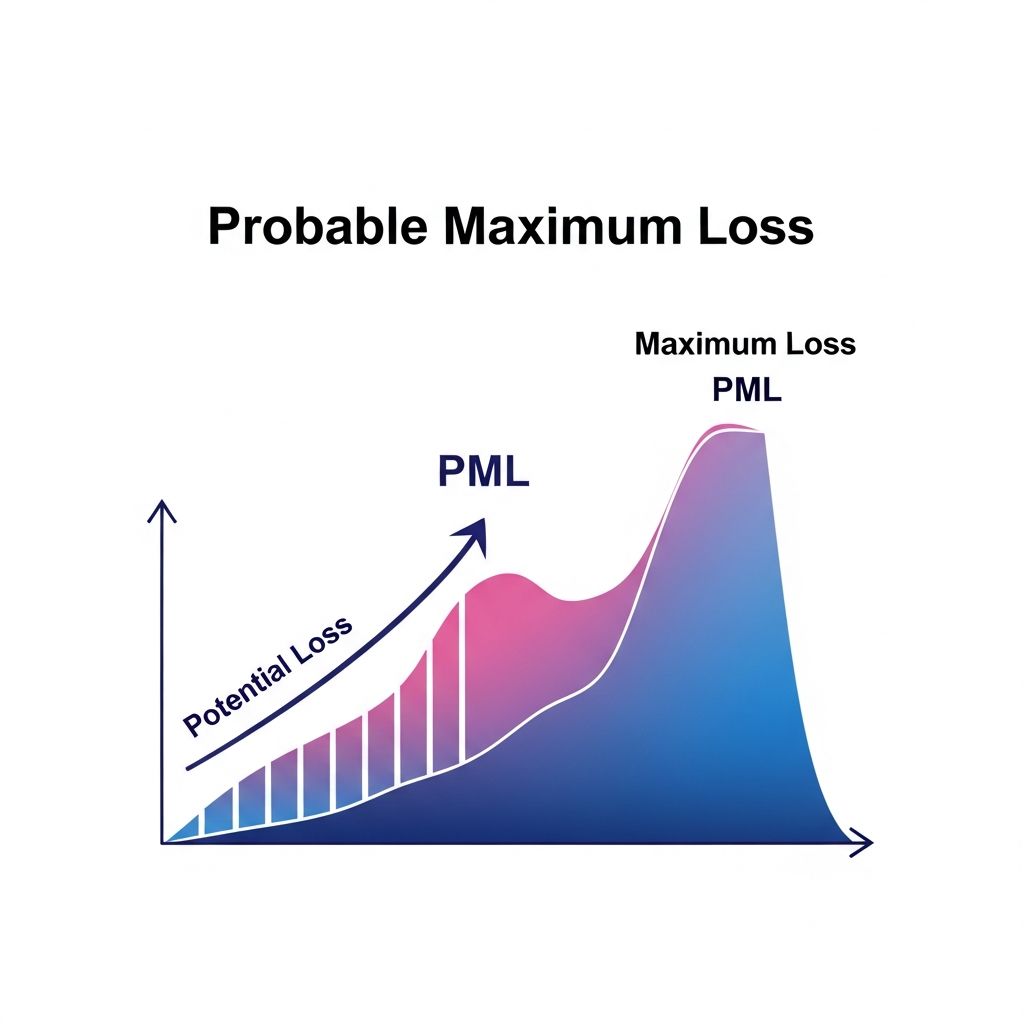
Probable Maximum Loss, commonly abbreviated as PML, is a critical concept in the insurance industry and commercial real estate sectors. It represents the largest financial loss that could reasonably occur from a specific disaster or peril, while assuming that passive protective features function normally and most active suppression systems operate as intended. Understanding PML is essential for insurance underwriters, risk managers, property owners, and real estate investors, as it directly influences underwriting decisions, premium calculations, and investment valuations.
The term “probable maximum loss” has evolved significantly since its inception in the 1970s, when crude loss estimation techniques were first developed to help underwriters and risk managers comprehend potential financial exposure from catastrophic events. Today, PML remains a cornerstone of modern insurance practices and real estate due diligence, though industry standards continue to evolve and refine how this metric is calculated and applied.
Defining Probable Maximum Loss
PML is generally defined as the value of the largest loss that could result from a disaster, assuming the normal functioning of passive protective features such as firewalls, nonflammable materials, and flood defenses, alongside the proper functioning of most active suppression systems like sprinkler systems and automated fire suppression equipment. This definition distinguishes PML from the Maximum Foreseeable Loss (MFL), which assumes the failure of all active protective features and typically represents a worst-case scenario.
In statistical and insurance terminology, PML can be more precisely defined as that proportion of the total value of a property or the limit of liability under an insurance contract that, with a specified probability, will equal or exceed the amount of loss from a particular peril or group of perils. This mathematical definition allows insurers to quantify risk more precisely and establish appropriate premium levels and retention limits.
The distinction between PML and MFL is important for risk managers to understand. While PML assumes that safety systems function as designed, MFL represents a true worst-case scenario where all protective mechanisms fail. Most insurance policies and underwriting guidelines reference PML rather than MFL because PML provides a more realistic assessment of exposure while accounting for the effectiveness of protective systems that are regularly maintained and tested.
Key Components of PML Assessment
Determining the PML for a specific property or risk requires gathering several critical pieces of information. Understanding these components helps stakeholders appreciate the complexity of loss estimation and why professional assessment is necessary.
Total Property Value: The first essential component is the total replacement value of the property at risk. This includes the building structure, contents, inventory, equipment, and any other assets that could be damaged or destroyed by the peril being evaluated.
Nature of the Peril: The specific peril or group of perils must be clearly identified. Different perils—such as fire, flood, earthquake, wind, or explosion—can produce vastly different maximum loss scenarios for the same property. Consequently, it is standard practice to determine separate PML values for each major peril and then select the largest for underwriting and risk management purposes.
Protective Features: Both passive and active protective systems must be inventoried and evaluated. Passive features include structural elements like firewalls, fire-resistant construction materials, and flood barriers. Active systems include sprinkler systems, fire detection and alarm systems, emergency response protocols, and suppression equipment. The condition, maintenance status, and reliability of these systems directly impact the PML calculation.
Historical Data and Exposure Factors: Historical loss data, industry statistics, building characteristics, occupancy patterns, maintenance records, and other exposure factors provide empirical foundation for PML estimates. These data points help analysts calibrate their assessments to reflect realistic loss potential rather than purely theoretical scenarios.
How PML Differs from Other Loss Measures
The insurance and risk management industries use several related but distinct metrics to quantify potential losses. Understanding how PML compares to these alternatives clarifies its specific role in underwriting and risk assessment.
| Loss Metric | Definition | Assumptions | Use Case |
|---|---|---|---|
| Probable Maximum Loss (PML) | Largest loss with passive features functioning and most active systems working | Realistic system performance | Standard underwriting decisions |
| Maximum Foreseeable Loss (MFL) | Largest loss assuming failure of all protective systems | Complete system failure | Worst-case scenario planning |
| Scenario Expected Loss (SEL) | Loss expected under typical scenarios with normal conditions | Average conditions | Modern ASTM-compliant assessments |
| Scenario Upper Loss (SUL) | Upper-bound loss under defined scenarios | Conservative but realistic | Seismic and catastrophic risk evaluation |
The emergence of new nomenclature reflects ongoing refinement in loss estimation methodologies. In 1999, the American Society for Testing and Materials (ASTM) produced Standard E2026 to standardize seismic loss estimation terminology and establish guidelines for review levels and reviewer qualifications. This standard was updated in 2016 and recommends transitioning away from the term “PML” toward more precisely defined metrics like SEL, SUL, and Probable Loss (PL). However, PML remains widely used in insurance underwriting and commercial real estate contexts.
The Role of PML in Insurance Underwriting
PML evaluations fundamentally influence underwriting decisions and shape how insurers manage their portfolios of risks. Underwriters use PML estimates to determine whether a risk falls within acceptable parameters, what premium should be charged, what policy limits should be offered, and whether reinsurance should be purchased to protect the insurer’s financial stability.
From an insurer’s perspective, the primary objective of determining PML for individual risks is to stabilize the overall claim results of their portfolio during each accounting period. Rather than accepting risks that could produce catastrophic losses, insurers establish target claim goals—either explicitly as specific monetary amounts or implicitly through target premium volumes and loss ratios. The PML assessment ensures that no single risk can adversely affect the insurer’s underwriting results by more than a specified acceptable amount.
This stability objective reflects the financial reality that insurers must maintain sufficient surplus capital to absorb adverse loss fluctuations. An insurer’s surplus size and its relationship to targeted claim amounts determine how much adverse fluctuation the insurer can safely absorb and what probability level must be maintained that maximum allowable losses will not be exceeded.
Importantly, accurate PML determinations alone do not guarantee portfolio stability. Insurers must also implement appropriate retention gradings across different classes of risks. This means that underwriters must carefully calibrate how much loss each individual insured retains versus how much the insurer assumes, ensuring that the portfolio as a whole remains stable and manageable.
PML in Commercial Real Estate and Seismic Assessment
In commercial real estate due diligence, PML assessments have become increasingly important for lenders, investors, and property owners. Seismic PML evaluations, in particular, are commonly performed in earthquake-prone regions according to ASTM Standard E2026-07 guidelines. These assessments typically are conducted by registered structural engineers and include on-site inspection or detailed building plan review.
Seismic loss estimation has evolved substantially since the 1980s, when initial methods like ATC-13 were developed. Modern seismic PML studies address two major components: loss estimation and building stability (including potential for collapse). The ASTM guidelines specify four investigation levels, designated Level 0 through Level 3, with Level 0 representing a desktop review and Level 3 representing an in-depth analysis. Current practice shows that most Level 0 reports provide loss estimation values but may not thoroughly address building stability concerns.
For chemical and petrochemical industries, PML estimation serves a specialized but critical function. Insurers and reinsurers worldwide use PML to estimate losses during events such as vapor cloud explosions (VCE) or high-pressure rupture (HPR). In these contexts, PML modeling accounts for the specific hazards and exposure factors unique to industrial facilities.
Methods for Measuring and Calculating PML
Several approaches exist for measuring and calculating PML, ranging from simple to highly sophisticated. The selection of methodology depends on available data, analytical resources, desired accuracy, and the complexity of the risk being evaluated.
Schedule Rating Approach: The simplest method involves examining variables included in insurance schedules and rating plans maintained by rating bureaus. This approach would theoretically benefit from centralized statistical databases where schedule-rating makeups for individual risks could be analyzed to derive PML estimates based on historical patterns and benchmark data.
Statistical Validation: A more rigorous approach involves recording the insurance PML percentage estimated by an underwriter for each risk, recording the actual percentage of loss to insured amount for each claim during a specified time period, calculating the error of estimate (actual percentage minus estimated percentage), and then analyzing the mean error and distribution of errors. This approach allows insurers to refine and validate their PML estimation processes over time.
Engineering Analysis: For seismic and specialized risks, detailed engineering studies may be required. These analyses incorporate building design specifications, material properties, soil conditions, historical performance data, and sophisticated modeling techniques to estimate loss potential under defined scenarios.
The trend in modern practice favors increasingly sophisticated methodologies as data availability improves and analytical tools become more powerful. Even if currently only simpler and less accurate methods are feasible, forward-looking organizations recognize that more accurate methods can be substituted as capabilities develop.
Standards and Evolution of PML Terminology
The insurance and engineering communities have recognized that inconsistent definitions and terminology surrounding PML have created confusion and hindered standardization across the industry. This realization prompted the development of more precise guidelines and nomenclature.
Before standardization efforts, different lenders and property owners applied varying risk tolerances, leading to inconsistent “PML” definitions and policies that lacked precision and comparability. This lack of standards made it difficult for market participants to communicate risk assessments clearly and compare properties on an equivalent basis.
The ASTM E2026 standard, originally produced in 1999 and updated in 2016, represents a major step toward standardization. The standard recommends discontinuing use of the imprecise term “PML” in favor of more clearly defined metrics: Scenario Expected Loss (SEL), Scenario Upper Loss (SUL), and Probable Loss (PL). These new terms provide more explicit guidance on the assumptions and confidence levels underlying each estimate.
Despite these standardization efforts, the term PML remains deeply embedded in insurance industry practice and commercial real estate convention. Many underwriters, brokers, and property professionals continue using PML terminology while incorporating elements of the newer ASTM-recommended approaches into their actual analytical practices.
Practical Applications and Implications
Understanding PML has direct practical implications for multiple stakeholder groups. Property owners and risk managers use PML estimates to determine appropriate insurance coverage levels and evaluate whether additional risk mitigation measures would be cost-effective. Insurance brokers reference PML in selecting appropriate insurers and negotiating policy terms. Lenders and real estate investors use PML in due diligence processes to assess the financial viability of proposed acquisitions or refinancings.
A building with a high PML relative to its market value may face higher insurance premiums, difficulty obtaining coverage, or requirements to implement additional protective measures before insurance becomes available. Conversely, buildings with low PML values due to superior protective systems and construction quality may benefit from favorable insurance terms and increased marketability to cautious investors.
For insurers, PML drives fundamental underwriting and capital management decisions. Accumulated PML values across an insurer’s entire portfolio must be managed carefully to ensure that no single catastrophic event could deplete the insurer’s surplus and threaten its financial stability. Many insurers accumulate catastrophe loadings or maintain dedicated catastrophe reserves based partly on aggregate PML estimates.
Frequently Asked Questions
What is the difference between PML and Maximum Foreseeable Loss?
PML assumes normal functioning of passive protective features and proper operation of most active suppression systems, while Maximum Foreseeable Loss (MFL) assumes failure of all protective systems. PML represents a realistic scenario, while MFL represents a true worst-case scenario.
Who typically conducts PML assessments?
PML assessments are usually conducted by insurance underwriters, registered structural engineers, risk assessment professionals, and specialized consultants with relevant expertise. The qualification requirements depend on the type of assessment and applicable industry standards.
How often should PML assessments be updated?
PML assessments should be updated whenever significant changes occur to the property, its protective systems, occupancy, or surrounding conditions. Many properties benefit from periodic reassessment every 3-5 years to ensure estimates remain current and accurate.
Can PML be zero?
PML could theoretically equal zero for properties with comprehensive passive and active protective systems that can completely prevent loss from a specific peril, though this scenario is extremely rare. More commonly, PML represents a small percentage of total property value.
How does PML affect insurance premiums?
Higher PML values typically result in higher insurance premiums because the insurer faces greater potential exposure from a single loss event. Properties with lower PML values due to superior protective systems generally qualify for more favorable premium rates.
References
- IS “PROBABLE MAXIMUM LOSS” (PML) A USEFUL CONCEPT? — Casualty Actuarial Society. 1969. https://www.casact.org/sites/default/files/database/proceed_proceed69_69031.pdf
- Probable maximum loss — ASTM International Standards Committee on Building Performance. 2016. https://en.wikipedia.org/wiki/Probable_maximum_loss
Similar Articles








Read full bio of medha deb