Pro Rata: Definition, Formula & Real-World Applications
Master pro rata calculations: Learn how proportional allocation works across investments, insurance, and business.
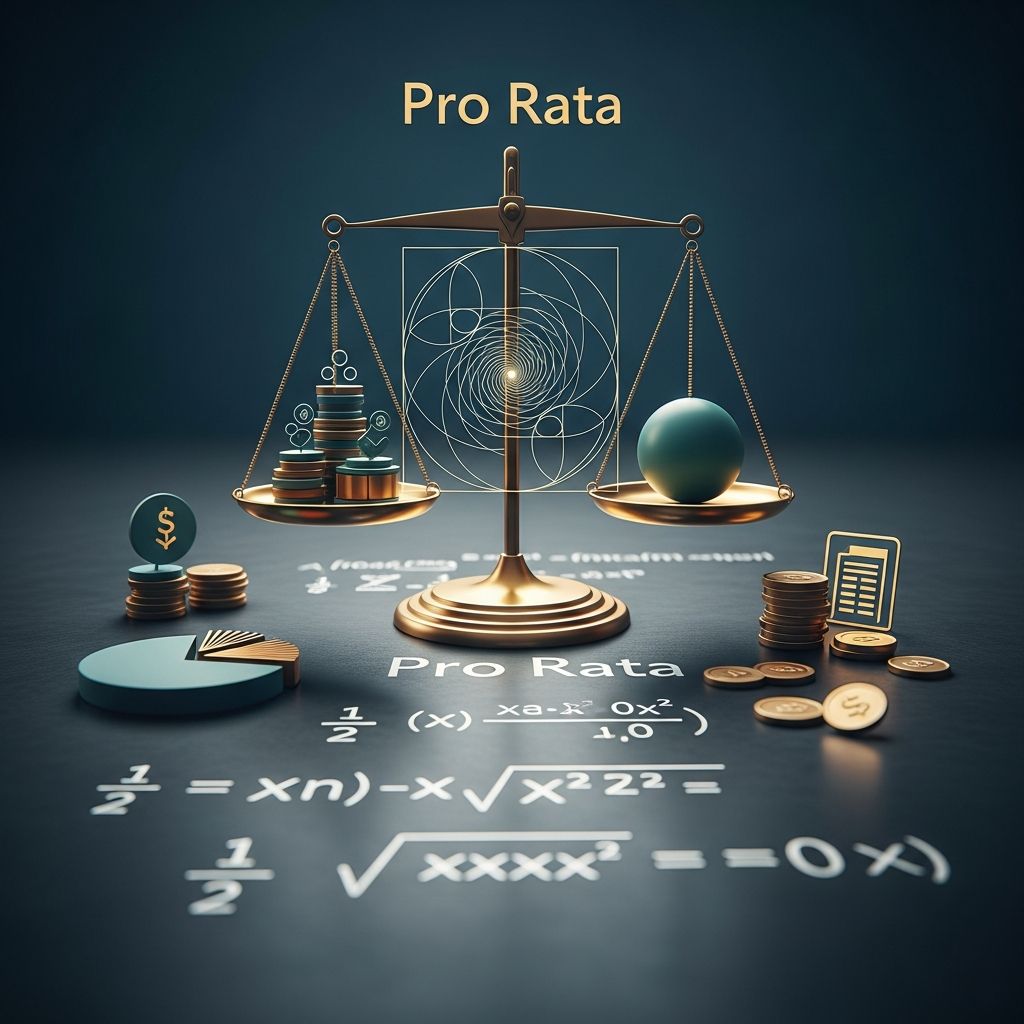
Pro rata is a Latin term meaning “according to the share” or “in proportion.” In modern financial and legal contexts, it refers to the practice of allocating something proportionally based on a specific factor or time period. Whether you’re dealing with investments, insurance premiums, employee benefits, or corporate dividends, understanding pro rata calculations is essential for accurate financial management and fair distribution of assets or obligations.
Understanding Pro Rata: The Basics
The term pro rata has Latin origins, derived from “pro” (meaning according to or by) and “rata” (meaning calculated or determined). When something is distributed pro rata, it means each party receives an amount that corresponds proportionally to their share, investment, or involvement.
In practical terms, pro rata allocation ensures fairness by distributing amounts in direct proportion to predefined criteria. This could be based on ownership percentage, time worked, days in a policy period, or any other measurable factor. The fundamental principle is that everyone receives a fair share relative to their contribution or involvement.
The Pro Rata Formula
The basic pro rata calculation follows a straightforward mathematical approach:
Pro Rata Share = (Individual Factor / Total Factor) × Total Amount
For example, if a company has three shareholders owning 30%, 50%, and 20% of shares respectively, and declares a $100,000 dividend, each shareholder would receive their pro rata share: $30,000, $50,000, and $20,000 respectively.
Pro Rata in Investment and Corporate Finance
In the corporate world, pro rata is commonly used in several contexts:
Dividend Distribution
When a company distributes dividends, each shareholder receives an amount proportional to their shareholding. A pro-rata dividend ensures that every shareholder gets an equal proportion for each share owned, maintaining fairness among investors regardless of the total number of shares held.
Stock Splits and Rights Offerings
During stock splits or rights offerings, shareholders are granted new shares or purchase opportunities on a pro rata basis. This maintains each shareholder’s percentage ownership in the company and prevents dilution of existing stakes.
Venture Capital and Private Equity
In venture capital financing, investors often have pro-rata participation rights, meaning they have the right to continue participating in future funding rounds to maintain their ownership percentage. This protection allows early investors to prevent dilution in subsequent investment rounds.
Bankruptcy Proceedings
When a company enters bankruptcy, remaining assets are typically distributed to creditors on a pro rata basis. If a debtor is insolvent, creditors generally agree to accept a pro rata share of what is owed to them. The remaining funds are divided proportionately among creditors according to the amount of individual debts owed to each creditor of the same class.
Pro Rata in Insurance
Insurance companies frequently use pro rata calculations in multiple scenarios:
Premium Adjustments
When an insurance policy period changes or coverage is modified mid-term, insurance premiums are often adjusted on a pro rata basis. If an annual policy costs $1,200 but coverage begins six months into the year, the policyholder pays approximately $600 for that half-year of coverage.
Return Premiums and Cancellations
When an insurance policy is cancelled, the return premium is calculated using a pro rata method. A return premium factor is calculated by dividing the number of days remaining in the policy period by the total number of days in the policy. This factor is then multiplied by the policy premium to determine the return amount. This calculation is sometimes referred to as a “wheel calculation.”
Risk Allocation
Insurance companies use pro rata calculations to determine risk based on the time an insurance policy is in effect. This method ensures that policyholders pay only for the coverage period they’re protected.
Proportional Liability
In cases where multiple parties are responsible for a loss or accident, pro rata liability allocation determines each party’s responsibility based on their degree of fault or contribution to the incident.
Pro Rata in Employment and Payroll
Employees regularly encounter pro rata calculations in their compensation and benefits:
Part-Time Compensation
Part-time employees typically receive wages calculated on a pro rata basis. If a full-time position offers an annual salary of $40,000 and benefits, a half-time employee in the same role would receive approximately $20,000 annually, plus a proportional share of benefits.
Overtime and Bonuses
Overtime pay and performance bonuses are often calculated pro rata, especially for employees who join or leave mid-year or those working irregular schedules.
Paid Time Off and Leave
Annual leave, vacation time, and sick leave are frequently allocated pro rata based on hours worked or tenure. Under US Federal regulations, when an employee’s service is interrupted by a non-leave earning period, leave is earned on a pro rata basis for each fractional pay period within the continuity of employment. Similarly, under British employment law, the pro rata principle applies to holiday entitlements for part-time workers.
Pension and Retirement Benefits
Pension benefits for employees who work less than full-time or leave early may be calculated on a pro rata basis, ensuring they receive a fair portion of their earned retirement benefits.
Pro Rata in Real Estate and Property Management
Real estate transactions frequently involve pro rata calculations:
Rent and Utilities
When tenants move in or out mid-month, rent is often charged on a pro rata basis. Similarly, utility costs in shared properties may be divided among occupants pro rata based on occupancy duration or usage.
Property Tax and HOA Fees
When property ownership changes mid-year, property taxes and homeowners association fees are typically split pro rata between the old and new owners based on their period of ownership.
Pro Rata in Banking and Finance
Financial institutions apply pro rata principles in various contexts:
Interest Rate Calculations
Pro-rating applies to interest rate calculations for different time frames. If an annual interest rate is 12%, this can be pro-rated to 1% per month (12% divided by 12 months) or adjusted for any specific period.
Loan Amortization
When loans are paid off early or periods change, interest calculations are often adjusted pro rata to reflect the actual time the money was borrowed.
Other Applications of Pro Rata
College Tuition Refunds
When college students withdraw from programs, tuition refunds are frequently calculated on a pro rata basis, refunding a percentage of tuition proportional to the remaining academic term.
Warranty and Guarantee Programs
Many product warranties use pro rata calculations. For example, a battery warranty might cover free replacement within the first two years. After those initial two years, a pro-rated fee is assessed for replacement, with the cost decreasing as time passes from the original purchase date.
Aviation
In the United States, private pilots carrying passengers must charge each passenger no less than the pro rata share of the total flight cost, ensuring fair cost distribution among all occupants.
Partnership Liability
In legal partnerships, each partner is typically liable for their own share or proportion only, described as being bound pro rata. This means each partner’s liability is limited to their proportional ownership or involvement in the partnership.
Advantages and Disadvantages of Pro Rata Allocation
Advantages
Pro rata allocation offers several benefits. It ensures fairness by distributing amounts proportionally based on objective criteria. It’s transparent and easy to understand, making it suitable for various stakeholders. The method is widely accepted legally and financially, reducing disputes. Additionally, it simplifies complex calculations and is easily scalable for multiple parties.
Disadvantages
However, pro rata allocation has limitations. It may not account for individual circumstances or hardships. In some cases, it can create inequitable outcomes if the underlying factor doesn’t reflect true value or contribution. The method also requires accurate data and calculations, and disputes can arise if parties disagree on the allocation factor.
Common Mistakes in Pro Rata Calculations
Several errors commonly occur in pro rata calculations. First, using incorrect totals or factors leads to miscalculation. Second, failing to account for timing or periods can skew results. Third, rounding errors compound when dealing with multiple parties. Fourth, misunderstanding the specific context or rules governing the allocation creates problems. Finally, not considering tax implications or regulatory requirements may result in non-compliance.
Pro Rata in Different Jurisdictions
Different countries apply pro rata principles with varying specific rules. In Ireland, secondary school teachers are entitled to pro rata pay for part-time work. In Tasmania, Australia, workers are granted part-time benefits for leave of absence under the Long Service Leave Act 1976. The American Federation of Teachers advocates that all part-time and adjunct instructors receive pro-rata pay for teaching college courses. These jurisdictional differences highlight the importance of understanding local regulations when applying pro rata principles.
Frequently Asked Questions
Q: What does pro rata mean?
A: Pro rata means “according to the share” or “in proportion.” It refers to the practice of allocating something proportionally based on specific factors, ensuring each party receives an amount corresponding to their share, investment, or involvement.
Q: How is pro rata different from equal distribution?
A: Equal distribution divides something equally among all parties regardless of their contribution or involvement. Pro rata distribution allocates amounts proportionally based on predetermined criteria like ownership percentage, time worked, or investment amount, ensuring fairness relative to contribution.
Q: Can pro rata calculations be used for negative amounts?
A: Yes, pro rata calculations can apply to negative amounts, such as losses, liabilities, or costs. Each party would receive their proportional share of the negative amount based on the established allocation factor.
Q: Is pro rata calculation always legally binding?
A: While pro rata allocation is widely accepted legally, its binding nature depends on specific agreements, regulations, and context. In employment, insurance, and corporate situations, pro rata calculations are typically legally required or contractually specified.
Q: How do I calculate a pro rata share?
A: Use the formula: Pro Rata Share = (Individual Factor / Total Factor) × Total Amount. For example, if you own 25% of a company and it distributes $100,000 in dividends, your pro rata share is (0.25 / 1.0) × $100,000 = $25,000.
Q: What is pro rata interest?
A: Pro rata interest refers to interest calculated for a specific time period that is less than the standard period. If an annual rate is 12%, the monthly pro rata rate would be 1% (12% ÷ 12 months).
Q: Are pro rata shares always equal?
A: No, pro rata shares are proportional to the allocation factor, not necessarily equal. If three partners own 40%, 35%, and 25% respectively, their pro rata shares of profits will differ based on these percentages.
References
- Pro Rata — Merriam-Webster Dictionary. Accessed 2025-11-29. https://www.merriam-webster.com/dictionary/pro%20rata
- Employee Retirement Income Security Act (ERISA) — U.S. Department of Labor. https://www.dol.gov/agencies/ebsa/laws-and-regulations/laws/erisa
- Insurance Premium Calculation Methods — National Association of Insurance Commissioners. https://www.naic.org/
- Bankruptcy Law and Creditor Distribution — U.S. Courts. https://www.uscourts.gov/
- Securities and Exchange Commission: Shareholder Rights — U.S. Securities and Exchange Commission. https://www.sec.gov/investor/
- Fair Work Act: Part-Time Employment — Australian Department of Employment. https://www.fairwork.gov.au/
Similar Articles








Read full bio of medha deb