Private Label Rights (PLR): Definition and Uses
Understanding Private Label Rights: A comprehensive guide to PLR licensing and business applications.
Understanding Private Label Rights (PLR)
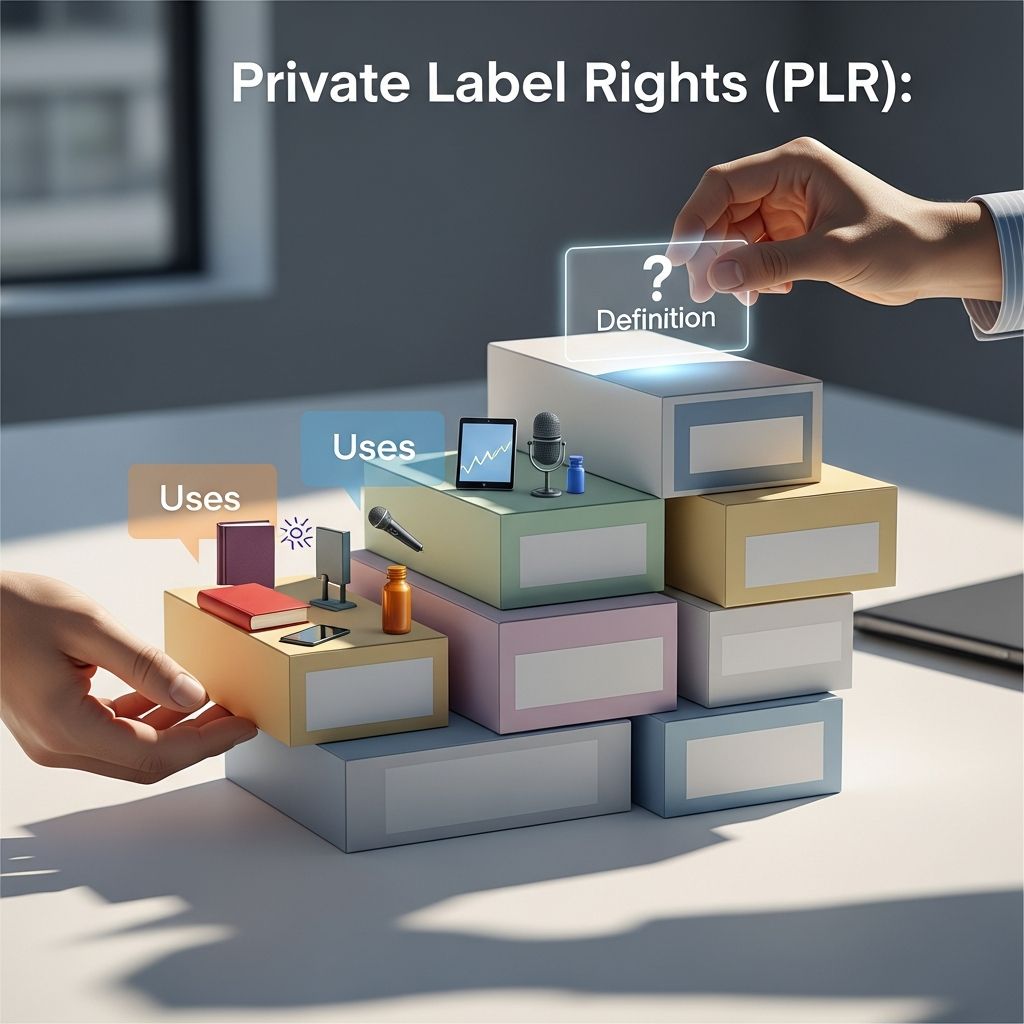
Private Label Rights, commonly referred to as PLR, represent a unique form of product licensing that has become increasingly popular in the digital economy. PLR is a licensing agreement that grants buyers the right to use, modify, and resell digital products as their own, without crediting the original creator or author. This business model has revolutionized how entrepreneurs and content creators approach product development and content creation, offering a cost-effective alternative to creating original materials from scratch.
The term PLR is most frequently applied to digital products such as blog posts, articles, eBooks, software, graphics, videos, and other digital content. When you purchase PLR content, you acquire rights that go beyond simple personal use—you can rebrand it, modify it, republish it, and even resell it to others. This flexibility makes PLR an attractive option for businesses looking to quickly build inventories of products or content without the significant time and financial investment required for original creation.
What Are Private Label Rights?
Private Label Rights are licensing agreements that come with specific rights and restrictions. When you purchase a product with PLR, you receive permission to use that product as if you created it yourself. The original creator retains ownership of the intellectual property but grants you the right to modify and distribute it under your own name or brand.
PLR differs from other licensing models like resell rights or master resell rights. With simple resell rights, you can only sell the product as-is without modifications. With master resell rights, you can grant resell rights to others. However, PLR goes further by allowing you to modify, rebrand, and customize the content entirely while still claiming it as your own work.
How Does PLR Work?
The mechanics of PLR are straightforward. A content creator or digital product developer licenses their work to multiple buyers simultaneously. Each buyer receives the same source material but can use it independently. The arrangement typically includes:
- The right to edit and modify the content
- The ability to rebrand the product with your logo and name
- Permission to resell the product to others
- The option to use content as lead magnets or freebies
- The right to incorporate PLR content into your own products
The PLR seller retains copyright ownership but allows multiple licensees to use the material simultaneously. This is what makes PLR sustainable as a business model—one piece of content can generate revenue from dozens or hundreds of buyers, each using it for their own purposes.
Types of PLR Products
PLR licensing applies to various types of digital products across different industries:
- Articles and Blog Posts: Pre-written content on specific topics that can be used directly on websites or modified for relevance
- eBooks: Full-length digital books that can be rebranded and sold or given away as lead magnets
- Email Sequences: Pre-written email templates and series for marketing campaigns
- Graphics and Templates: Design files, website templates, and visual assets ready for customization
- Software and Tools: Digital applications and software with modification and resale rights
- Video Content: Footage, tutorials, and video materials for various uses
- Music and Audio: Background music, sound effects, and audio content
- Courses and Training Materials: Educational content and course curricula
Advantages of Using PLR
PLR offers several compelling benefits for entrepreneurs, small business owners, and content creators:
Cost Efficiency: Purchasing PLR content is significantly cheaper than hiring writers, designers, or developers to create original content. This cost advantage allows businesses to scale their operations without proportional increases in expenses.
Time Savings: PLR dramatically reduces the time required to develop products and content. Instead of spending weeks or months creating materials from scratch, businesses can have ready-to-use resources within days.
Quick Market Entry: Entrepreneurs can rapidly enter new markets or launch new product lines by leveraging existing PLR materials. This accelerates time-to-market and allows businesses to test concepts quickly.
Scalability: PLR makes it easier to scale business operations. A small team can manage multiple product lines by utilizing PLR content as a foundation, then customizing it for their specific audience.
Content Repurposing: PLR content can be transformed into multiple formats. A single eBook can become blog posts, social media content, email sequences, and even a course.
Reduced Technical Barriers: Individuals without specialized skills in writing, design, or programming can still launch sophisticated digital products using PLR as a starting point.
Disadvantages and Limitations of PLR
Despite its advantages, PLR comes with notable limitations and potential drawbacks:
Quality Concerns: Not all PLR content meets high-quality standards. Some material may be outdated, poorly written, or filled with errors that require significant editing.
Lack of Uniqueness: Since multiple people can purchase and use the same PLR material, your competitors may be using identical content. This reduces differentiation in the marketplace.
Modification Limitations: While PLR allows modifications, overly extensive changes may be required to make the content unique and valuable to your audience.
Limited Support: PLR sellers typically provide no support or guarantees. If you encounter issues with the product, assistance is often limited or unavailable.
Credibility Issues: Savvy audiences may recognize PLR content, especially if it’s not substantially customized. This can damage your credibility if customers discover you’re using pre-made materials.
Rights Restrictions: Despite the name, PLR doesn’t grant all possible rights. There are typically restrictions on how many people can resell the product or specific territories where use is prohibited.
Ethical Concerns: Some businesses and audiences consider using PLR content misleading, particularly if it’s presented as original work without any modifications or improvements.
Common Uses of PLR
Businesses and entrepreneurs employ PLR in various practical applications:
Content Marketing: Companies purchase PLR articles and blog posts to build substantial content libraries for their websites, improving SEO and establishing thought leadership.
Lead Generation: Free PLR eBooks and guides serve as lead magnets to build email lists and attract potential customers.
Product Development: Entrepreneurs use PLR as a foundation for creating their own products, adding value through customization and combining multiple PLR resources.
Course Creation: Online educators use PLR course materials as starting points for their own educational products.
Email Marketing: PLR email templates and sequences accelerate the development of marketing campaigns.
Social Media Content: PLR articles can be repurposed into social media posts, graphics, and promotional content.
PLR vs. Other Content Licensing Options
| Licensing Type | Modification Rights | Resale Rights | Attribution Required | Cost |
|---|---|---|---|---|
| Private Label Rights (PLR) | Yes, fully modifiable | Yes, can resell | No | Low to Medium |
| Resell Rights | Limited or none | Yes, as-is only | Usually yes | Low |
| Master Resell Rights | Limited | Yes, can grant rights | Usually yes | Medium |
| Personal Use License | Limited | No | Yes | Low |
| Original Creation | Yes, complete control | Yes, all rights | No | High |
Finding Quality PLR Resources
When purchasing PLR content, it’s essential to evaluate quality carefully. Look for PLR providers with positive reviews, clear terms of service, and a portfolio of quality samples. Many PLR marketplaces specialize in specific niches, offering targeted content for particular industries or audiences. Before purchasing in bulk, buy individual products to assess quality and alignment with your brand standards.
Reputable PLR vendors typically provide clear documentation about usage rights, modification permissions, and any restrictions. Be cautious of providers offering unrealistically cheap content, as this often correlates with lower quality and limited support.
Best Practices for Using PLR Effectively
To maximize the value of PLR content and maintain credibility with your audience:
- Substantially customize and improve all PLR content before publishing
- Add your unique insights, examples, and perspective to PLR materials
- Update outdated information and statistics
- Maintain consistency with your brand voice and style
- Use PLR as a foundation rather than the final product
- Combine multiple PLR resources to create unique content
- Verify all facts and claims in PLR material before republishing
- Never simply republish PLR content without modifications
Frequently Asked Questions
Q: Is using PLR content ethical?
A: Using PLR is ethical if you substantially modify the content, add genuine value, and operate within the licensing terms. However, simply republishing PLR content without modifications and presenting it as original work raises ethical concerns.
Q: Can I legally resell PLR content?
A: Yes, PLR specifically grants resale rights. However, you must review the specific licensing agreement, as some PLR may have restrictions on resale or require substantial modifications before resale.
Q: How is PLR different from copyright infringement?
A: PLR is a legal licensing agreement where the copyright owner voluntarily grants usage rights to buyers. Copyright infringement occurs when someone uses copyrighted material without permission. PLR provides that permission.
Q: Can I use PLR content on commercial websites?
A: Yes, PLR typically permits commercial use. However, always review the specific licensing agreement, as some PLR licenses may restrict commercial applications or require additional fees.
Q: How much should I modify PLR content before using it?
A: While there’s no specific legal requirement, modifying at least 30-50% of the content and adding substantial original material ensures the content is meaningfully differentiated and provides genuine value to your audience.
Q: Are there risks associated with using PLR?
A: Potential risks include quality issues, non-uniqueness, credibility concerns if your audience recognizes the content, and limited support from PLR providers. These risks can be minimized through careful vendor selection and significant customization.
Q: Can I use PLR for creating courses?
A: Yes, many PLR licenses specifically include course creation rights. However, verify the licensing terms, as some PLR may have restrictions on educational applications.
Q: What happens if multiple people sell the same PLR content?
A: This is permissible under PLR licensing. Multiple buyers can purchase and sell the same base content, though significant customization helps differentiate offerings in the marketplace.
References
- What Is PLR Content? A Beginner’s Guide To Private Label Rights — Austin Carroll. Accessed 2025. https://austincarroll.com/what-is-plr-content/
- What is PLR Articles — PLR Articles by Nicepage. Accessed 2025. https://plrarticles.nicepage.io/what-is-plr-articles.html
- U.S. Copyright Office – Copyright Basics — United States Copyright Office. Updated 2024. https://www.copyright.gov/what-is-copyright/
Similar Articles








Read full bio of Sneha Tete