Price-to-Book Ratio: Definition and How to Calculate
Understanding the price-to-book ratio and its role in value investing analysis.

Understanding the Price-to-Book Ratio
The price-to-book ratio, often abbreviated as P/B ratio, is a fundamental financial metric used by investors and analysts to evaluate whether a stock is trading at a fair value relative to its book value. Also known as the price-to-equity ratio, this valuation indicator compares a company’s market capitalization to its net asset value. The price-to-book ratio is particularly valuable for investors seeking to identify undervalued stocks and make informed investment decisions based on tangible asset values rather than speculative market sentiment.
In essence, the price-to-book ratio measures how much investors are willing to pay for each dollar of a company’s net assets. A lower P/B ratio may suggest that a stock is undervalued, while a higher ratio could indicate overvaluation or represent a premium that investors assign to growth prospects and brand value. Understanding this metric is crucial for value investors who base their investment strategies on identifying securities trading below their intrinsic worth.
Definition of Price-to-Book Ratio
The price-to-book ratio is calculated by dividing a company’s market capitalization by its total book value, or alternatively, by dividing the stock price per share by the book value per share. Book value represents the company’s total assets minus its total liabilities, essentially reflecting what shareholders would theoretically receive if the company were liquidated and all debts were paid off.
The formula for price-to-book ratio is straightforward:
Price-to-Book Ratio = Market Price Per Share / Book Value Per Share
Or alternatively:
Price-to-Book Ratio = Market Capitalization / Total Book Value
This metric serves as a bridge between market perception and accounting reality, helping investors understand whether the market price reflects the actual tangible value of a company’s assets. Unlike other valuation metrics that rely on earnings or future growth projections, the price-to-book ratio focuses on hard assets and historical accounting data.
How to Calculate Price-to-Book Ratio
Calculating the price-to-book ratio requires gathering specific financial information from a company’s financial statements and current market data. Here’s a detailed step-by-step guide:
Step 1: Obtain the Current Stock Price
The first step involves finding the current market price per share of the stock. This information is readily available on financial websites, brokerage platforms, and stock exchanges. The stock price represents what investors are currently willing to pay for one share of the company.
Step 2: Calculate Book Value Per Share
Book value per share is determined by dividing the company’s total shareholders’ equity by the number of outstanding shares. This information can be found in the company’s balance sheet, typically included in quarterly or annual financial reports filed with the Securities and Exchange Commission (SEC).
The formula is:
Book Value Per Share = Shareholders’ Equity / Number of Outstanding Shares
Step 3: Divide Market Price by Book Value Per Share
Once you have both figures, simply divide the current stock price by the book value per share to obtain the price-to-book ratio. The resulting number indicates the multiple at which the market is valuing the company’s assets.
Example Calculation
Consider a hypothetical company with the following figures:
- Current stock price: $45 per share
- Shareholders’ equity: $500 million
- Outstanding shares: 50 million
Book value per share = $500 million / 50 million = $10
Price-to-book ratio = $45 / $10 = 4.5
This means investors are paying $4.50 for every dollar of book value, suggesting either the company has strong growth prospects or may be overvalued depending on industry standards.
Interpreting Price-to-Book Ratio Values
Understanding what different price-to-book ratios mean requires context and industry comparison:
Low Price-to-Book Ratios
A P/B ratio below 1.0 indicates that the stock is trading below its book value, potentially suggesting undervaluation. However, this may also signal underlying problems such as declining profitability, poor management, or industry headwinds. Value investors often seek stocks with P/B ratios below 1.0, but further analysis is essential to understand why the market has priced the stock at a discount.
High Price-to-Book Ratios
A P/B ratio above the industry average may indicate that investors expect strong future growth, have confidence in management, or perceive intangible value such as brand strength and intellectual property. Growth companies and those in technology sectors typically command higher P/B ratios than mature industrial companies.
Industry Comparisons
The appropriate P/B ratio varies significantly across industries. Banks and financial institutions typically have lower P/B ratios, while technology and software companies often have higher ratios due to their growth potential and minimal tangible assets. Comparing a company’s P/B ratio to its industry peers provides more meaningful insights than examining the ratio in isolation.
Advantages of Using Price-to-Book Ratio
The price-to-book ratio offers several advantages as an investment analysis tool:
- Simplicity: The metric is straightforward to calculate and understand, requiring only readily available financial data.
- Objective Basis: Unlike earnings-based metrics, book value is derived from accounting standards, providing a more objective foundation for valuation.
- Useful for Asset-Heavy Industries: For companies with significant tangible assets such as banks, insurance companies, and manufacturers, the P/B ratio is particularly relevant.
- Identifies Undervalued Stocks: The metric effectively highlights stocks trading below their accounting value, potentially presenting value opportunities.
- Stability: Book value changes less dramatically than earnings, making the P/B ratio less volatile than earnings-based multiples.
- Useful During Economic Downturns: When earnings become uncertain, book value provides a stable reference point for valuation.
Limitations of Price-to-Book Ratio
Despite its usefulness, the price-to-book ratio has significant limitations that investors must consider:
- Ignores Profitability: The P/B ratio doesn’t indicate whether a company is generating returns on its assets, overlooking return on equity and operating efficiency.
- Intangible Assets: For companies whose value lies primarily in intangible assets such as brands, patents, and intellectual property, book value provides an incomplete picture.
- Accounting Variations: Different accounting methods for depreciation, inventory valuation, and asset write-downs can distort book value comparisons.
- Outdated Asset Values: Book value based on historical cost may not reflect current market values of assets, particularly for real estate and long-held investments.
- Industry Variability: The appropriateness of P/B ratios varies dramatically across industries, making cross-sector comparisons problematic.
- Growth Potential Ignored: The metric doesn’t account for a company’s growth prospects, innovation pipeline, or competitive advantages.
- Quality of Assets: Two companies with identical P/B ratios may have vastly different asset quality and earning power.
Price-to-Book Ratio Across Different Industries
The price-to-book ratio varies considerably across economic sectors due to differences in capital intensity and growth expectations:
| Industry | Typical P/B Ratio Range | Reason |
|---|---|---|
| Banks and Financial Services | 0.5 – 2.0 | Asset-heavy, regulated, tangible asset-based valuation |
| Manufacturing and Industrial | 1.0 – 3.0 | Significant property, plant, and equipment |
| Utilities | 1.0 – 2.5 | Capital-intensive, stable, asset-based businesses |
| Technology and Software | 3.0 – 8.0+ | Growth potential, minimal tangible assets, high intangibles |
| Retail | 0.5 – 2.0 | Real estate and inventory-based, competitive pressures |
| Pharmaceuticals | 2.0 – 5.0 | High R&D, intellectual property, growth expectations |
Understanding these industry norms helps investors interpret whether a specific company’s P/B ratio represents a genuine opportunity or reflects sector-specific characteristics.
Price-to-Book Ratio vs. Other Valuation Metrics
While the price-to-book ratio is valuable, it’s best used alongside other valuation metrics:
Price-to-Earnings Ratio (P/E)
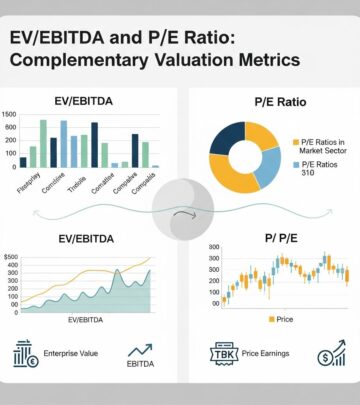
The P/E ratio compares stock price to earnings per share, focusing on profitability rather than assets. The P/E ratio better captures earning power and is more widely followed, but it can be distorted by accounting choices and one-time charges.
Enterprise Value-to-EBITDA
This metric relates total enterprise value to earnings before interest, taxes, depreciation, and amortization, providing a capital-structure-neutral valuation. It’s particularly useful for comparing companies with different debt levels and capital structures.
Price-to-Sales Ratio
The P/S ratio divides market capitalization by total revenue, offering a perspective less susceptible to accounting manipulations than earnings-based metrics. However, it ignores profitability entirely.
Price-to-Free Cash Flow
This metric focuses on actual cash generation rather than accounting earnings, providing insights into a company’s ability to fund operations and shareholder returns. It’s often considered more reliable than earnings-based metrics.
Using Price-to-Book Ratio in Investment Strategy
The price-to-book ratio can be effectively incorporated into various investment approaches:
Value Investing
Value investors traditionally seek stocks with low P/B ratios, particularly those trading below 1.0, believing the market has mispriced assets. Warren Buffett and other renowned value investors have long utilized P/B ratios as part of their investment selection process.
Contrarian Investing
Contrarian investors may use extremely low P/B ratios as signals that the market has become overly pessimistic about a company, potentially presenting buying opportunities for investors with conviction in the company’s recovery prospects.
Comparative Analysis
Investors can rank companies within an industry by P/B ratio to identify relative valuation opportunities. Companies with lower P/B ratios than peers may warrant further investigation.
Risk Assessment
Unusually low P/B ratios may signal financial distress or structural industry problems, making the metric useful for identifying potential risks in a portfolio.
What Affects Price-to-Book Ratio
Several factors influence a company’s price-to-book ratio:
- Profitability: Companies with strong return on equity typically command higher P/B ratios as investors value their efficiency in generating returns on assets.
- Growth Prospects: Expected future growth typically increases P/B ratios as investors pay premiums for companies expected to expand.
- Market Sentiment: Investor enthusiasm or pessimism can drive P/B ratios above or below fundamental values.
- Interest Rates: Rising interest rates may compress P/B ratios as discount rates increase, reducing valuations.
- Industry Cycles: Cyclical industries may see P/B ratios contract during downturns and expand during upswings.
- Asset Quality: Companies with high-quality, profitable assets typically justify higher P/B multiples.
- Balance Sheet Strength: Companies with strong balance sheets and low debt typically command premium valuations.
Frequently Asked Questions (FAQs)
Q: What is a good price-to-book ratio?
A: A good P/B ratio depends on the industry and company specifics. Generally, ratios below 1.0 suggest undervaluation, while ratios between 1.0 and 3.0 are considered reasonable for many industries. Technology companies typically have higher ratios due to growth expectations.
Q: Can price-to-book ratio be negative?
A: Yes, a negative P/B ratio occurs when a company has negative book value (liabilities exceed assets). This signals severe financial distress and is typically a red flag for investors.
Q: Is a lower price-to-book ratio always better?
A: Not necessarily. While lower P/B ratios may indicate undervaluation, they can also signal underlying business problems. Thorough fundamental analysis is essential to distinguish between genuine opportunities and value traps.
Q: Why do technology companies have higher price-to-book ratios?
A: Technology companies typically have fewer tangible assets relative to their market value, as their worth derives from intellectual property, software, and growth potential. Investors assign premiums based on future earnings expectations rather than current asset values.
Q: How frequently should I recalculate price-to-book ratio?
A: Stock prices change daily, making the P/B ratio dynamic. While you might check the P/B ratio daily for active trading, quarterly or annual recalculations based on updated financial statements provide more meaningful comparisons for long-term investors.
Q: Is price-to-book ratio useful for financial institutions?
A: Yes, the P/B ratio is particularly relevant for banks and insurance companies, where assets and liabilities are fundamental to business operations and customer protection. These institutions typically trade at lower P/B multiples due to their asset-based business models.
Conclusion
The price-to-book ratio remains a fundamental tool in the investor’s analytical toolkit, offering a straightforward method to assess whether a stock’s market price aligns with its tangible asset value. By comparing market capitalization to book value, investors can identify potentially undervalued opportunities and compare companies within industries on a consistent basis.
However, successful investment decisions require using the price-to-book ratio in conjunction with other financial metrics, industry analysis, and fundamental research. The P/B ratio works best for asset-heavy industries and should be supplemented with profitability metrics, growth analysis, and competitive positioning assessment. Understanding both the strengths and limitations of this valuation metric ensures that investors make informed, evidence-based investment decisions aligned with their investment objectives and risk tolerance.
References
- Investopedia – Price-to-Book Ratio Definition and How to Calculate — Investopedia. Retrieved November 2025. https://www.investopedia.com/terms/p/price-to-bookratio.asp
- U.S. Securities and Exchange Commission – How to Read a 10-K — SEC.gov. 2021. https://www.sec.gov/cgi-bin/browse-edgar
- Financial Accounting Standards Board – Balance Sheet Presentation — FASB. 2021. https://www.fasb.org/
- CFA Institute – Equity Valuation Metrics and Analysis — CFA Institute Research Foundation. 2020. https://www.cfainstitute.org/
- Journal of Portfolio Management – Value Investing and Book-to-Market Ratios — Institutional Investor. 2019. Research on valuation metrics and market efficiency in equity selection.
Similar Articles








Read full bio of medha deb