Present Value vs. Future Value of Annuity
Understand the key differences between present value and future value of annuities to make informed financial decisions for retirement and investments.

Annuities are powerful financial tools for retirement planning and steady income streams, but understanding their valuation is crucial.
Present value (PV)
represents the current worth of future annuity payments, discounted for time value of money, whilefuture value (FV)
projects the accumulated worth of payments over time with compounding interest. These concepts help investors decide whether to buy, sell, or hold annuities.What Is an Annuity?
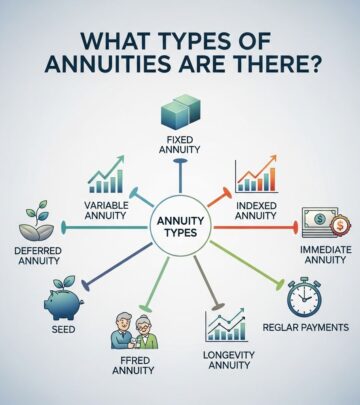
An annuity is a financial contract where you make a series of payments (or receive them) over time, typically to or from an insurance company. Annuities provide predictable income, often used in retirement to mimic a paycheck. They come in types like fixed (guaranteed payments), variable (market-linked), and indexed (tied to market indexes with protections).
Key features include:
- Periodic payments: Regular deposits or withdrawals, monthly, quarterly, or annually.
- Time horizon: Immediate (starts soon) or deferred (accumulates first).
- Payout options: Lifetime, fixed period, or joint life.
Annuities leverage the time value of money—the principle that $1 today is worth more than $1 tomorrow due to earning potential and inflation.
Present Value of an Annuity
The
present value of an annuity
calculates how much a stream of future payments is worth today. It discounts future cash flows back to the present using an interest or discount rate, accounting for opportunity cost and inflation. This is essential when buying an annuity (how much to pay now) or evaluating lump-sum settlements vs. payments.Formula for Present Value (Ordinary Annuity):
PV = PMT × [(1 – (1 + r)^(-n)) / r]
Where:
- PV = Present Value
- PMT = Payment per period
- r = Interest rate per period (decimal)
- n = Number of periods
Example: For $1,000 annual payments for 5 years at 5% interest:
PV = 1000 × [(1 – (1 + 0.05)^(-5)) / 0.05] ≈ $4,329.48
This means you’d pay about $4,329 today for those future payments. For annuity due (payments at period start), multiply by (1 + r).
Applications:
- Retirement: Compare annuity income to lump-sum needs.
- Lotteries: Choose cash now vs. installments.
- Loans: Value installment payments today.
Future Value of an Annuity
The
future value of an annuity
estimates the total value of regular payments at a future date, including compounded interest. It’s useful for savers projecting retirement nest eggs from consistent contributions.Formula for Future Value (Ordinary Annuity):
FV = PMT × [((1 + r)^n – 1) / r]
Where variables match PV formula.
Example: $1,000 annual investments for 5 years at 5%:
FV = 1000 × [((1 + 0.05)^5 – 1) / 0.05] ≈ $5,525.63
For annuity due, multiply by (1 + r). This shows growth from compounding.
Applications:
- Savings plans: Project 401(k) or IRA growth.
- Investments: Assess annuity accumulation phase returns.
- Debt payoff: Calculate total cost of loan payments.
Present Value vs. Future Value: Key Differences
While both deal with annuities and time value of money, PV and FV serve opposite purposes. Here’s a comparison:
| Aspect | Present Value | Future Value |
|---|---|---|
| Definition | Current worth of future payments (discounting) | Worth of current payments in the future (compounding) |
| Direction | Future to present | Present to future |
| Formula Focus | Discounting: (1 – (1+r)^(-n))/r | Compounding: ((1+r)^n – 1)/r |
| Purpose | Buying, settling, valuing now | Projecting growth, saving |
| Inflation | Often included in discount rate | Typically not direct |
| Decision Use | High: Immediate investment choice | Medium: Long-term projections |
PV is more conservative for today’s decisions; FV motivates saving by showing growth potential.
Time Value of Money in Annuities
Central to both calculations,
time value of money (TVM)
posits money available now can earn interest, making it superior to future money eroded by inflation or risk. Annuities embody TVM: PV discounts for this, FV compounds it.Factors affecting TVM:
- Interest rates: Higher rates increase FV, decrease PV.
- Time periods: Longer n amplifies compounding/discounting.
- Payment timing: Ordinary (end) vs. due (start).
- Inflation: Reduces real PV/FV.
Tools like financial calculators or Excel (PV, FV functions) simplify computations.
Why These Calculations Matter for Financial Planning
Mastering PV and FV empowers better choices:
- Retirement: Compare annuity payouts to Social Security or pensions.
- Investments: Decide between annuity purchase vs. stocks/bonds.
- Risk assessment: PV helps weigh surrender charges/taxes.
- Loans/settlements: Evaluate structured payments vs. lump sums.
For instance, a retiree might use PV to see if an annuity’s current value beats market investments. FV aids young savers in setting contribution goals.
Practical Examples and Scenarios
Example 1: Buying an Annuity
You’re offered an annuity paying $10,000/year for 20 years at 4% discount rate. PV ≈ $134,910. Worth buying if cost < this amount.
Example 2: Retirement Savings
Monthly $500 contributions for 30 years at 6% yields FV ≈ $576,000—highlighting power of consistent saving.
Example 3: Annuity Due Adjustment
Adjust FV formula by ×(1+r) for payments at start, increasing value.
Frequently Asked Questions (FAQs)
What is the main difference between present value and future value of an annuity?
Present value discounts future payments to today’s worth; future value compounds current payments to a future amount.
How do you calculate the present value of an annuity?
Use PV = PMT × [(1 – (1 + r)^(-n)) / r]. Excel’s PV function automates it.
When would I use future value calculations?
For projecting savings growth, like retirement accounts or investment accumulation.
Does inflation affect these calculations?
Yes, incorporate into discount rate for PV to reflect purchasing power.
Are annuities always better than lump sums?
No—use PV to compare; consider taxes, fees, and personal needs.
Conclusion
Grasping present value vs. future value of annuities demystifies these instruments, enabling smarter financial strategies. Whether planning retirement or evaluating options, these tools grounded in time value of money provide clarity.
References
- Present Value vs. Future Value: Annuities — SmartAsset. 2023. https://smartasset.com/insurance/present-value-vs-future-value
- How To Calculate Present And Future Value Of Annuity — Bankrate. 2024-05-15. https://www.bankrate.com/retirement/calculate-present-and-future-value-of-annuity/
- Difference between Present Value of Annuity and Future Value Annuity — BYJU’S. 2023. https://byjus.com/commerce/difference-between-present-value-annuity-and-future-value-annuity/
- Present vs Future Value of an Annuity — New York Life. 2024. https://www.newyorklife.com/articles/present-vs-future-value-annuity
- Explain the Time Value of Money and Calculate Present and Future Values of Lump Sums and Annuities — LibreTexts (OpenStax Managerial Accounting). 2023-08-01. https://biz.libretexts.org/Bookshelves/Accounting/Managerial_Accounting_(OpenStax)/11:_Capital_Budgeting_Decisions/11.04:_Explain_the_Time_Value_of_Money_and_Calculate_Present_and_Future_Values_of_Lump_Sums_and_Annuities
Similar Articles








Read full bio of Sneha Tete