Pre-Tax Income vs. After-Tax Income Explained
Understand how pre-tax and after-tax income affect your paycheck, benefits, and long-term financial planning.
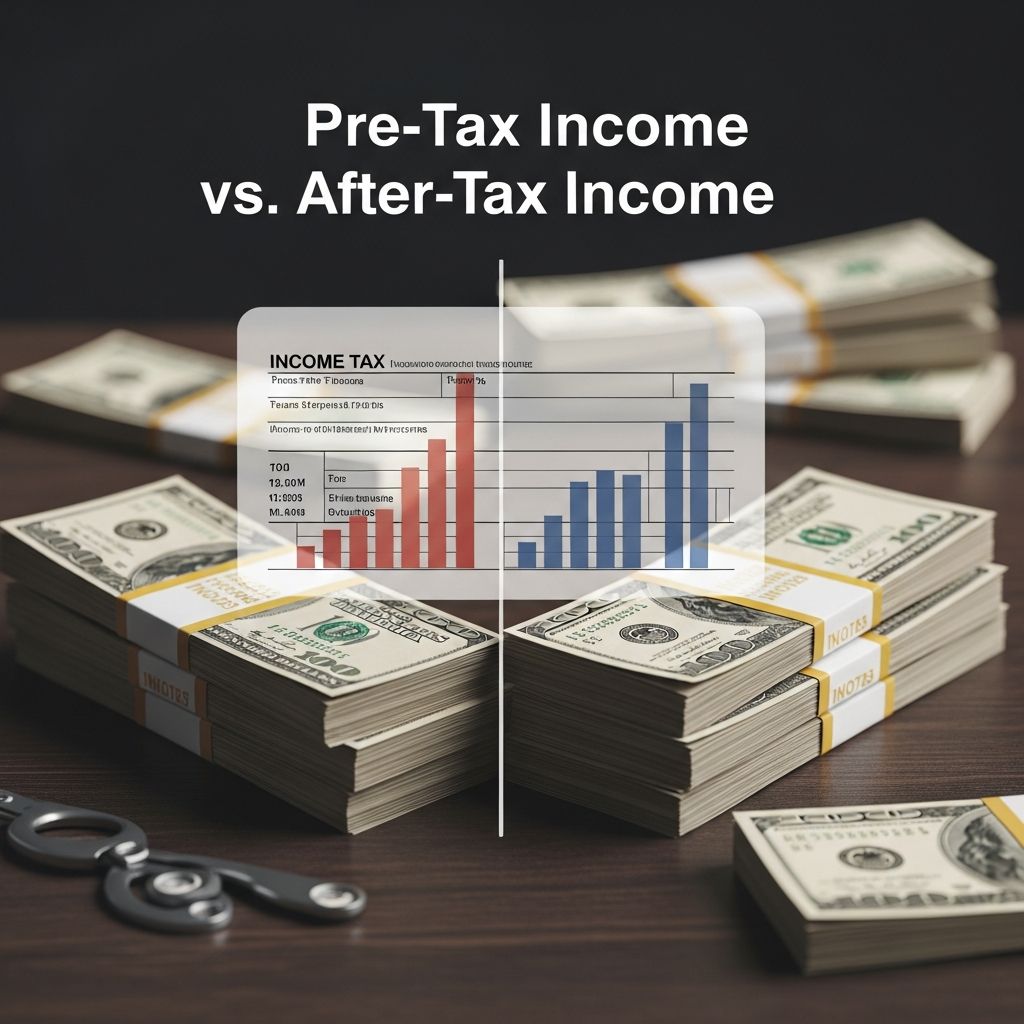
Understanding the difference between pre-tax income and after-tax income is essential if you want to read your paycheck correctly, choose the right benefits, and make smart decisions about saving and investing for the future. This guide breaks down what each term means, how they affect your take-home pay, and how to use both strategically in your financial plan.
What is pre-tax income?
Pre-tax income generally refers to your gross pay before federal, state, and payroll taxes are taken out, but after certain qualified pre-tax deductions are applied. In a broader sense, it is the amount you earn that is subject to taxes but has not yet had those taxes withheld.
On a paycheck, pre-tax income is usually your gross wage or salary minus any benefits or contributions that are allowed to be deducted before taxes, such as some retirement plan contributions and health insurance premiums.
Common examples of pre-tax income and deductions
- Salary and hourly wages before tax withholding
- Bonuses and commissions before tax withholding
- Employer-sponsored health, dental, and vision insurance premiums deducted on a pre-tax basis
- Traditional 401(k) or 403(b) retirement plan contributions
- Health Savings Account (HSA) and eligible Flexible Spending Account (FSA) contributions
- Pre-tax commuter or transportation benefits where allowed
Because these contributions are taken from your paycheck before taxes are calculated, they reduce the income the government uses to calculate your tax bill.
What is after-tax income?
After-tax income is the amount of money you actually take home after all required taxes and other deductions have been withheld. This is also called your net pay or take-home pay.
After-tax income is what lands in your bank account and is available for everyday spending, saving in regular bank or brokerage accounts, and paying bills.
What comes out before you see after-tax income?
- Federal income tax
- State and local income taxes (where applicable)
- Social Security and Medicare (FICA) payroll taxes
- Pre-tax benefit deductions (health insurance, HSA, FSA, traditional 401(k), etc.)
- Any required garnishments or other mandatory deductions
Once all of these are taken out, the remaining amount is your after-tax income, which determines how much you can spend and save in your everyday budget.
Pre-tax vs. after-tax income: What’s the difference?
Although the terms sound similar, pre-tax and after-tax describe very different points in the flow of your money. The key difference is when taxes are applied.
| Feature | Pre-tax income | After-tax income |
|---|---|---|
| Basic definition | Income before taxes are calculated (after eligible pre-tax deductions) | Income left after all taxes and deductions are taken out (net pay) |
| Shown on paycheck as | Gross pay minus pre-tax deductions | Net pay / take-home pay |
| Impact on taxes | Determines how much income tax and payroll tax you owe; can be reduced by pre-tax deductions | Does not change current tax owed; it’s what you have after taxes are settled |
| Use in budgeting | Helps estimate your tax bracket and tax liability | Used to plan monthly spending, saving, and debt payments |
| Use in benefits | Funds for pre-tax contributions (retirement, HSA, FSA, etc.) | Funds for after-tax savings, investments, and expenses |
How pre-tax income affects your paycheck
Pre-tax deductions change how much of your gross pay is subject to tax. The more eligible expenses you pay with pre-tax dollars, the lower your taxable wages, which can reduce what you owe in federal income tax, some state taxes, and in many cases, payroll taxes such as Social Security and Medicare.
Key benefits of pre-tax income and deductions
- Lower taxable income now: Pre-tax contributions to eligible plans reduce the income reported for income tax purposes, which can decrease your tax bill in the current year.
- Potential lower payroll taxes: Many pre-tax deductions also reduce the wages used to calculate Social Security and Medicare taxes, providing additional savings.
- Immediate paycheck savings: A $100 pre-tax deduction often reduces your take-home pay by less than $100 because you also save on taxes.
- Tax-deferred growth for retirement: Contributions to pre-tax retirement accounts like traditional 401(k)s and IRAs grow tax-deferred until you withdraw the money in retirement.
Common types of pre-tax benefits
- Traditional 401(k) or 403(b) retirement plans
- Traditional individual retirement accounts (when deductible)
- Employer-sponsored health, dental, and vision plans
- Health Savings Accounts (HSAs) and many FSAs when funded through payroll
- Eligible dependent care or commuter benefits
By using these benefits, you effectively pay some of your key expenses before the government takes its share.
How after-tax income affects your real life
While pre-tax income drives your tax bill, after-tax income is what determines your lifestyle. This is the money you actually have available each month.
Why after-tax income matters
- It funds your everyday expenses like rent, groceries, transportation, and childcare.
- It is the source for building an emergency fund, paying off debt, and investing in taxable accounts.
- It signals whether your current lifestyle is sustainable or if you are overspending.
- It helps you decide what you can safely commit to long-term goals, such as retirement or homeownership.
Because of this, many financial planners recommend building your monthly budget around your net pay, not your gross salary.
Pre-tax vs. after-tax for savings and investing
Pre-tax and after-tax also describe how you contribute to savings and investment accounts, especially for retirement. The difference is again about when you pay taxes.
Pre-tax contributions (traditional retirement accounts)
- Money goes into the account before income tax is applied, lowering your taxable income now.
- Investments grow tax-deferred.
- You pay ordinary income tax when you withdraw the money in retirement.
- Examples: Traditional 401(k), 403(b), and many traditional IRAs.
After-tax contributions (Roth and taxable accounts)
- Money is contributed after you have already paid income tax on it.
- For Roth accounts, qualified withdrawals in retirement are generally tax-free, including earnings.
- For regular taxable investment accounts, you may owe taxes on interest, dividends, and capital gains along the way.
- Examples: Roth 401(k), Roth IRA, and standard brokerage accounts.
Which is better: pre-tax or after-tax retirement saving?
There is no universal answer, but the choice often depends on your current tax rate compared to what you expect in retirement.
- If you expect to be in a lower tax bracket later, pre-tax contributions may save you more overall because you avoid higher taxes now and pay at a lower rate later.
- If you think your tax rate will be the same or higher in retirement, Roth (after-tax) contributions can be attractive because qualified withdrawals are tax-free.
- Many people use a mix of both to diversify their tax situation in retirement.
How to read your paycheck: pre-tax vs. after-tax in action
Looking at a typical pay stub can help you see how pre-tax and after-tax amounts show up in real life.
Typical order of calculations on a paycheck
- Gross pay: Your total earnings for the pay period (salary, hourly wages, overtime, bonuses).
- Pre-tax deductions: Amounts taken out for pre-tax benefits (health insurance, HSA, traditional 401(k), etc.).
- Taxable wages: Gross pay minus pre-tax deductions. This is what income and payroll taxes are based on.
- Taxes withheld: Federal income tax, state and local tax (if applicable), and FICA.
- Post-tax deductions: Any deductions taken after taxes, such as Roth contributions or voluntary insurance that is not pre-tax.
- Net pay: What remains after all of the above—your after-tax income.
Pros and cons of pre-tax vs. after-tax income strategies
Both pre-tax and after-tax strategies play important roles in a solid financial plan. Understanding the trade-offs helps you choose what is best at each stage of your life.
Advantages of focusing on pre-tax benefits
- Reduces your taxable income today, potentially lowering your current tax bill.
- Can make valuable benefits (like health insurance) more affordable by using pre-tax dollars.
- Boosts retirement savings through tax-deferred growth.
- May reduce both employee and employer payroll tax costs, making benefits more attractive at work.
Potential drawbacks of relying only on pre-tax strategies
- Reduces your take-home pay, which can make budgeting feel tighter if you over-commit.
- For pre-tax retirement accounts, you still owe taxes later, and future tax rates are uncertain.
- Too much focus on tax savings now may leave you with less tax flexibility in retirement.
Advantages of after-tax income strategies
- Gives you clear visibility of what you truly have available to spend and save.
- After-tax savings in Roth accounts can provide tax-free income later, which is valuable if tax rates rise.
- After-tax contributions to taxable investment accounts provide liquidity and flexibility (no early withdrawal penalties, though taxes may apply).
Potential drawbacks of after-tax strategies
- Provide no immediate tax reduction; your current tax bill may be higher than necessary.
- It can be tempting to spend all of your after-tax income instead of saving and investing.
How to decide which approach to prioritize
You do not have to choose only pre-tax or only after-tax strategies. In practice, almost everyone uses a combination. The key is to align your choices with your goals and tax situation.
Questions to ask yourself
- What is my current tax bracket, and is it likely to go up or down in the future?
- Do I need more take-home pay immediately, or can I afford to reduce net pay to save on taxes?
- Am I already taking advantage of pre-tax benefits like health insurance and retirement plans through work?
- Do I have at least a small emergency fund built from after-tax savings?
- Would a mix of pre-tax and Roth retirement contributions give me more flexibility later?
Simple guidelines
- Make sure you understand your paycheck and know the difference between gross pay, taxable wages, and net pay.
- Try to use available pre-tax benefits (like employer retirement plans and health coverage) if they fit your situation.
- Build a budget based on your after-tax income to avoid overspending.
- As your income rises, consider adding Roth or other after-tax savings to diversify how your future withdrawals will be taxed.
Frequently Asked Questions (FAQs)
Q: Is pre-tax income the same as gross income?
A: Gross income is your total earnings before any deductions. Pre-tax income is often used to describe the amount that remains after eligible pre-tax deductions but before taxes are calculated. On many paychecks, people casually use the terms interchangeably, but technically, pre-tax deductions reduce gross income to determine taxable wages.
Q: Why is my take-home pay so much lower than my salary?
A: Your salary reflects gross income, while your take-home pay reflects after-tax income. The difference comes from pre-tax deductions, federal and state income tax withholding, Social Security and Medicare taxes, and any post-tax deductions you have selected.
Q: Are pre-tax deductions always better than after-tax deductions?
A: Not always. Pre-tax deductions reduce your taxable income today, which is beneficial, but they can also reduce your current cash flow. Some goals, such as building an emergency fund or using Roth accounts for tax-free withdrawals later, require after-tax savings.
Q: How do pre-tax and after-tax contributions show up on my W-2?
A: Pre-tax deductions usually lower the wages reported in certain W-2 boxes used to calculate income and sometimes payroll taxes, while after-tax contributions do not reduce those reported wage amounts. Your W-2 instructions and employer payroll summary can help you see the details.
Q: Should I choose a pre-tax 401(k) or a Roth 401(k)?
A: If you want to reduce your current taxable income and expect to be in a lower tax bracket in retirement, a pre-tax 401(k) can be helpful. If you prefer tax-free withdrawals later and think your tax rate could be higher in the future, a Roth 401(k) is worth considering. Many people split contributions between the two to balance current and future tax benefits.
References
- Pre-tax and after-tax retirement savings accounts — Protective Life. 2023-06-01. https://www.protective.com/learn/understanding-the-difference-between-pre-tax-and-after-tax
- Pre-tax vs Post-Tax Deductions: Key Differences You Should Know — Paycor. 2023-04-10. https://www.paycor.com/resource-center/articles/pre-tax-vs-post-tax/
- Understanding Pretax vs. After-Tax Investment Benefits — SmartAsset. 2022-08-15. https://smartasset.com/taxes/understanding-pre-tax-vs-after-tax-investment-benefits
- Choosing between pre-tax and Roth after-tax options — TIAA. 2024-01-05. https://www.tiaa.org/public/learn/financial-essentials/traditional-or-roth-retirement-plan-options
- What are payroll deductions? Pre-tax & post-tax — ADP. 2023-03-20. https://www.adp.com/resources/articles-and-insights/articles/w/what-are-payroll-deductions.aspx
- Understanding Pre vs. Post-Tax Benefits — PeopleKeep. 2023-02-14. https://www.peoplekeep.com/blog/pre-tax-vs-post-tax-benefits
- The Difference Between Gross Income Before and After Taxes — Global Expansion. 2022-07-01. https://www.globalexpansion.com/blog/gross-income-before-and-after-taxes
Similar Articles








Read full bio of Sneha Tete