Positive Correlation: Definition, Examples, and Applications
Understanding how two variables move together and their statistical relationship.

What Is Positive Correlation?
Positive correlation is a fundamental concept in statistics and finance that describes the relationship between two variables. When two variables are positively correlated, they tend to move in the same direction. This means that when one variable increases, the other tends to increase as well, and conversely, when one decreases, the other typically decreases. Understanding positive correlation is essential for investors, analysts, and researchers who need to comprehend how different factors interact within financial markets and scientific studies.
In practical terms, a stock that rises when the overall stock market increases demonstrates positive correlation with the broader market. However, the magnitude of the stock’s movement relative to the market will depend on numerous factors, including company-specific news, sector performance, and macroeconomic conditions. Recognizing these relationships helps professionals make informed decisions about portfolio construction, risk management, and strategic planning.
Understanding Correlation as a Statistical Measure
Correlation is fundamentally about measuring how two variables relate to one another. Rather than simply observing whether variables move together, statisticians use precise mathematical formulas to quantify the strength and direction of these relationships. This standardization allows for objective comparison across different datasets and contexts.
The technical definition of correlation involves converting the covariance between two variables into a standardized measure. Covariance measures how two variables change together, but it can be difficult to interpret because it depends on the scale of the variables. Correlation solves this problem by dividing the covariance by the product of the standard deviations of both variables, creating a number that falls between -1 and +1.
The Correlation Coefficient Scale
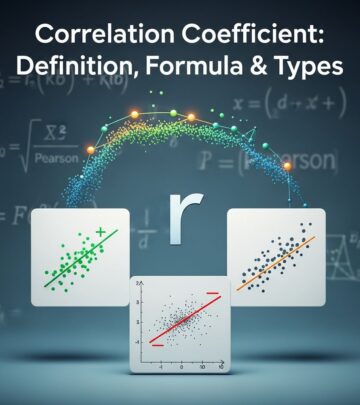
The correlation coefficient, typically represented as “r” in statistical notation, provides a clear numerical representation of the relationship between two variables. Understanding where a correlation value falls on the scale is crucial for interpreting data relationships:
- Perfect Positive Correlation (+1.0): Movements in one variable are exactly mirrored by movements in the other. This is extremely rare in real-world scenarios.
- Strong Positive Correlation (0.7 to 0.99): The variables move together frequently and predictably, with high reliability.
- Moderate Positive Correlation (0.4 to 0.69): The variables show a noticeable tendency to move together, though the relationship is not as consistent.
- Weak Positive Correlation (0.1 to 0.39): There is some tendency for variables to move together, but the relationship is modest and less reliable.
- No Correlation (0): The movements of the two variables are completely unrelated and have no discernible pattern.
- Negative Correlation (-1.0 to 0): Variables move in opposite directions, with correlations approaching -1 indicating increasingly strong inverse relationships.
Sign and Strength Interpretation
The sign of a correlation coefficient (positive or negative) defines the directional relationship between two variables. A positive sign indicates that variables move in the same direction, while a negative sign indicates they move in opposite directions. The absolute value of the correlation coefficient indicates the strength of the relationship.
A correlation value close to zero suggests that the movements of the two assets are essentially uncorrelated, meaning changes in one variable provide little information about changes in the other. Conversely, as the correlation moves closer to the limits of -1 and +1, the connection between the variables becomes stronger and more predictable. When a correlation reaches +1, the relationship is perfectly linear and positive, with one variable’s movement completely explained by the other’s movement.
The Pearson Correlation Coefficient
The Pearson Correlation Coefficient (PCC), named after British mathematician Karl Pearson who developed it in the late nineteenth century, is one of the most widely used statistical measures for quantifying linear relationships between variables. This coefficient is represented by the letter “r” and can take values from -1 to 1. The PCC is particularly valuable in statistical analysis and is foundational to linear regression analysis.
A PCC value close to 1 indicates a strong positive correlation, meaning that as one variable increases, the other tends to increase proportionally. Conversely, a value close to -1 signifies a strong negative correlation, where an increase in one variable corresponds with a decrease in the other. A PCC of 0 implies no correlation, indicating that the two variables do not influence each other in any linear fashion.
Practical Applications of Positive Correlation
Investment Portfolio Analysis
In finance, understanding positive correlation is critical for portfolio construction. When two stocks are highly positively correlated, they tend to move together, which means owning both provides limited diversification benefits. Conversely, combining assets with low or negative correlations can reduce portfolio volatility and enhance risk-adjusted returns. Portfolio managers use correlation analysis to select securities that provide complementary price movements.
Market and Individual Security Relationships
Individual stocks often show positive correlation with the broader market indices. When the overall market rises, most stocks tend to rise as well, though not necessarily at the same rate. A stock with a correlation of 0.8 to the S&P 500, for example, will typically move in the same direction as the market but with varying magnitudes. This relationship helps investors understand how their holdings will behave during different market conditions.
Scientific Research
In scientific studies, positive correlation helps researchers understand cause-and-effect relationships. For instance, research examining the relationship between sunlight exposure and plant growth would likely find a positive correlation, where increased sunlight leads to increased growth. Similarly, studies might examine correlations between education levels and income, physical activity and cardiovascular health, or study hours and academic performance.
Calculating R-Squared from Correlation
An important application of the correlation coefficient involves squaring the correlation number to obtain the coefficient of determination, commonly referred to as “R-squared.” This value tells us what proportion of the change in one variable can be explained by changes in the other variable. For example, if a correlation coefficient is 0.7, then R-squared equals 0.49, meaning 49% of the variation in one variable can be explained by changes in the other variable, while 51% remains unexplained by this relationship.
This calculation is crucial for evaluating the predictive power of statistical models. A higher R-squared value indicates that the independent variable explains more of the variance in the dependent variable, making predictions more reliable. However, it’s important to note that correlation does not imply causation—a high R-squared value shows a strong relationship but does not prove that one variable causes changes in the other.
Real-World Examples of Positive Correlation
Financial Markets
In financial markets, technology stocks often show positive correlation with each other. When one major technology company experiences positive news about earnings or innovation, other technology firms frequently see their stock prices rise as well. Similarly, commodities like crude oil and gasoline prices tend to be positively correlated, as gasoline is derived from crude oil.
Economic Variables
Gross Domestic Product (GDP) and employment levels typically show positive correlation. As economies grow and produce more goods and services, they generally require more workers, leading to higher employment rates. Conversely, during economic downturns, both GDP and employment tend to decline simultaneously.
Consumer Behavior
Consumer spending and retail sales typically exhibit positive correlation. During periods of economic growth and rising consumer confidence, retail sales increase. When consumer confidence declines, retail sales generally decrease as well.
Distinguishing Positive Correlation from Causation
A critical distinction in statistics is that positive correlation does not imply causation. Two variables might move together without one causing the other. This relationship could result from both variables being influenced by a third factor, or the correlation could be coincidental. For example, while ice cream sales and drowning incidents are positively correlated during summer months, ice cream consumption does not cause drowning. Both are driven by warm weather and increased outdoor activities.
Establishing causation requires more rigorous analysis, including controlled experiments, temporal evidence showing the cause precedes the effect, and a logical mechanism explaining how one variable causes changes in the other. Analysts must be careful not to draw causal conclusions from correlation alone.
Limitations and Considerations
While positive correlation is a useful measure, it has important limitations. Correlation measures only linear relationships; two variables might have a strong nonlinear relationship that correlation would fail to capture. Additionally, correlation can be influenced by outliers in the data, which can distort the calculated coefficient.
Correlation also provides no information about the size of the relationship, only its direction and consistency. Two variables might be perfectly correlated but with one changing only slightly when the other changes dramatically. Analysts must examine additional statistics, such as regression coefficients and confidence intervals, to fully understand the nature of relationships between variables.
Correlation in Different Time Frames
Correlation between variables can change depending on the time period examined. Two stocks might show strong positive correlation over a five-year period but much weaker correlation when examined on a daily basis. Market conditions, economic cycles, and company-specific events can all influence how strongly two variables move together across different timeframes. Investors and analysts must consider appropriate time horizons when evaluating correlations for decision-making purposes.
Frequently Asked Questions (FAQs)
Q: What is the difference between positive and negative correlation?
A: Positive correlation means two variables move in the same direction—when one increases, the other tends to increase. Negative correlation means variables move in opposite directions—when one increases, the other tends to decrease. The sign of the correlation coefficient indicates this directional relationship.
Q: What does a correlation of 0.5 mean?
A: A correlation of 0.5 indicates a moderate positive relationship between two variables. This means the variables tend to move in the same direction about half the time, and the relationship is neither particularly strong nor weak. When squared, an R-squared of 0.25 means only 25% of the variation in one variable is explained by the other.
Q: Can correlation be used to predict future values?
A: While correlation indicates that two variables move together, it has limited predictive power on its own. Strong correlation suggests that historical patterns might continue, but markets and natural systems are complex, and past relationships do not guarantee future performance. Regression analysis and other statistical methods provide better predictive frameworks when combined with correlation analysis.
Q: Why is positive correlation important for investors?
A: Positive correlation helps investors understand portfolio diversification. Assets that are highly positively correlated move together, offering less diversification benefit. By combining assets with low or negative correlations, investors can reduce overall portfolio risk while maintaining growth potential.
Q: How is correlation different from covariance?
A: Covariance measures how two variables change together but depends on the scale of the variables, making it difficult to compare across different datasets. Correlation standardizes this relationship by dividing covariance by the product of standard deviations, resulting in a value between -1 and 1 that is scale-independent and easier to interpret.
Q: What causes positive correlation between variables?
A: Positive correlation can result from direct causation, where one variable causes changes in another. However, it can also result from both variables responding to a common third factor, or from pure coincidence. Establishing the actual cause requires additional analysis beyond simple correlation measurement.
References
- Positive Correlation — Finance Unlocked. Accessed 2025-01-15. https://financeunlocked.com/discover/glossary/positive-correlation
- Pearson Correlation Coefficient (PCC) — EBSCO Research Starters. Accessed 2025-01-15. https://www.ebsco.com/research-starters/science/pearson-correlation-coefficient-pcc
Similar Articles








Read full bio of Sneha Tete