Portfolio Manager: Investment Strategy & Management
Expert guide to portfolio managers: roles, responsibilities, strategies, and market impact.

What Is a Portfolio Manager?
A portfolio manager (PM) is a professional responsible for making investment decisions and carrying out investment activities on behalf of individuals and institutions. These skilled professionals manage assets entrusted to them by investors who seek long-term financial growth through various investment vehicles such as retirement funds, endowment funds, education funds, and managed investment accounts. Portfolio managers work in collaboration with teams of analysts and researchers to develop comprehensive investment strategies, select appropriate securities, and allocate capital efficiently across different asset classes and investment opportunities.
The primary objective of a portfolio manager is to generate returns that exceed what would be expected given the level of risk undertaken. This performance is typically monitored through regular performance reports shared with clients on a weekly, monthly, quarterly, or annual basis. Portfolio managers establish clear investment policies that outline critical details including minimum investment requirements, liquidity provisions, specific investment strategies, and the markets in which they will actively invest.
Types of Investors Served by Portfolio Managers
Portfolio managers serve two distinct categories of investors, each with unique needs and investment objectives:
Institutional Investors
Institutional investors represent large organizations with substantial capital to invest. This category includes pension funds, insurance companies, endowment funds, sovereign wealth funds, and hedge funds. These entities typically have complex investment requirements and long-term financial objectives that require sophisticated portfolio management strategies.
Individual Investors
Individual investors range from ultra-high net worth individuals (UHNW) to high net worth individuals (HNW) who have significant personal wealth to manage. These clients seek professional guidance to preserve and grow their assets while managing risk according to their personal financial goals and life circumstances.
Core Responsibilities of Portfolio Managers
Portfolio managers fulfill several critical responsibilities in their role as stewards of client capital:
Investment Decision Making: Portfolio managers make strategic decisions about the overall investment mix and policy, carefully matching investments to client objectives and risk tolerance. They analyze market opportunities and determine which securities to buy and sell.
Asset Allocation: A fundamental responsibility involves allocating capital across different asset classes, geographic regions, and investment types. They balance competing considerations such as debt versus equity investments, domestic versus international exposure, growth-oriented versus safety-focused positions, and various other strategic trade-offs.
Risk Management: Portfolio managers continuously evaluate and manage the relationship between risk and potential performance returns. They work to maximize returns while maintaining risk levels appropriate to their clients’ investment objectives and risk appetites.
Research and Analysis: Throughout each trading day, portfolio managers review detailed research reports, communicate with company management teams, and monitor industry trends and macroeconomic developments. This ongoing analysis helps them identify optimal investment opportunities and timing for capital deployment.
Portfolio Management Strategies and Approaches
Portfolio managers employ different management methodologies depending on the type of fund and investment objectives:
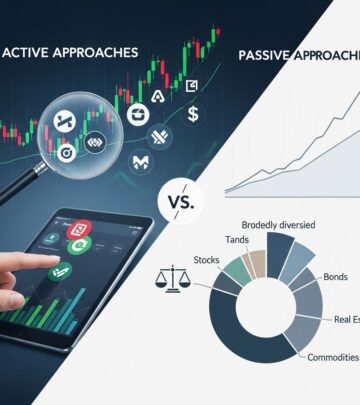
Active Portfolio Management
Active management involves one manager, co-managers, or teams of managers who actively work to outperform market returns. These professionals conduct extensive research, make individual security selections, and frequently adjust portfolio holdings based on market analysis and investment opportunities. Active managers believe they can identify mispricings and generate superior returns through skillful selection and timing decisions.
Passive Portfolio Management
Passive management strategies involve tracking a market index, commonly referred to as indexing or index investing. Rather than attempting to beat the market through active security selection, passive managers construct portfolios that closely replicate the holdings and weightings of a specific market index. This approach typically results in lower management fees and reduced portfolio turnover.
Mutual funds and exchange-traded funds (ETFs) commonly employ both active and passive management approaches, while closed-end funds are generally actively managed. The choice between active and passive management represents a fundamental decision about investment philosophy and expected outcomes.
Historical Development of Portfolio Management Theory
Modern portfolio management is built upon foundational theoretical work developed over several decades. In the 1950s, economist Harry Markowitz developed modern portfolio theory, which revolutionized how professionals think about portfolio construction and diversification. Subsequent researchers including Jack Treynor, William F. Sharpe, John Lintner, and Jan Mossin built upon Markowitz’s work to develop the Capital Asset Pricing Model (CAPM), which has become one of the primary tools used in portfolio management today.
The CAPM provides a mathematical framework for calculating the expected return percentage of an investment based on its risk level. The formula is:
( mu_{i} = r_{f} + (mu_{M} – r_{f}) * beta_{i} )
Where:
- ( mu_{i} ) = Expected returns on the investment
- ( r_{f} ) = Risk-free rate of return
- ( mu_{M} ) = Expected market returns
- ( beta_{i} ) = Beta, the risk measure relative to the overall market
This model helps portfolio managers determine whether potential investments offer adequate compensation for their associated risks, making it invaluable for investment decision-making and portfolio construction.
Collaboration with Analysts and Researchers
Portfolio managers do not operate in isolation; they work closely with investment teams including both internal buy-side analysts and sell-side analysts from investment banks. Buy-side analysts work directly for the portfolio manager and investment firm, while sell-side analysts provide research and investment recommendations from investment banking firms. Portfolio managers must effectively filter through the substantial volume of investment ideas and research provided by these analysts, using their professional judgment and experience to identify the most promising opportunities for their portfolios.
The collaborative process involves reviewing detailed research reports, attending meetings with company management, and discussing market opportunities with various team members. Portfolio managers leverage their expertise and judgment to synthesize this information into informed investment decisions that advance their clients’ financial objectives.
Performance Monitoring and Benchmarking
Portfolio managers establish clear performance benchmarks against which to measure their results. These benchmarks might be specific market indices or custom performance targets aligned with client objectives. Regular performance reporting allows clients to monitor returns and assess whether the portfolio manager is achieving the stated investment objectives. Performance reports typically include detailed information about portfolio holdings, returns earned, risk metrics, and comparison to relevant benchmarks.
Ethical Considerations and Insider Trading Prohibitions
Portfolio managers occupy positions of trust and must operate within strict legal and ethical boundaries. One of the most serious violations involves insider trading, where portfolio managers use non-public information to make investment decisions. Courts have treated insider trading as the ultimate abuse of a portfolio manager’s position of trust. Consequences for engaging in insider trading can be severe, including forced disgorgement of all compensation received during the period in which wrongdoing occurred. Beyond personal consequences, insider trading violations expose investment firms to government investigations, direct financial losses, and reputation damage—all significant consequences for both the individual manager and the firm.
Technology and Portfolio Management Systems
Modern portfolio management relies heavily on sophisticated information technology infrastructure. Portfolio management systems (PMS) provide the technological foundation enabling portfolio managers to access updated prices and market information, execute trades, and monitor overall portfolio value. These systems include multiple integrated components:
- Order Management System (OMS) for processing investment orders
- Execution Management System (EMS) for executing trades efficiently
- Portfolio valuation tools for calculating current portfolio worth
- Risk management systems for monitoring portfolio risk exposure
- Compliance systems ensuring adherence to regulations and policies
- Middle office and back office functions including trade management and cash management
- Net asset value calculations for fund valuation
These integrated systems enable portfolio managers to make informed decisions quickly and efficiently while maintaining proper documentation and compliance with regulatory requirements.
Frequently Asked Questions
Q: What qualifications do portfolio managers typically have?
A: Most portfolio managers hold at least a bachelor’s degree in finance, economics, business, or related fields. Many pursue advanced credentials such as the Chartered Financial Analyst (CFA) designation, which requires passing three rigorous exams and meeting experience requirements. Some also hold MBA degrees or other advanced business credentials.
Q: How do portfolio managers get compensated?
A: Portfolio managers are typically compensated through a combination of salary and performance-based incentives. Many investment firms employ a fee structure based on assets under management (AUM), with managers earning a percentage of the total assets they manage. Some managers also receive performance bonuses based on how well their portfolios perform relative to benchmarks.
Q: What is the difference between a portfolio manager and a financial advisor?
A: Portfolio managers typically work with larger institutional clients or wealthy individuals and make investment decisions directly on behalf of clients. Financial advisors generally work with individual investors, provide comprehensive financial planning services, and may recommend that clients use portfolio managers for specific portions of their wealth.
Q: How often do portfolio managers make changes to client portfolios?
A: The frequency of portfolio changes depends on the management strategy. Active managers may make frequent adjustments based on market opportunities and research insights, while passive managers make fewer changes to maintain index alignment. Most managers review and potentially rebalance portfolios quarterly or annually.
Q: Can portfolio managers guarantee investment returns?
A: No, portfolio managers cannot guarantee specific investment returns. All investments carry risk, and past performance does not guarantee future results. Portfolio managers work to achieve returns appropriate to the risk level, but actual results may vary based on market conditions and other factors.
Q: What role does diversification play in portfolio management?
A: Diversification is a cornerstone principle of modern portfolio management. Portfolio managers diversify across asset classes, geographic regions, market capitalizations, and industries to reduce risk without necessarily sacrificing expected returns. Proper diversification helps smooth returns and reduces vulnerability to individual security or sector performance.
References
- Capital Asset Pricing Model — Federal Reserve Bank of St. Louis. 2024. https://www.investopedia.com/terms/c/capm.asp
- Insider Trading Laws and Enforcement — U.S. Securities and Exchange Commission. 2024. https://www.sec.gov/litigation/insider-trading.shtml
- Portfolio Management Systems — Financial Industry Regulatory Authority (FINRA). 2024. https://www.finra.org/
Similar Articles








Read full bio of medha deb