Ponzi Scheme: Definition, History, and Warning Signs
Understanding Ponzi schemes: How they work, their history, and how to protect yourself from investment fraud.
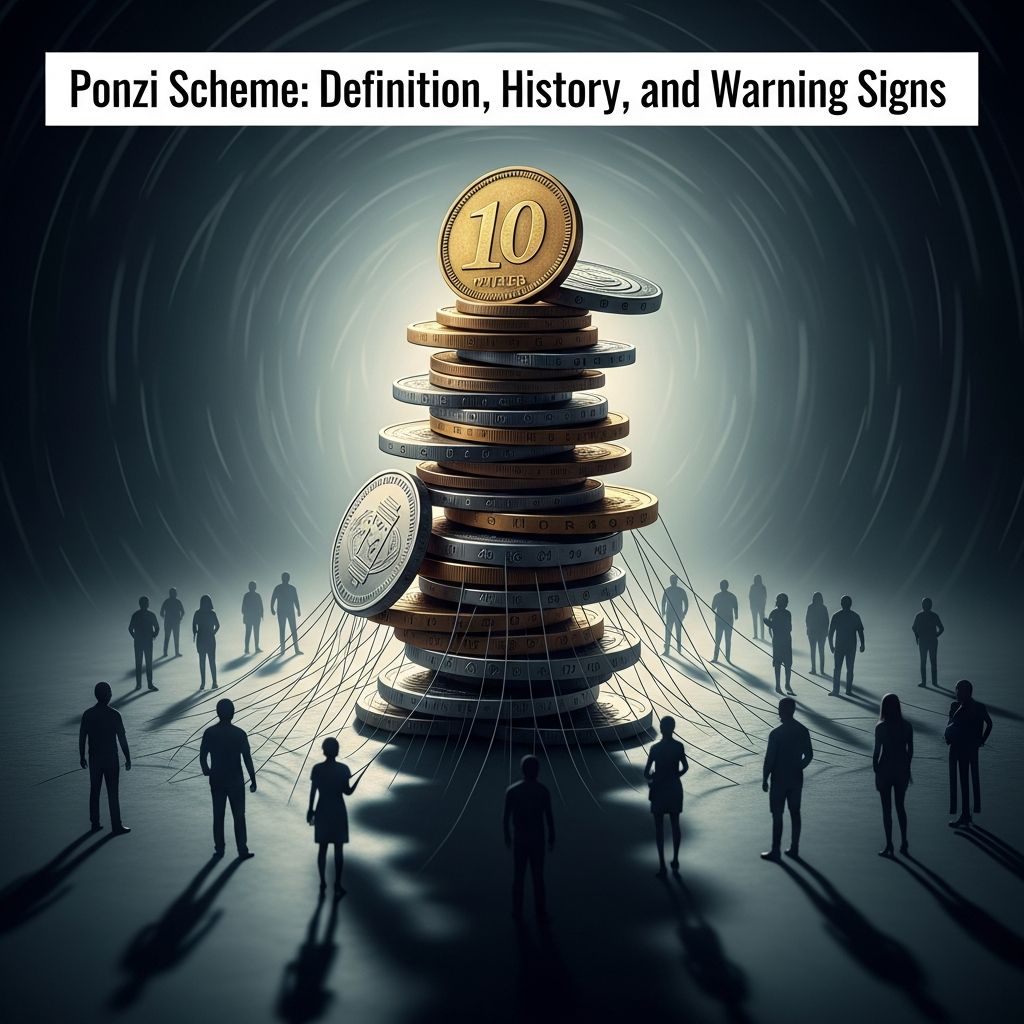
Ponzi Scheme: Definition and How It Works
A Ponzi scheme is an investment fraud that operates by paying returns to existing investors using funds collected from new investors rather than from actual investment profits or legitimate business operations. Named after Charles Ponzi, who perpetrated one of the most famous schemes in financial history, these fraudulent arrangements rely on continuous recruitment of new participants to sustain the illusion of profitability.
The fundamental mechanism of a Ponzi scheme is deceptively simple yet remarkably effective. Scheme operators promise potential investors exceptionally high returns on their investments with minimal or no risk involved. These promises are often backed by claims of exclusive investment opportunities, proprietary trading strategies, or access to specialized markets. However, instead of actually investing the money in legitimate ventures, the fraudsters use incoming funds from new investors to pay “returns” to earlier investors, creating a false sense of profitability and legitimacy.
This structure works only as long as new money continues to flow into the scheme. When growth slows or when existing investors attempt to withdraw their funds, the mathematical reality of the scheme becomes apparent: there are insufficient funds to meet all withdrawal demands because no genuine profits have been generated.
Historical Origins: Charles Ponzi and the Postage Stamp Scheme
Charles Ponzi, an Italian immigrant living in Boston, orchestrated one of the most notorious investment frauds in American history during the 1920s. Ponzi promised investors a 50% return within a few months on investments in international postal reply coupons, claiming he had access to exclusive opportunities in the postage stamp speculation market.
In reality, Ponzi had no legitimate investment operation. Instead, he collected funds from thousands of investors and used the money from new investors to pay the promised returns to earlier participants. At the height of his scheme, Ponzi was receiving approximately $250,000 per day from eager investors. The scheme eventually collapsed in August 1920 when newspapers began investigating his claims and authorities discovered that the entire operation was fraudulent.
Ponzi’s scheme caused significant financial losses to investors and led to important regulatory changes in securities markets. His name became permanently associated with this type of investment fraud, and the term “Ponzi scheme” is now universally used to describe any investment scam that pays early investors with new investor funds.
Key Characteristics of Ponzi Schemes
Understanding the defining characteristics of Ponzi schemes is essential for investors seeking to protect themselves from fraud. These schemes typically share several common features:
Promise of Guaranteed High Returns
Ponzi schemes universally promise returns far exceeding those available through legitimate investments. While genuine investments carry varying degrees of risk proportional to potential returns, Ponzi operators claim to offer high yields with little or no risk. They often emphasize that their investment strategy is “guaranteed” or “risk-free,” language that should raise immediate red flags for any savvy investor.
Unrealistic Consistency
Legitimate investments naturally fluctuate based on market conditions, economic factors, and performance variables. Ponzi schemes, by contrast, deliver remarkably consistent returns regardless of broader market performance. An investment that generates steady positive returns regardless of whether overall markets are rising or falling suggests the returns are manufactured rather than earned.
Lack of Regulatory Registration
Ponzi schemes typically involve investments that are not registered with the Securities and Exchange Commission (SEC) or state securities regulators. Registration serves as an important protective mechanism, providing investors with access to verified information about company management, financial records, products, and services. Unregistered investments should be viewed with substantial suspicion.
Unlicensed Investment Professionals
Federal and state securities laws require investment professionals and firms to obtain proper licensing and registration. Most Ponzi schemes involve individuals or firms operating without these required credentials, operating outside regulatory oversight and investor protections.
Red Flags and Warning Signs
Investors should remain alert to warning signs that may indicate a potential Ponzi scheme. Recognizing these red flags can help prevent financial losses:
- Pressure for rapid investment decisions: Fraudsters often create artificial urgency, claiming that investment opportunities are available only for a limited time
- Secretive or overly complex investment strategies: If you cannot fully understand how your money will be invested or cannot obtain complete information about the investment strategy, this represents a significant red flag
- Difficulty obtaining written documentation: Legitimate investments come with clear, detailed documentation. Hesitation or refusal to provide such materials suggests fraudulent activity
- Payment problems: Difficulty receiving promised returns or encountering obstacles when attempting to cash out investments should trigger immediate concern
- Pressure to recruit others: Emphasis on bringing in new investors rather than on legitimate investment performance is a hallmark of Ponzi schemes
- Account statement discrepancies: Errors or inconsistencies in account statements may indicate that funds are not being invested as promised
- Vague or evasive answers: When asking direct questions about investment operations yields unclear or evasive responses, this suggests something is amiss
Why Ponzi Schemes Eventually Collapse
Ponzi schemes are inherently unsustainable and must eventually fail. These fraudulent arrangements require exponential growth in new investors to maintain the illusion of profitability. Each cycle requires progressively more new money to pay returns to the growing base of earlier investors. Eventually, the pool of potential new investors becomes exhausted, making recruitment increasingly difficult.
When the flow of new money slows, scheme operators face a critical juncture. They cannot pay the promised returns to existing investors because funds are not being generated through legitimate investment activity. At this point, several outcomes typically occur: existing investors attempt mass withdrawals, regulatory authorities discover the fraud, or the scheme operator simply disappears with remaining funds. In virtually all cases, later investors lose their entire investment, while early investors may have profited at the expense of others.
Comparison: Ponzi Schemes vs. Pyramid Schemes
While often mentioned together, Ponzi schemes and pyramid schemes are distinct types of fraud with important differences:
| Characteristic | Ponzi Scheme | Pyramid Scheme |
|---|---|---|
| Primary Revenue Source | New investor funds only | Recruitment of participants and sales |
| Product or Service | Typically none (claims of investment) | May involve actual products |
| Focus | Attracting investment capital | Building hierarchical network |
| Participants’ Role | Passive investors | Active recruiters and sellers |
| Promised Returns | From investment performance | From recruitment success |
Real-World Examples of Major Ponzi Schemes
Throughout financial history, several enormous Ponzi schemes have caused substantial losses to thousands of investors. The Bernie Madoff investment scheme, discovered in 2008, defrauded investors of approximately $65 billion, making it among the largest financial frauds ever perpetrated. Allen Stanford’s scheme, which operated for nearly two decades, resulted in approximately $7 billion in losses. These examples demonstrate the sophisticated methods modern fraudsters employ and the substantial sums at risk.
Regulatory Protections and Investor Resources
Regulatory agencies including the SEC and state securities regulators actively work to identify and prosecute Ponzi scheme operators. The Financial Industry Regulatory Authority (FINRA) maintains databases of registered investment professionals and firms, allowing investors to verify credentials. The Investor Protection Bureau (investor.gov) provides resources, red flag information, and fraud reporting mechanisms to help protect the investing public.
How to Protect Yourself from Ponzi Schemes
Investors can take several concrete steps to minimize their vulnerability to Ponzi schemes:
- Verify credentials: Confirm that investment professionals are properly licensed and registered through official regulatory databases
- Research thoroughly: Conduct independent investigation of investment opportunities and the firms offering them
- Demand documentation: Require detailed, written information about investment strategy, fees, risks, and expected returns
- Understand your investments: Never invest in opportunities you don’t fully comprehend
- Diversify investments: Spread investment across multiple vehicles and institutions to minimize fraud exposure
- Be skeptical of guarantees: Recognize that legitimate investments carry risk and guaranteed returns are red flags
- Report suspicious activity: Contact regulatory authorities immediately if you suspect fraudulent schemes
Frequently Asked Questions
Q: What is the difference between a Ponzi scheme and a legitimate investment?
A: Legitimate investments generate returns through actual business operations or market performance. Ponzi schemes create false returns using new investor funds. Legitimate investments have proper registration, clear documentation, and realistic return expectations based on risk levels.
Q: Can I recover losses from a Ponzi scheme?
A: Recovery depends on whether the operator is prosecuted and assets are recovered. Victims may receive partial restitution through victim compensation funds or civil litigation, but recovery rates are typically quite low. Early investors may recover more than later investors.
Q: How do I report suspected Ponzi schemes?
A: Report suspected fraud to the SEC, state securities regulators, the FBI, or the Financial Industry Regulatory Authority (FINRA). The Investor Protection Bureau website provides reporting mechanisms and contact information.
Q: Are seniors particularly vulnerable to Ponzi schemes?
A: Yes, seniors are frequently targeted because they may have accumulated savings and may prioritize income stability over growth. Fraudsters specifically market schemes to seniors using age-appropriate messaging and relationships of trust.
Q: What role does technology play in modern Ponzi schemes?
A: Modern Ponzi schemes increasingly utilize digital communication, cryptocurrency, and online platforms to reach victims globally and obscure fund flows. Virtual currency-based schemes present particular challenges for regulatory oversight.
References
- Ponzi Schemes — U.S. Securities and Exchange Commission Investor.gov. 2025. https://www.investor.gov/introduction-investing/investing-basics/glossary/ponzi-schemes
- Ponzi Scheme — U.S. Securities and Exchange Commission Investor.gov. 2025. https://www.investor.gov/protect-your-investments/fraud/types-fraud/ponzi-scheme
Similar Articles








Read full bio of Sneha Tete