Pizza Deal Math: Save Money Ordering Pizza
Use simple geometry and math to always order the best pizza deal and maximize your savings.
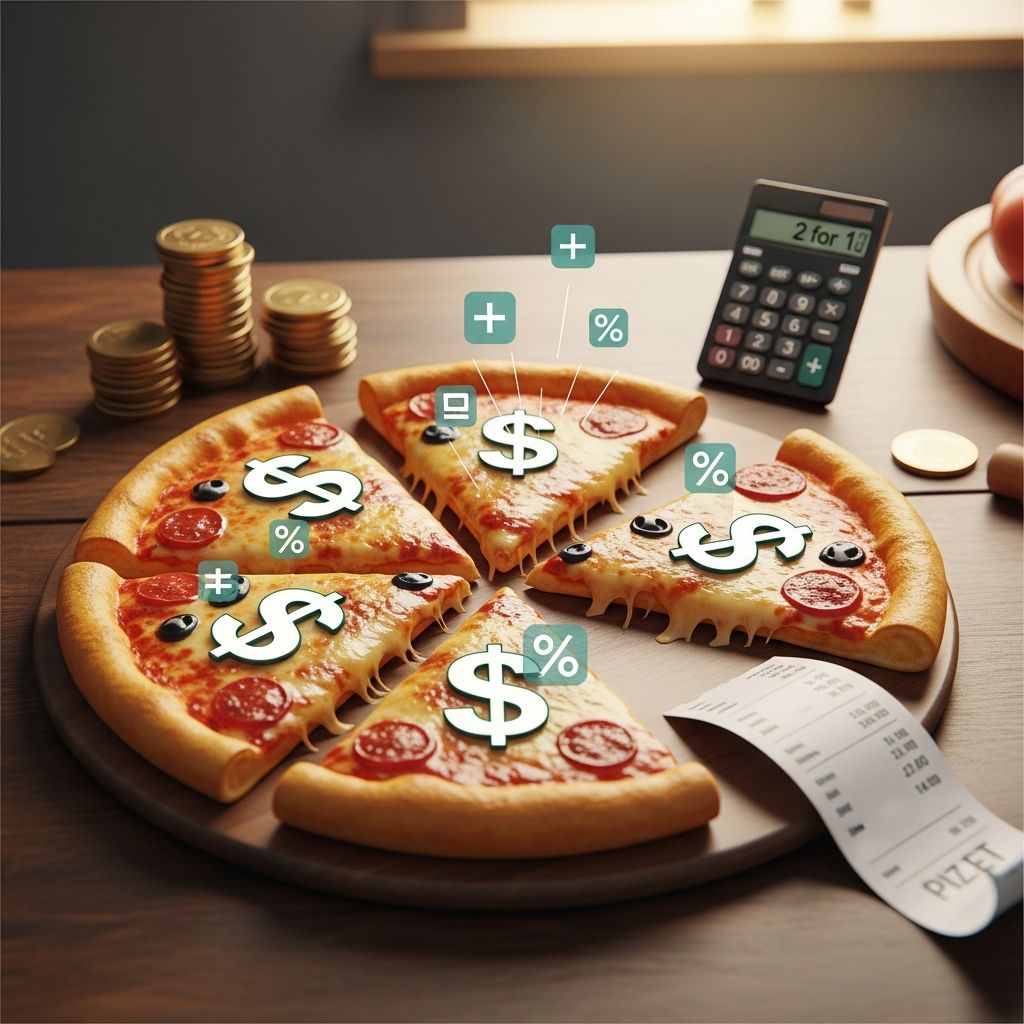
Pizza Deal Math: How to Save Money Every Time You Order Pizza
We’ve all been there at the pizza counter, staring at a menu board displaying various sizes and prices, trying to figure out which option gives us the most pizza for our money. The intuition might tell you that a 16-inch pizza isn’t much bigger than an 8-inch one, but the math tells a very different story. Thanks to some straightforward geometry and price analysis, you can make an informed decision that will save you money every single time you order pizza.
The Pizza Size Misconception
When you look at pizza sizes, your eyes can deceive you. A 16-inch pizza doesn’t look twice as big as an 8-inch pizza, so many people assume it’s only slightly larger and therefore not worth the extra cost. However, this visual perception is misleading because of how pizza is measured.
Pizza is measured by diameter, not by radius. This seemingly small detail creates a massive difference in the actual amount of pizza you’re getting. While the diameter only doubles from 8 inches to 16 inches, the area of the pizza quadruples. Understanding this fundamental principle is the key to always finding the best pizza deal.
The Mathematics Behind Pizza Size
To understand why a larger pizza is always the better deal, we need to revisit a formula from high school geometry: the area of a circle. The formula is πr², where π (pi) equals approximately 3.14159 and r represents the radius of the circle.
The radius is half of the diameter, so when calculating pizza areas, you must first divide the diameter by two. This is where the magic happens. When you square the radius, small increases in diameter create exponentially larger increases in area.
Calculating Pizza Areas
Let’s look at some practical examples:
- 8-inch pizza: Radius = 4 inches. Area = 3.14159 × (4²) = 50.27 square inches
- 12-inch pizza: Radius = 6 inches. Area = 3.14159 × (6²) = 113.10 square inches
- 14-inch pizza: Radius = 7 inches. Area = 3.14159 × (7²) = 153.94 square inches
- 16-inch pizza: Radius = 8 inches. Area = 3.14159 × (8²) = 201.06 square inches
Notice how the 16-inch pizza has four times the area of the 8-inch pizza, even though its diameter is only twice as large. This is the fundamental reason why larger pizzas offer superior value.
How NPR Analyzed Pizza Pricing
The team at Planet Money, a division of NPR, decided to investigate whether the mathematical advantage of larger pizzas translated into real-world savings. They analyzed an impressive dataset of 74,476 prices from 3,678 pizza restaurants across the United States. This comprehensive study provided irrefutable evidence about pizza pricing patterns.
The analysis revealed a consistent trend: smaller pizzas have a significantly higher price per square inch than larger pizzas. This means that restaurants charge proportionally less for pizza when you order a bigger size, even though you might expect them to maintain consistent pricing.
Real-World Pizza Pricing Examples
To illustrate how this works in practice, let’s examine Pizza Hut’s pricing structure, which offers three sizes:
| Pizza Size | Diameter | Area (sq in) | Price | Price Per Sq In |
|---|---|---|---|---|
| Personal Pan | 6 inches | 28.27 | $4.50 | 15.92¢ |
| Medium | 12 inches | 113.10 | $9.99 | 8.83¢ |
| Large | 14 inches | 153.94 | $11.99 | 7.79¢ |
The data is striking. The personal pan pizza costs nearly twice as much per square inch as the large pizza. By ordering the medium instead of the personal pan, you’re already saving approximately 43% per square inch. By ordering the large instead of the medium, you save another 11.8% per square inch.
The Cost of Choosing Smaller Sizes
If you need a specific amount of pizza, choosing smaller sizes instead of ordering one large pizza becomes extraordinarily expensive. According to the NPR Planet Money analysis, if you wanted to get the same amount of pizza as you’d receive in a 16-inch pizza, you would need to purchase multiple smaller pizzas:
- Ordering 14-inch pizzas instead would cost you an extra $2.35
- Ordering 8-inch pizzas instead would cost you an extra $16.41
These numbers represent a staggering difference in cost for the exact same amount of pizza. This is why the mathematics of pizza pricing is so important for budget-conscious consumers.
Why Does This Price Disparity Exist?
You might wonder why restaurants charge less per square inch for larger pizzas. The answer involves several factors:
- Ingredient efficiency: Making one large pizza uses less packaging and handling time than making multiple smaller pizzas
- Marketing strategy: Restaurants want to encourage customers to buy larger sizes, so they offer better unit pricing
- Perceived value: Customers are more likely to notice and question the price of a large pizza, so restaurants keep the per-square-inch cost competitive
- Production economies: Larger pizzas benefit from economies of scale in production and distribution
Making the Smart Pizza Purchase Decision
Armed with this mathematical knowledge, here’s what you should do every time you order pizza:
- Calculate the area of each pizza size using the πr² formula
- Divide the price by the area to get the price per square inch
- Compare the results across all available sizes
- Order the largest pizza with the lowest price per square inch
Most restaurants will show you that the largest available size offers the best value. Even if you can’t finish all the pizza in one sitting, the leftovers are typically excellent the next day, and you’ll still spend less than if you’d ordered multiple smaller pizzas.
Applying Pizza Math to Special Deals
When your local pizzeria runs specials or promotions, it’s even more important to do the math. A “buy one, get one half off” deal on medium pizzas might seem enticing, but it could still work out to a higher price per square inch than a standard large pizza at regular price. Always calculate before you order.
Similarly, when comparing prices between different restaurants, the price-per-square-inch calculation allows you to make meaningful comparisons. One pizzeria might charge $12 for a 14-inch pizza while another charges $13, but the smaller difference in total price might mean very different values per square inch depending on their exact sizes.
The Geometry Lesson That Saves Money
This entire lesson circles back to a fundamental principle of geometry: areas scale with the square of linear dimensions. This isn’t just true for pizza—it applies to any circular food item. Whether you’re buying a cake, a pie, or a cookie, understanding how area increases with radius will help you make smarter purchasing decisions throughout your life.
The pizza theorem demonstrates that mathematics isn’t just an abstract academic subject. It’s a practical tool that directly impacts your wallet. In this case, pizza + math = delicious savings.
Frequently Asked Questions
Q: Is it always cheaper to order a large pizza instead of multiple small pizzas?
A: Yes. Based on NPR’s analysis of over 74,000 pizza prices from nearly 3,700 restaurants, larger pizzas consistently offer better value per square inch. Even if you can’t finish a large pizza in one sitting, leftovers are typically worth the savings compared to multiple smaller pizzas.
Q: How much bigger is a 16-inch pizza than an 8-inch pizza?
A: While the diameter is twice as large, the 16-inch pizza is actually four times the size in terms of area. This exponential relationship comes from the πr² formula used to calculate circular areas.
Q: Can I use the price-per-square-inch calculation for any pizza size?
A: Absolutely. You can apply this calculation to any pizza size at any restaurant. Simply divide the price by the area (calculated using πr²) to determine the value you’re getting for each square inch of pizza.
Q: Do all restaurants follow the same pricing pattern where larger pizzas are cheaper per square inch?
A: The NPR study found this pattern consistent across most restaurants, but it’s always wise to calculate for your specific pizzeria, as individual pricing strategies may vary.
Q: What should I do with leftover pizza?
A: Pizza keeps well when properly stored in the refrigerator for several days or in the freezer for months. Reheating methods range from the oven (for maintaining crust quality) to the microwave (for convenience), making leftovers a practical solution rather than a waste.
References
- The Science Is In: You Should Always Order the Biggest Pizza — Big Think. 2017. https://bigthink.com/surprising-science/the-science-is-in-you-should-always-order-the-biggest-pizza/
- Here’s How to Get More Pizza For Your Money By Using Math — TIME Magazine. 2016. https://time.com/4419238/heres-how-to-get-more-pizza-for-your-money-by-using-math/
- The Area of a Circle Formula and Pizza Pricing — Khan Academy. https://www.khanacademy.org/math/geometry
- NPR Planet Money Pizza Analysis Study — NPR. 2017. https://www.npr.org/
Similar Articles








Read full bio of Sneha Tete