Personal Loans vs. Personal Lines of Credit
Understand the key differences between personal loans and lines of credit to choose the right borrowing option.
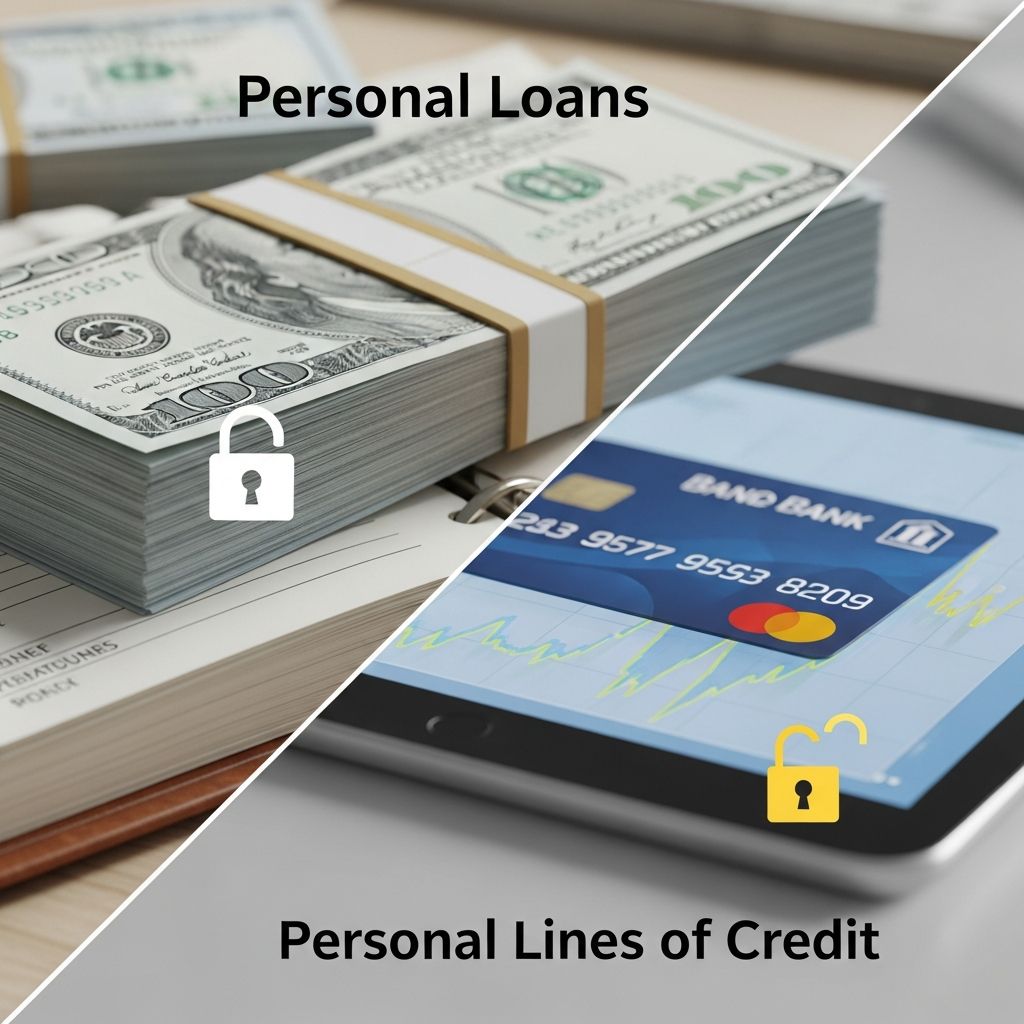
Personal Loans vs. Personal Lines of Credit: Which is Right for You?
When you need to borrow money, you have several options available to you. Two of the most popular choices are personal loans and personal lines of credit. While both can provide the funds you need, they work quite differently and serve different purposes. Understanding the key differences between these two borrowing options is essential to make an informed decision that aligns with your financial goals and circumstances.
Personal loans are best suited for one-time, fixed expenses where you know exactly how much money you need upfront. Personal lines of credit, on the other hand, are ideal for ongoing financing needs or situations where you require flexibility in how much you borrow and when you borrow it. Both options typically offer lower average interest rates compared to credit cards for borrowers with good credit, making them attractive alternatives to high-interest credit card debt.
Key Differences Between Personal Loans and Personal Lines of Credit
Understanding how personal loans and personal lines of credit differ is crucial to selecting the right borrowing option for your specific situation. The differences span several important areas including fund disbursement, interest rates, repayment structures, and eligibility requirements.
How Funds Are Disbursed
One of the most fundamental differences between personal loans and personal lines of credit is how you receive your funds. With a personal loan, you receive a lump sum of money immediately upon approval. This entire amount is deposited into your account, and you begin making monthly payments on the full amount right away, regardless of when or how you plan to use the funds.
In contrast, a personal line of credit provides access to funds as needed during a designated draw period. You can borrow only what you need, when you need it, up to your credit limit. This flexibility means you’re not paying interest on funds you haven’t yet used, making it a more economical choice if you’re unsure about your exact borrowing needs.
Interest Rates and Types
Personal loans typically come with fixed interest rates, meaning your rate remains the same throughout the life of your loan. This provides predictability and stability in your monthly payments. The average interest rates for personal loans typically range from 8% to 36%, depending on your creditworthiness, the lender, and market conditions.
Personal lines of credit, however, usually carry variable interest rates during the draw period. These rates are typically tied to the prime rate plus a lender margin, meaning your rate can fluctuate based on market conditions. Once the draw period ends, many lines of credit convert to fixed rates. The average interest rates for personal lines of credit generally range from 8% to 32%, though this can vary based on your credit profile and the lender.
Repayment Terms and Structures
Personal loans have a fixed repayment term that you agree to at the time of borrowing. Common terms range from one to seven years, and your monthly payments remain consistent throughout the loan’s life. This consistency makes budgeting easier since you know exactly what your payment will be each month.
Personal lines of credit operate differently with a two-phase structure. During the draw period, typically lasting two to five years, you can borrow and repay as needed. In this phase, you may only be required to pay interest on the amount you’ve borrowed. Once the draw period ends, you enter the repayment phase, where you can no longer borrow additional funds. Repayment may involve monthly payments on your remaining balance or, in some cases, a single balloon payment for the entire outstanding balance.
Monthly Payment Variability
Personal loan payments are predictable and consistent each month. Since you have a fixed interest rate and a set repayment term, your payment amount never changes, which helps with financial planning and budgeting.
Personal line of credit payments can vary from month to month, depending on how much you’ve borrowed and the current interest rate. If you have a variable rate during the draw period, your payment could increase or decrease based on rate changes. Additionally, the amount you owe fluctuates based on how much you draw and how much you repay, making your monthly payment less predictable than with a personal loan.
Borrowing Limits
Personal loan lenders often cap loan amounts at around $50,000, though amounts up to $100,000 may be available to borrowers with excellent credit scores and strong financial profiles. This higher limit makes personal loans suitable for larger, one-time expenses.
Personal lines of credit typically have lower credit limits, often closer to $20,000. This lower limit reflects the ongoing nature of the credit line and the additional risk lenders assume with variable-rate products. However, a line of credit’s limit is usually based on your income and financial situation, so it can vary significantly among lenders and borrowers.
Personal Loans Explained
A personal loan is a type of installment loan that provides you with a fixed amount of money that you repay over a set period with fixed monthly payments. Personal loans are unsecured, meaning you don’t need to provide collateral like a home or car to obtain one.
Common Uses for Personal Loans
Personal loans are versatile financial tools that can be used for a wide variety of purposes, including:
- Paying down credit card debt and consolidating multiple balances
- Repaying medical bills and healthcare expenses
- Covering moving costs
- Financing a large purchase
- Covering home improvement projects
- Funding education or professional development
- Managing emergency expenses
Advantages of Personal Loans
- You receive funding in one lump sum, providing immediate access to the full amount you need
- Your payment amount remains consistent each month, making budgeting straightforward
- You have a fixed interest rate and a defined repayment timeline, eliminating rate uncertainty
- The funds can be used for nearly any purpose, giving you maximum flexibility in how you use the money
Disadvantages of Personal Loans
- You may face potential origination fees charged by the lender
- Your monthly payment is based on the full borrowed amount, not just what you use
- Personal loans typically have stricter eligibility requirements than other types of credit
- You must repay the full amount received at disbursement, even if you only needed part of it
Qualifying for a Personal Loan
You can obtain a personal loan from various sources including local banks, credit unions, and online lenders. The best rates are generally reserved for borrowers with good credit, typically a credit score of 670 or higher. However, bad credit personal loans are available through some lenders, though you should expect to pay higher interest rates.
Your interest rate is primarily determined by your credit score. If you have an excellent score above 800, you may qualify for the lender’s lowest rates. Lenders also consider other factors when determining your rate, including your debt-to-income ratio and your requested loan term. A high percentage of income already used for debt payments may result in a higher rate, as the lender views you as a higher risk.
Personal Lines of Credit Explained
A personal line of credit, often abbreviated as PLOC, is an unsecured revolving credit line with a variable interest rate. It functions similarly to a credit card but typically offers lower interest rates. The monthly payment is based solely on the amount you use, not your full credit limit.
How Personal Lines of Credit Work
When you’re approved for a personal line of credit, the lender establishes a credit limit based on your income and financial profile. During the draw period, which typically lasts two to five years, you can borrow up to your limit, repay the borrowed amount, and borrow again as needed. This revolving access to funds distinguishes lines of credit from traditional personal loans.
The monthly payment and interest charges are only calculated on the amount you actually use. For example, if you receive approval for a $10,000 personal line of credit but only need $1,000, your payment is based only on that $1,000 balance. This feature can result in lower monthly payments if you don’t need or want to use all your available funds immediately.
Variable interest rates on personal lines of credit are typically tied to the prime rate plus a lender margin. As the prime rate changes, your interest rate and monthly payment can fluctuate accordingly. After the draw period ends, you enter the repayment phase and can no longer borrow additional funds. At this point, many lines of credit convert to fixed rates for the repayment phase.
Common Uses for Personal Lines of Credit
Personal lines of credit are particularly useful for situations where you need ongoing access to funds or aren’t certain about the exact amount you’ll need. Common uses include:
- Home improvement projects where costs may be unknown or phased
- Overdraft protection on your checking account
- Emergency situations requiring unexpected funds
- Managing temporary cash flow gaps
- Funding major projects with variable expenses
Advantages of Personal Lines of Credit
- You have access to funds as needed throughout the draw period
- Some accounts offer overdraft protection, providing additional safety
- Interest rates are typically much lower than credit card rates
- Your payment is based only on the credit you actually use, not your full limit
Disadvantages of Personal Lines of Credit
- Variable rates may lead to higher payments if interest rates rise
- The draw period is limited compared to credit cards, which have no draw period
- Interest rates are typically higher than home equity lines of credit (HELOCs)
- You typically need good to excellent credit scores to qualify, and a limited credit history can be a deal-breaker
Qualifying for a Personal Line of Credit
Most lenders require good or excellent credit to qualify for a personal line of credit. While you can sometimes get a personal loan with less-than-perfect credit, qualifying for a line of credit with lower credit scores is more challenging. Lenders often have stricter eligibility requirements for lines of credit than for personal loans.
Maintaining good credit practices can help improve your credit score over time. If you repay your line of credit debt as agreed and keep your outstanding balance at or below 30 percent of your credit limit, your credit score can rise over time. This demonstrates responsible credit management to lenders and credit reporting agencies.
Comparison Table: Personal Loans vs. Personal Lines of Credit
| Feature | Personal Loans | Personal Lines of Credit |
|---|---|---|
| How funds are disbursed | Lump sum upon approval | As needed during the draw period |
| Average interest rates | 8%-36% | 8%-32% |
| Type of interest rate | Fixed | Variable |
| Fees | May include origination fees and late fees | May include annual, origination, late payment, or transaction fees |
| Best for | Fixed expenses | Ongoing costs or projects requiring flexibility |
| Borrowing limits | $500 to $100,000 | Typically up to $20,000 |
| Monthly payments | Same each month | Can vary month to month |
| Repayment structure | Fixed term, typically 1-7 years | Draw period (2-5 years) followed by repayment phase |
Making Your Decision: Personal Loan or Personal Line of Credit?
Choosing between a personal loan and a personal line of credit depends on your specific financial situation, borrowing needs, and preferences for payment structure and predictability.
Choose a personal loan if you need a specific amount of money for a particular purpose and want predictable monthly payments. Personal loans work well for large, one-time expenses where you know exactly how much money you need. The fixed interest rate and consistent monthly payment make budgeting easier, and the lump sum funding provides immediate access to the full amount.
Choose a personal line of credit if you need flexibility in how much you borrow and when you borrow it. A line of credit is ideal when you’re unsure about the total amount you’ll need or when you’ll need to access funds. If you prefer lower monthly payments and only want to pay interest on the amount you use, a line of credit offers this advantage. This option works well for ongoing projects or situations requiring fluctuating access to funds.
Consider your credit score when making your decision. If you have less-than-perfect credit but need to borrow, a personal loan may be easier to qualify for than a line of credit. However, if you have good to excellent credit, both options should be available, and you can choose based on your borrowing patterns and preferences.
Bottom Line
Personal loans and personal lines of credit serve similar purposes but function quite differently. A personal loan provides a single lump sum of money that you repay in fixed monthly installments over a predetermined period. A personal line of credit offers ongoing access to funds during a draw period, with payments based only on what you borrow and variable rates that can fluctuate.
The best choice for you will depend on your current financial situation, how much money you need, how quickly you need it, and how you want your repayments to look. Compare both options carefully, and look for lenders offering borrowing terms that fit your specific needs. Take time to understand the fees, interest rates, and repayment structures each lender offers, as these can vary significantly and impact the total cost of your borrowing.
Frequently Asked Questions
Q: What is the difference between a fixed and variable interest rate?
A: A fixed interest rate remains the same throughout your loan term, providing payment predictability. A variable interest rate fluctuates based on market conditions and the prime rate, meaning your monthly payment can increase or decrease over time.
Q: Can I use a personal loan or line of credit for any purpose?
A: Yes, both personal loans and personal lines of credit can generally be used for nearly any purpose, whether for debt consolidation, home improvements, medical expenses, education, or other needs. However, some lenders may have specific restrictions, so it’s best to check with your lender.
Q: What credit score do I need for a personal loan or line of credit?
A: For personal loans, you typically need a credit score of 580 or higher, though better rates are available with scores of 670 or above. For personal lines of credit, most lenders require good to excellent credit, typically 670 or higher, with some requiring scores of 700 or above.
Q: How long does it take to get approved for a personal loan or line of credit?
A: Approval times vary by lender. Online lenders often provide decisions within hours to a few business days, while banks and credit unions may take several business days to a week. Once approved, personal loan funding is typically immediate, while line of credit access may take a few additional days to set up.
Q: What fees should I expect with a personal loan or line of credit?
A: Common fees include origination fees (charged by lenders to process your loan), late payment fees, and annual fees. Some lines of credit may also charge transaction fees. Be sure to ask about all potential fees when comparing lenders and loan products.
Q: Can I pay off a personal loan early?
A: Most personal loans allow early repayment without penalties. Paying off your loan early can save you money on interest. However, always check your loan agreement or ask your lender about their early repayment policy before committing.
References
- Personal Loans vs. Personal Lines of Credit — Bankrate. 2025. https://www.bankrate.com/loans/personal-loans/personal-loan-line-of-credit/
- What Is A Personal Line Of Credit And How Does It Work? — Bankrate. 2025. https://www.bankrate.com/loans/personal-loans/what-is-a-personal-line-of-credit/
- What Is A Personal Loan? What To Know — Bankrate. 2025. https://www.bankrate.com/loans/personal-loans/what-is-a-personal-loan/
- Personal Loan Interest Rate Forecast for 2025 — Bankrate. 2025. https://www.bankrate.com/loans/personal-loans/personal-loan-rates-forecast/
- Pros And Cons Of Personal Loans: Should You Get One? — Bankrate. 2025. https://www.bankrate.com/loans/personal-loans/pros-cons-of-personal-loans/
- Personal Loan Vs. Home Equity Loan: Which Is Better? — Bankrate. 2025. https://www.bankrate.com/loans/personal-loans/personal-loans-vs-home-equity-loans/
- What’s the difference between a personal loan and a line of credit? — Oportun. 2025. https://oportun.com/financial-education/whats-the-difference-between-a-personal-loan-and-a-line-of-credit/
Similar Articles








Read full bio of Sneha Tete