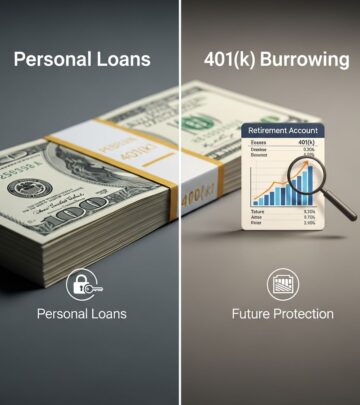
Personal Loan Or 401(k) Loan: How To Choose Smartly
Compare personal loans and 401(k) loans to find the best borrowing option for your financial needs and retirement goals.

When facing unexpected expenses, debt consolidation, or major purchases like home improvements, borrowers often debate between a
personal loan
from a lender and a401(k) loan
from their retirement savings. Each option has unique advantages and risks: 401(k) loans offer low rates and no credit checks but jeopardize retirement growth and carry job-loss penalties, while personal loans provide flexibility, higher limits, and no savings impact but require good credit and higher interest. This guide breaks down how they work, compares costs, and helps you choose based on your situation.How a 401(k) Loan Works
A 401(k) loan lets you borrow from your own retirement account balance, typically up to
$50,000 or 50% of your vested balance
, whichever is less. Funds are available only if your employer’s plan permits loans—not all do. Approval is straightforward: no credit check or income verification is needed since you’re borrowing from yourself.Repayment occurs via automatic payroll deductions over a maximum of
five years
(or longer for primary residence purchases). The interest rate is low—often prime rate plus 1-2% (around 9.5-10.5% as of late 2024)—and the interest paid goes back into your account. However, the borrowed amount stops earning investment returns, which can cost thousands in compound growth over time.If you leave your job (voluntarily or not) before full repayment, the outstanding balance is due immediately—often within 60-90 days. Failure triggers taxes on the amount plus a
10% early withdrawal penalty
if under 59½, turning it into a distribution.Pros and Cons of a 401(k) Loan
401(k) loans appeal for their simplicity but hide significant retirement risks.
Pros of a 401(k) Loan
- Easy approval: No credit check or financial review; just a plan request.
- Low interest: Rates around 9.5-10.5%; interest returns to your account.
- No credit impact: Doesn’t appear on credit reports or affect scores.
- No taxes/penalties if repaid: Avoids early withdrawal issues with on-time payments.
- Quick access: Funds often available in days to weeks.
Cons of a 401(k) Loan
- Retirement growth loss: Borrowed funds miss market returns, potentially costing $10,000+ over decades.
- Job risk: Full repayment due upon leaving employer, or face taxes + 10% penalty.
- Borrowing limits: Capped at $50,000/50% vested balance.
- Double taxation: Repayments use after-tax dollars, taxed again on withdrawal.
- Plan restrictions: Not all 401(k)s allow loans; only one outstanding loan typically.
How a Personal Loan Works
A
personal loan
is unsecured credit from banks, credit unions, or online lenders, ranging from$1,000 to $100,000+
(up to $250,000 from some providers). Funds deposit directly into your bank account for any use: emergencies, debt payoff, weddings, or renovations.Qualification depends on credit score (typically 670+ for best rates), income, and debt-to-income ratio. Rates average
12.35%
(8-36% range as of 2024), fixed for terms of2-7 years
(up to 10+). No collateral needed, but missed payments hurt credit. Prepayment is penalty-free at most lenders.Pros and Cons of a Personal Loan
Pros of a Personal Loan
- Higher limits: Up to $100,000+, ideal for large needs.
- Flexible terms: Customize amount, rate, and repayment (1-7+ years).
- No retirement risk: Preserves 401(k) growth and compounding.
- Quick funding: Approved and funded in 1-3 days.
- Builds credit: On-time payments boost scores.
- Debt consolidation: Lower rates than cards (avg. 12% vs. 20%+).
Cons of a Personal Loan
- Higher rates: Average 12.35%, up to 36% for poor credit.
- Credit check: Applications ding score temporarily; needs good credit.
- Fees: Origination (1-8%), late charges possible.
- No self-interest: Payments go to lender, not your pocket.
401(k) Loan vs. Personal Loan Comparison
Side-by-side analysis highlights trade-offs. Personal loans win on flexibility; 401(k) on cost if job-secure.
| Feature | 401(k) Loan | Personal Loan |
|---|---|---|
| Max Amount | $50,000 or 50% vested | $100,000+ |
| Avg. Rate (2024) | 9.5-10.5% | 12.35% (8-36%) |
| Term | Up to 5 years | 2-7 years |
| Credit Impact | None | Yes (app & payments) |
| Taxes/Penalties | If job loss/default | None |
| Retirement Risk | High (lost growth) | None |
| Availability | Plan-dependent | Widespread |
When to Choose a 401(k) Loan
Opt for 401(k) if:
- Plan allows it and you have sufficient balance.
- Job-secure with steady income for repayments.
- Need < $50,000 short-term, credit poor.
- Temporary bridge (e.g., 6-12 months).
Avoid if markets rising (lost gains hurt) or job unstable.
When to Choose a Personal Loan
Personal loans suit most: higher needs, flexibility, no savings risk. Ideal for:
- Large expenses >$50k (e.g., medical, home).
- Debt consolidation from high-rate cards.
- Job change likely or self-employed.
- Good credit (670+) for rates <12%.
Alternatives to 401(k) and Personal Loans
- 0% balance transfer cards: For small debts, 12-21 months promo.
- Home equity/HELOC: Low rates if equity, but home risk.
- Credit union loans: Competitive rates for members.
- Emergency fund/negotiate bills: Non-borrowing first.
- 401(k) hardship withdrawal: Last resort—taxes/penalties apply.
Frequently Asked Questions
Can I lose my 401(k) loan if I quit or get fired?
Yes, outstanding balance due immediately (often 60 days); else, treated as distribution with taxes + 10% penalty if under 59½.
Does a 401(k) loan affect my credit score?
No, no credit check or reporting. Personal loans do via hard inquiry and payment history.
Are personal loan rates higher than 401(k) loans?
Usually yes (12% vs. 9.5-10.5%), but personal preserves retirement growth.
Can I have both a 401(k) and personal loan?
Yes, but assess total debt load and affordability.
Is a personal loan better for debt consolidation?
Often yes—lower rates than cards, fixed payments, one monthly bill.
Final Thoughts
Personal loans generally outperform 401(k) loans for most by protecting retirement while offering scale and terms—especially with strong credit. Consult a financial advisor for personalized math on opportunity costs. Shop rates via prequalification to minimize impact.
References
- 401(k) Loan vs. Personal Loan — Experian. 2024. https://www.experian.com/blogs/ask-experian/401k-loan-vs-personal-loan/
- 401(k) Loan vs Personal Loan: Which Option is Better? — BHG Financial. 2024. https://bhgfinancial.com/personal-loans/401k-loan-vs-personal-loan
- 401(k) loan or personal loan: Which is right for you? — Prudential Financial. 2024. https://www.prudential.com/financial-education/retirement-vs-personal-loan
- 401k Loan vs Personal Loan — Atmos Financial. 2024. https://www.joinatmos.com/blog/401k-loan-vs-personal-loan
- Borrowing From Your 401(k) vs Getting a Personal Loan — SoFi. 2024-08. https://www.sofi.com/learn/content/401k-loan-vs-personal-loan/
- 401k Loan vs Personal Loan: What’s the Difference? — OneMain Financial. 2024. https://www.onemainfinancial.com/resources/loan-basics/401k-loan-vs-personal-loan
- Taking a 401k loan or withdrawal | What you should know — Fidelity Investments. 2024. https://www.fidelity.com/viewpoints/financial-basics/taking-money-from-401k
Similar Articles








Read full bio of Sneha Tete