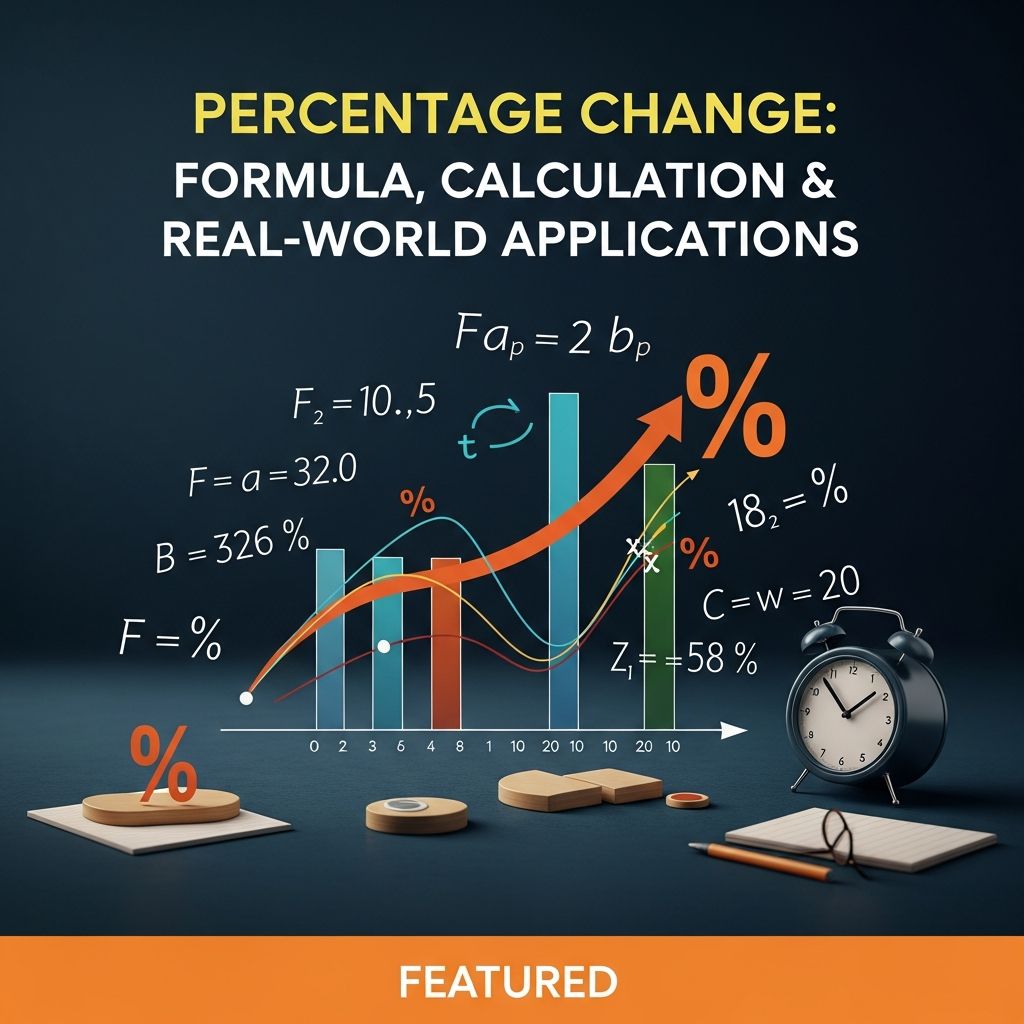
Percentage Change: Formula, Calculation & Real-World Applications
Master percentage change calculations with formulas, examples, and practical applications in finance and investing.
Understanding Percentage Change
Percentage change is a fundamental mathematical concept that measures the degree to which a quantity has increased or decreased relative to its initial value. In financial and business contexts, it represents one of the most critical metrics for analyzing trends, comparing investments, and measuring performance. Whether you’re tracking stock prices, evaluating investment returns, analyzing business growth, or assessing economic indicators, understanding how to calculate and interpret percentage change is essential for making informed decisions.
The importance of percentage change extends across various disciplines, from personal finance to corporate analysis. It provides a standardized way to compare changes of different magnitudes, making it easier to understand relative movements in data. For instance, a $10 increase means something very different if the starting value is $100 versus $1,000, and percentage change captures this distinction effectively.
The Percentage Change Formula
The percentage change formula is straightforward and serves as the foundation for all percentage change calculations. The standard formula is:
Percentage Change = [(New Value – Original Value) / Original Value] × 100
Breaking down this formula:
- New Value: The final or current value of the quantity being measured
- Original Value: The starting or initial value of the quantity
- The Difference: Subtracting the original value from the new value gives you the absolute change
- Division by Original Value: This normalizes the change relative to the starting point, making it comparable across different scales
- Multiplication by 100: Converts the decimal result into a percentage format
This formula works for both increases and decreases. A positive result indicates growth or appreciation, while a negative result indicates decline or depreciation.
Calculating Percentage Increase
A percentage increase occurs when the new value is greater than the original value, resulting in a positive percentage change. This is commonly observed in investment returns, salary increases, price inflation, and business revenue growth.
Example of Percentage Increase:
Suppose a stock was trading at $50 per share last year and is now trading at $65 per share. To calculate the percentage increase:
- New Value = $65
- Original Value = $50
- Percentage Change = [($65 – $50) / $50] × 100 = ($15 / $50) × 100 = 30%
This means the stock price has increased by 30% over the period. This type of calculation helps investors assess whether their investment has performed well relative to their initial purchase price.
Percentage increases are particularly useful for:
- Tracking investment gains and returns on investment (ROI)
- Measuring business growth and revenue expansion
- Analyzing wage and salary growth
- Understanding inflation and cost increases
- Evaluating market performance improvements
Calculating Percentage Decrease
A percentage decrease occurs when the new value is less than the original value, resulting in a negative percentage change. This is commonly observed in asset depreciation, market downturns, cost reductions, and declining sales.
Example of Percentage Decrease:
Consider a property valued at $250,000 that has depreciated to $200,000. To calculate the percentage decrease:
- New Value = $200,000
- Original Value = $250,000
- Percentage Change = [($200,000 – $250,000) / $250,000] × 100 = (-$50,000 / $250,000) × 100 = -20%
This indicates a 20% decrease in property value. Understanding percentage decreases is crucial for:
- Assessing investment losses
- Evaluating asset depreciation
- Understanding market corrections
- Analyzing cost reductions and efficiency improvements
- Measuring declining business performance
Real-World Applications of Percentage Change
Percentage change calculations are ubiquitous in financial analysis and decision-making. Understanding these applications helps you interpret financial news, evaluate investments, and assess economic trends.
Stock Market Analysis
Investors and analysts use percentage change to track stock performance over time. When financial news reports mention that “Stock ABC rose 5% today,” they’re using percentage change calculations. This metric helps investors compare the performance of stocks across different price ranges and assess whether their portfolio is performing as expected.
Investment Returns
The return on investment (ROI) is essentially a percentage change calculation. When you invest $10,000 and it grows to $12,500, the percentage change shows a 25% return. This standardized metric allows investors to compare returns across different investment vehicles, from stocks to real estate to bonds.
Economic Indicators
Economists and policymakers use percentage change to track important economic metrics such as GDP growth, inflation rates, unemployment changes, and consumer spending. These indicators help governments and central banks make decisions about monetary and fiscal policy.
Business Performance
Companies use percentage change to measure revenue growth, profit margins, expense changes, and market share movements. Quarterly earnings reports frequently highlight percentage changes in key metrics like earnings per share (EPS) and revenue.
Real Estate and Asset Valuation
Real estate agents, appraisers, and investors use percentage change to track property value appreciation or depreciation over time. This metric is essential for understanding market trends and investment property performance.
Key Distinctions and Considerations
While percentage change is straightforward, several important considerations and potential pitfalls deserve attention:
Absolute Change vs. Percentage Change
Absolute change measures the actual dollar or unit difference, while percentage change measures the relative change. For example, an increase from $100 to $150 is a $50 absolute change and a 50% percentage change. An increase from $1,000 to $1,050 is also a $50 absolute change but only a 5% percentage change. Percentage change provides better context for comparing changes across different scales.
The Importance of the Base Value
The starting or original value is critical in percentage change calculations. A 20% increase applied to a base of $100 yields $120, while a 20% increase applied to a base of $1,000 yields $1,200. Always verify what the original value is when interpreting percentage changes.
Compounding Effects
When analyzing multiple periods of percentage change, simple addition does not work due to compounding effects. A 50% increase followed by a 50% decrease does not result in no change. For example, a $100 investment increasing 50% becomes $150, but then decreasing 50% becomes $75—a net loss of 25%. This demonstrates why understanding compounding is crucial in long-term financial analysis.
Percentage Change in Comparative Analysis
One of the most powerful uses of percentage change is comparing different scenarios or time periods on an equal footing. This table illustrates how percentage change standardizes comparisons:
| Asset | Starting Value | Ending Value | Percentage Change |
|---|---|---|---|
| Stock A | $25 | $35 | +40% |
| Stock B | $80 | $95 | +18.75% |
| Stock C | $120 | $108 | -10% |
In this comparison, Stock A shows the strongest relative performance at 40% gain, even though it started at the lowest price. Stock B’s absolute dollar increase ($15) was larger than Stock A’s ($10), but Stock A’s percentage increase was superior. This demonstrates why percentage change is a more meaningful metric for investment comparison than absolute dollar changes.
Common Uses in Financial Analysis
Professional analysts and investors rely on percentage change calculations daily:
- Performance Benchmarking: Comparing a fund’s returns to market indices using percentage change
- Trend Analysis: Identifying whether metrics are improving or deteriorating over time
- Valuation Assessment: Understanding whether assets are overvalued or undervalued based on historical percentage changes
- Risk Assessment: Analyzing the volatility of percentage changes to gauge investment risk
- Forecasting: Using historical percentage changes to project future values
Frequently Asked Questions
Q: How do I calculate percentage change if the original value is negative?
A: The formula remains the same. However, the results may be counterintuitive. For example, if a value changes from -$50 to $50, the percentage change would be [($50 – (-$50)) / -$50] × 100 = -200%. When working with negative values, it’s often helpful to consider the context carefully, as percentage changes with negative bases can be misleading.
Q: What’s the difference between percentage change and percentage difference?
A: Percentage change measures change from an initial value to a final value, implying direction and time. Percentage difference is often calculated as the absolute difference between two values divided by their average, and is typically used when there is no clear before-and-after scenario.
Q: Can percentage change be greater than 100%?
A: Yes, absolutely. For example, if a stock goes from $10 to $30, the percentage change is 200%. There is no upper limit to percentage change—theoretically, it can be infinitely large.
Q: Why is the base value so important in percentage change calculations?
A: The base value determines the scale of the percentage. The same absolute change applied to different bases yields different percentages. This is why percentage change is such a powerful tool for standardizing comparisons across different magnitudes.
Q: How do I calculate annualized percentage change?
A: For periods other than one year, you can annualize percentage change using the formula: Annual Rate = (1 + Period Return)^(365/Number of Days) – 1. This standardizes returns to an annual basis for meaningful comparison.
References
- Understanding Financial Mathematics and Calculations — CFA Institute. 2024. https://www.cfainstitute.org
- Financial Analysis and Investment Management Standards — U.S. Securities and Exchange Commission (SEC). 2024. https://www.sec.gov
- Quantitative Financial Analysis Methods — NIST (National Institute of Standards and Technology). 2023. https://www.nist.gov
- Investment Performance Measurement Standards — Global Investment Performance Standards Committee. 2023. https://www.gipsstandards.org
Similar Articles








Read full bio of Sneha Tete