Per Capita Income: Definition, Calculation & Uses
Understanding per capita income: A key metric for measuring economic prosperity and living standards across regions.
What Is Per Capita Income?
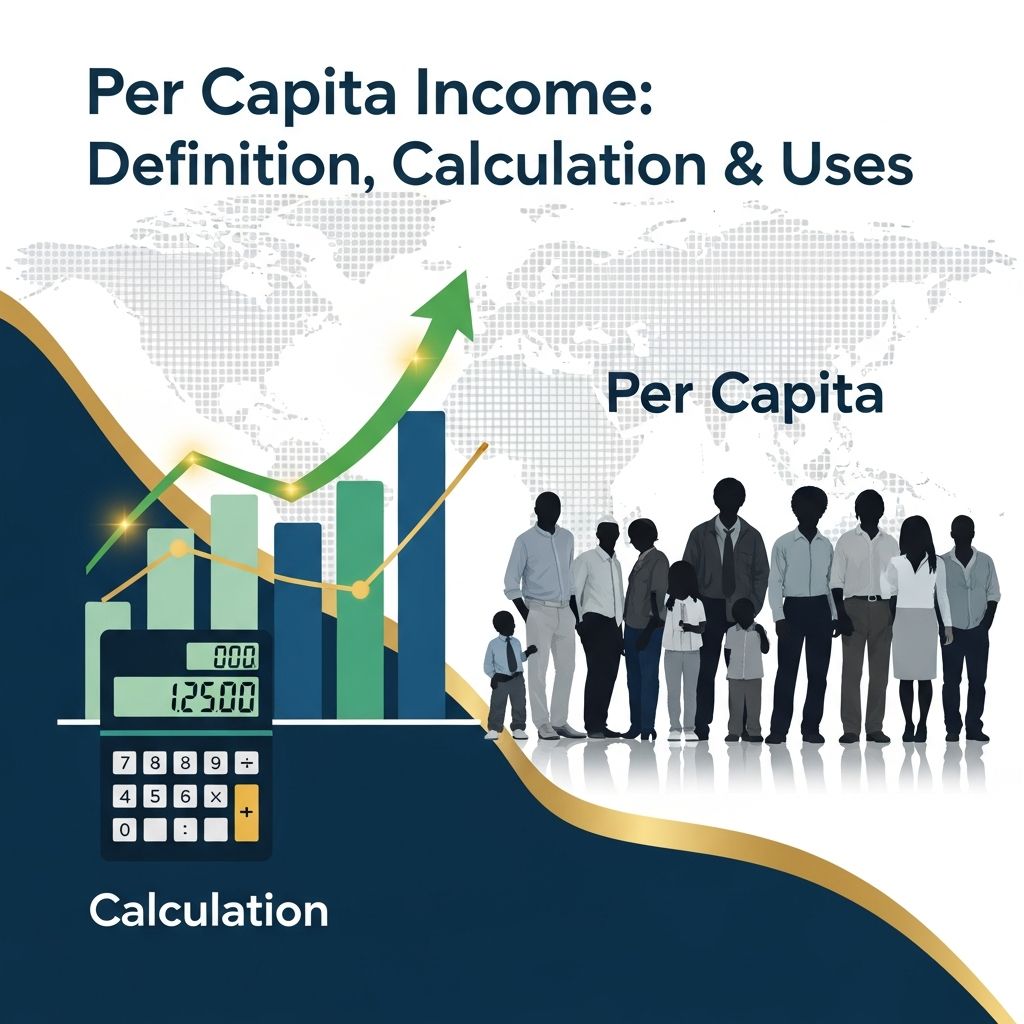
Per capita income is a fundamental economic metric that represents the average income earned per person in a specific geographic area, calculated by dividing the total personal incomes by the total population. This measurement has become increasingly important for researchers, policymakers, and economists seeking to assess and compare the standard of living across different regions, cities, and countries worldwide. By providing a snapshot of economic conditions, per capita income can indicate trends in prosperity and economic development over time, making it a valuable tool for understanding how societies are progressing economically.
The calculation includes all individuals within a region, from children to adults, in the population count. This ensures a comprehensive view of how income is distributed across an entire community. While per capita income offers a useful comparative understanding between two locations, it is important to recognize that this metric only tells us about the amount of money earned by individuals and does not account for factors such as the price of goods and services in different locations or the value of non-purchased goods.
Understanding Per Capita Income
Per capita income calculations have become increasingly important as scholars and policymakers attempt to compare the ways that people live in different countries and cities. By comparing per capita income between two cities, researchers can make informed conclusions about what goods and services residents can afford and assess the relative purchasing power within each community. Additionally, per capita income allows economists to compare how the economy has changed over time in a specific region, helping them understand whether an area is becoming more or less economically prosperous.
In the United States, per capita income calculations allow for detailed comparisons between cities and states. This enables policymakers and researchers to identify places experiencing poverty and economic weakness, facilitating the development of targeted programs to help those areas. The specific calculations are produced using data from the US Department of Commerce’s Bureau of Economic Analysis, which meticulously tracks wages, salaries, and other sources of income such as farms, building rentals, and small businesses.
How Per Capita Income Is Calculated
The calculation of per capita income is straightforward in its methodology. The formula involves dividing the total personal incomes in an area by the total population of that area. For example, if a city has a total personal income of $50 billion and a population of 5 million people, the per capita income would be $10,000 per person. However, this simple calculation masks the complexity of income distribution within any given population.
This calculation is often made in dollars, regardless of the local currency, to facilitate international comparisons. While this standardization enables useful cross-border analysis, it requires careful attention to exchange rates and currency fluctuations when comparing income levels between different countries.
Key Uses of Per Capita Income
Per capita income serves multiple important functions in economic analysis and policy development:
- Comparative Analysis: Enables researchers to compare living standards between geographic regions and assess economic disparities
- Policy Development: Helps policymakers identify economically disadvantaged areas requiring targeted interventions and support programs
- Economic Trending: Allows analysts to track whether a region’s economy is improving or declining over time
- Investment Decisions: Assists investors in identifying regions with growing or declining economic potential
- International Comparisons: Facilitates global economic assessments and development comparisons between nations
- Social Research: Provides scholars with quantifiable data on economic conditions for academic research and studies
Limitations of Per Capita Income
While per capita income is a valuable metric, it has significant limitations that economists and policymakers must carefully consider. Critics point out that per capita income calculations often oversimplify a complex network of economic situations and statuses. One of the most critical limitations is that per capita income does not account for income distribution within a population. A region with a high per capita income may still contain significant income inequality, where a small percentage of the population holds a majority of wealth, leaving many residents in poverty. This masks the true economic reality for many individuals.
Additionally, per capita income does not account for inflation, making historical comparisons challenging without further adjustments. When analyzing how per capita income has changed over decades, economists must perform additional calculations to adjust for inflation and understand how the numbers relate to present-day economic conditions. Furthermore, this metric fails to consider local costs of living, which can vary dramatically between regions. A per capita income of $50,000 may provide a comfortable living in rural areas but prove inadequate in expensive urban centers.
The metric also overlooks non-monetary factors that significantly impact quality of life, such as leisure time, environmental quality, access to healthcare and education, and cultural amenities. It does not measure the value of goods and services that do not need to be purchased or account for non-market activities.
Per Capita Income vs. Other Metrics
To enhance understanding of economic conditions, analysts often combine per capita income with other measurement tools. One particularly important complementary metric is purchasing power parity (PPP), which considers the relative cost of goods and services between regions. Purchasing power parity calculates the comparative cost of basic commodities, such as the price of a loaf of bread or a gallon of milk in different locations. By considering per capita income alongside purchasing power parity, researchers can provide more detailed and accurate comparisons between different locations.
Another important metric is the Human Development Index (HDI), developed by the United Nations in 1990. The HDI considers life expectancy at birth, adult literacy rates, and per capita GDP to measure a country’s level of development. This multifaceted approach provides a more comprehensive picture of economic health and human well-being than per capita income alone.
The Relationship Between Per Capita Income and Standard of Living
Per capita income is closely related to, but distinct from, the broader concept of standard of living. Standard of living refers to the level of wealth, comfort, material goods, and necessities available to a certain socioeconomic class or geographic area. While per capita income is one component of standard of living, the latter encompasses many additional factors such as employment opportunities, cost of goods and services, poverty rates, life expectancy, inflation rates, access to quality healthcare, quality and availability of education, infrastructure, and environmental quality.
The standard of living is measured by factors that are easily quantified, making it more tangible than related concepts. Comparing the standard of living in different regions allows economists to assess whether populations have access to adequate housing, healthcare, education, and employment opportunities. For instance, the standard of living in the United States has greatly improved over the past century, with the same amount of work now purchasing larger quantities of goods and items that were once considered luxuries, such as refrigerators and automobiles. Leisure time has increased while annual hours worked have decreased.
Real-World Applications and Examples
Per capita income calculations are applied in numerous real-world contexts. In the United States, comparisons can be made between individual states to identify regional economic disparities. Cities can also be compared; for example, analysts might compare per capita income in New York City versus Detroit to understand economic differences between these urban centers. International comparisons allow economists to assess how the United States compares to other developed nations like Canada or to developing nations worldwide.
These comparisons reveal important patterns. Developed nations typically have higher per capita incomes than developing nations, though this alone does not tell the complete story about quality of life or economic opportunity. By examining per capita income trends over multiple years or decades, economists can identify whether a region is experiencing economic growth or decline, though inflation adjustments are necessary for meaningful historical analysis.
Challenges in International Comparisons
Comparing per capita income between different locations presents several challenges that researchers must address. Price of goods and services can differ widely between regions due to factors such as local production costs, taxation, transportation expenses, and market conditions. A dollar spent in one country may purchase significantly more or fewer goods than the same dollar spent in another country. This is why purchasing power parity calculations are essential when making international comparisons.
Currency exchange rates add another layer of complexity to international comparisons. Exchange rates fluctuate constantly, and using current exchange rates to convert per capita income figures between countries may not accurately represent the true purchasing power available to residents. Historical comparisons are further complicated by the need to adjust for inflation, which varies between countries and over time.
Income Distribution and Economic Inequality
One of the most significant limitations of per capita income is that it does not reflect income distribution patterns within a population. Two regions with identical per capita incomes may have vastly different economic situations. In one region, income might be relatively evenly distributed, with most residents earning close to the average. In another region, income might be highly concentrated, with a small wealthy elite and a large poor population. Per capita income would show the same figure for both regions, despite dramatically different lived experiences for most residents.
This limitation is particularly important for policymakers seeking to understand poverty and inequality. A high per capita income figure can mask severe poverty affecting significant portions of the population. Economists increasingly use supplementary measures such as median income, income distribution percentiles, and Gini coefficient calculations to better understand inequality alongside per capita income figures.
Adjusting for Inflation
When analyzing per capita income over time, inflation adjustments are essential. Without accounting for inflation, comparing per capita income from different years can be misleading. A per capita income of $30,000 in 2000 represented significantly more purchasing power than $30,000 in 2023. Economists address this by converting historical figures into constant dollars, typically using a base year for reference. This adjustment allows meaningful comparisons of how real income has changed over time, separate from the effects of inflation on the value of money.
Frequently Asked Questions
What is the difference between per capita income and median income?
Per capita income is the average income calculated by dividing total income by total population, while median income is the midpoint income where half the population earns more and half earns less. Median income often provides a better representation of typical earnings when income distribution is unequal.
How does per capita GDP differ from per capita income?
Per capita GDP measures the average economic output per person, while per capita income measures the average income earned per person. These related metrics approach economic measurement from different angles but can be complementary when used together.
Why is purchasing power parity important when comparing per capita income?
Purchasing power parity adjusts for differences in cost of living between regions, making per capita income comparisons more meaningful by accounting for what income can actually purchase in different locations.
Can per capita income alone determine if a country is developed?
No. While per capita income is one factor, the United Nations’ Human Development Index considers multiple factors including life expectancy and literacy rates for a more comprehensive assessment of development.
How often is per capita income calculated?
In the United States, per capita income is regularly calculated and updated by the Bureau of Economic Analysis using data on wages, salaries, and other income sources, allowing for frequent monitoring of economic conditions.
References
- Per Capita Income — EBSCO Research Starters. 2025. https://www.ebsco.com/research-starters/politics-and-government/capita-income
- Standard of Living vs. Quality of Life: What’s the Difference? — Investopedia. March 7, 2019. https://www.investopedia.com/articles/financial-theory/08/standard-of-living-quality-of-life.asp
- Why Nations Fail: The Origins of Power, Prosperity, and Poverty — Acemoglu, Daron and James A. Robinson. Crown Business, 2013.
- The Rise and Fall of American Growth: The U.S. Standard of Living Since the Civil War — Gordon, Robert J. Princeton University Press, 2016.
- Putting Per-Capita Income Back into Trade Theory — Journal of International Economics, vol. 90, no. 2, 2013. https://doi.org/10.1016/j.jinteco.2013.04.003
- Bureau of Economic Analysis — U.S. Department of Commerce. https://www.bea.gov/
Similar Articles








Read full bio of medha deb