Pegged vs Floating Currencies: A Comprehensive Guide
Understand the differences between pegged and floating exchange rate systems and their impact on global trade.
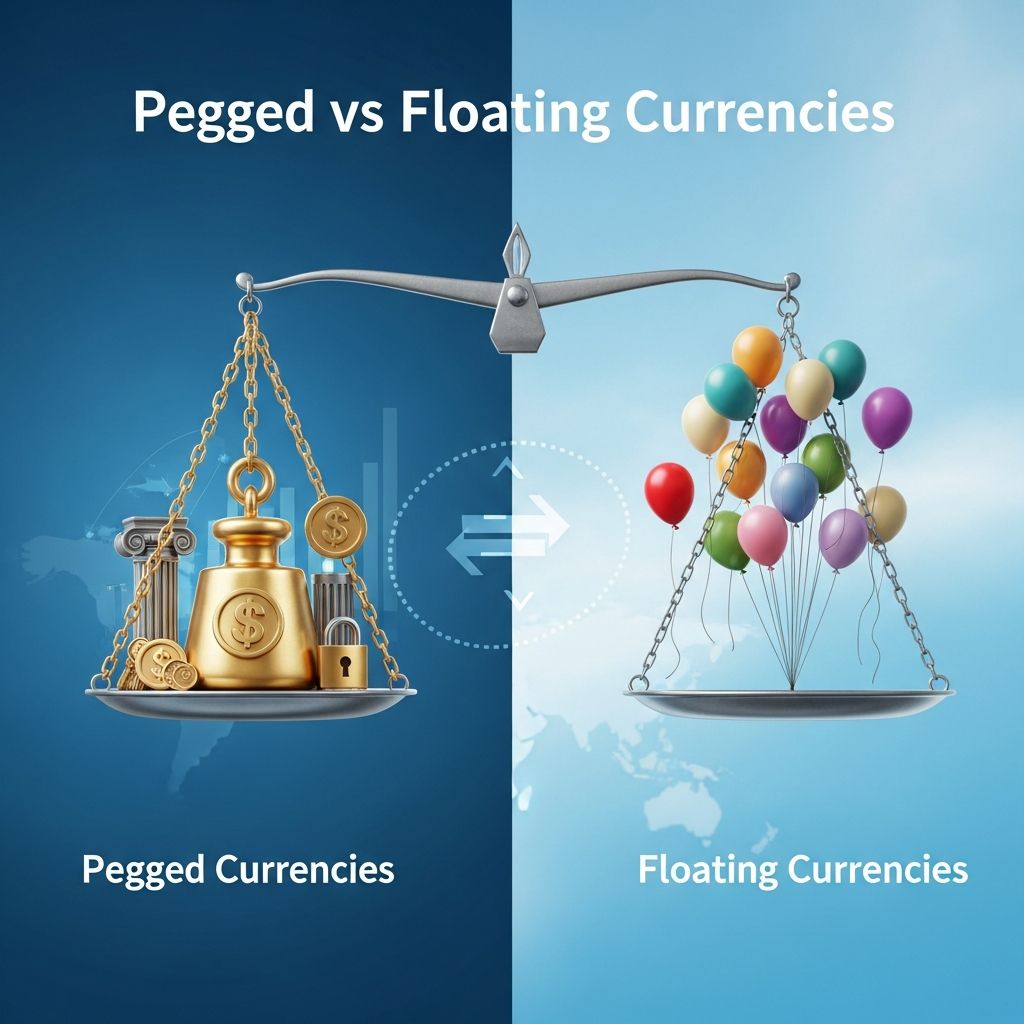
Pegged vs Floating Currencies: Understanding Exchange Rate Systems
Exchange rate systems form the backbone of international trade and finance. Every country must decide how to manage its currency’s value relative to other currencies. The two primary approaches—pegged and floating exchange rates—represent fundamentally different philosophies about currency management. Understanding these systems is essential for investors, businesses, and policymakers navigating the global economy.
The choice between a pegged or floating exchange rate system has profound implications for economic stability, inflation control, trade relationships, and investment strategies. This guide explores both systems in detail, examining their mechanisms, advantages, disadvantages, and real-world applications.
Understanding Fixed and Pegged Exchange Rates
A fixed exchange rate, also known as a pegged exchange rate, represents a system where a currency’s value is tied to another currency, a basket of currencies, or a commodity such as gold or silver. The monetary authority commits to maintaining a specific exchange rate, preventing the currency from fluctuating freely based on market forces.
Historically, the gold standard served as the primary fixed exchange rate mechanism. Countries would tie their currency values directly to gold, creating a stable international monetary system. This system functioned relatively well until the mid-20th century, when countries began abandoning gold-backed currencies in favor of more flexible approaches.
In a pegged exchange rate system, the monetary authority establishes an official exchange rate and maintains it through active intervention in currency markets. For example, if a country pegs its currency to the US dollar, it commits to exchanging its currency at a specified rate against the dollar. The Danish krone provides a practical illustration: it is pegged to the euro at a rate of 1 euro equaling 7.46 kroner, though it can fluctuate within a narrow band between 7.29 and 7.62 kroner per euro.
How Pegged Currencies Work
When a country establishes a pegged exchange rate, participating nations agree upon an initial target exchange rate and set a fluctuation range outlining acceptable deviations from that target. This creates a stable anchor for the currency while allowing for minor market movements.
Key mechanisms of pegged systems include:
- Target exchange rates agreed upon by participating countries
- Fluctuation ranges (narrow bands of ±1% or wide bands of ±30%)
- Regular reviews and adjustments to accommodate changing economic conditions
- Central bank intervention to maintain the peg when market pressures emerge
- Potential devaluation or revaluation when economic circumstances shift significantly
Pegged exchange rate agreements typically require periodic review to adapt target rates and acceptable fluctuation ranges to evolving economic circumstances. When a currency’s actual market value diverges significantly from its pegged value, governments may choose to reset the peg or abandon it entirely.
The Advantages of Pegged Currencies
Pegged exchange rate systems offer several compelling advantages, particularly for smaller or developing economies:
Currency Stability: By pegging to a major currency, smaller economies reduce currency volatility and make their economies more attractive to international investors and trading partners. Investors can more confidently engage in business with currencies that maintain predictable values.
Trade Facilitation: Smaller economies conducting significant trade with a particular country benefit from pegging to that country’s currency. This eliminates exchange rate risk and makes pricing more predictable for both exporters and importers.
Inflation Control: A pegged exchange rate can serve as a disciplinary mechanism, forcing governments to maintain more disciplined monetary policies. Countries cannot simply inflate their currency away when tied to a more stable anchor currency.
Reduced Speculation: By maintaining a target exchange rate backed by the central bank’s commitment and reserves, pegged systems can discourage certain types of currency speculation that might otherwise destabilize the economy.
Capital Flows: A stable, predictable exchange rate encourages direct foreign investment and makes it easier for companies to plan international business operations.
The Disadvantages of Pegged Currencies
Despite their advantages, pegged exchange rate systems present significant challenges and risks:
Loss of Monetary Policy Flexibility: According to the Mundell-Fleming model, with perfect capital mobility, a fixed exchange rate prevents governments from using domestic monetary policy to achieve macroeconomic stability. The central bank must prioritize maintaining the peg over addressing domestic economic conditions.
Vulnerability to Speculation: Pegged systems can attract investor speculation if the market perceives the peg as unsustainable. This may exert pressure on the currency’s value and force the central bank to expend reserves defending the peg.
Reserve Depletion: Maintaining a peg requires holding substantial foreign currency reserves. If speculators attack the currency or market conditions shift adversely, the central bank may exhaust its reserves trying to defend the peg.
Dependent on Reference Value: A pegged currency becomes dependent on its reference value to dictate its worth. When the reference currency rises or falls, the pegged currency must follow suit, regardless of domestic economic conditions.
Periodic Crises: Soft pegs have proven vulnerable to financial crises that can trigger large devaluations or complete abandonment of the peg. When the market determines that a peg cannot be sustained, rapid currency collapses often follow.
Understanding Floating Exchange Rates
A floating exchange rate, also called a flexible exchange rate, is determined by market forces—supply and demand for the currency in foreign exchange markets. No central authority commits to maintaining a specific exchange rate. Instead, the currency’s value adjusts continuously based on economic conditions, interest rates, inflation expectations, and other market factors.
In a freely floating regime, the monetary authority rarely intervenes in currency markets except during disorderly conditions. This contrasts with managed floating regimes, where the central bank intervenes more frequently to limit excessive volatility while still allowing the exchange rate to move based on underlying economic fundamentals.
Floating exchange rates are most common in countries with stable, mature economies such as the United States, Great Britain, Australia, and Canada. These nations have the economic strength and institutional capacity to function effectively without a fixed exchange rate anchor.
The Advantages of Floating Currencies
Floating exchange rate systems provide several important benefits:
Monetary Policy Autonomy: Floating rates allow central banks to implement monetary policy focused on domestic objectives like controlling inflation and managing unemployment. The exchange rate adjusts to reflect these policies rather than constraining them.
Automatic Adjustment Mechanism: Floating currencies make exchanges more efficient because markets adjust automatically for fluctuations in value. If a country experiences rising inflation, its currency naturally depreciates, making exports cheaper and imports more expensive, which helps restore balance.
Market-Driven Efficiency: Prices determined by market forces rather than government decree tend to allocate resources more efficiently. The exchange rate reflects true economic conditions and expectations.
Resilience to Shocks: While floating rates can be volatile, they avoid the crisis-prone dynamics of pegged systems where market pressure can force unsustainable devaluations.
No Reserve Requirements: Countries need not maintain large foreign currency reserves to defend a particular exchange rate level.
The Disadvantages of Floating Currencies
Floating exchange rate systems also present significant challenges:
Currency Volatility: Floating exchange rates can result in larger and more frequent fluctuations in currency values compared with pegged regimes. This volatility creates uncertainty for businesses engaged in international trade and investment.
Unpredictable Business Costs: Companies cannot accurately predict future revenue and costs when dealing with volatile exchange rates. This uncertainty can discourage international business activities and direct foreign investment.
Speculation Risk: Floating rates can attract speculative trading that amplifies currency movements beyond what economic fundamentals alone would justify.
Inflation Vulnerability: Without the disciplinary anchor of a fixed peg, governments may be tempted to pursue inflationary monetary policies.
Pegged vs Floating: A Comparative Overview
| Characteristic | Pegged Exchange Rate | Floating Exchange Rate |
|---|---|---|
| Exchange Rate Determination | Fixed by monetary authority | Determined by market forces |
| Volatility | Low and predictable | Higher and variable |
| Monetary Policy | Limited independence | Full independence |
| Inflation Control | Disciplined by anchor | Central bank responsibility |
| Reserve Requirements | Substantial reserves needed | Minimal reserves needed |
| Crisis Risk | Subject to speculative attacks | Absorbs shocks gradually |
| Best For | Small, developing economies | Mature, stable economies |
Soft Pegs: The Middle Ground
Between hard fixed pegs and freely floating regimes exists a middle approach: soft pegs. These currencies maintain relatively stable values against an anchor currency or composite of currencies while allowing for limited fluctuation.
Soft pegs typically permit exchange rate movement within narrow bands (±1 percent) or wider bands (up to ±30 percent). Over time, the peg itself may move up or down, usually reflecting differences in inflation rates between countries.
Examples of soft peg systems include Costa Rica, Hungary, and China. Although soft pegs maintain a firm nominal anchor to settle inflation expectations, they allow for limited monetary policy flexibility to address economic shocks. However, soft pegs remain vulnerable to financial crises that can lead to large devaluations or peg abandonment.
Current Global Trends
As of recent international data, 48 countries maintain hard pegs, 60 countries operate soft peg systems, and 79 countries employ floating exchange rates on a de facto basis. This distribution reflects significant changes from the early 1990s, when the global financial system featured different proportions.
An important trend termed the “hollowing out of the middle” emerged during the 1990s and early 2000s, with countries moving away from soft pegs toward either hard pegs (more resilient to capital inflows) or floats (eliminating the need to defend a specific exchange rate level).
More recently, within the floating group, many countries have begun managing exchange rates rather than allowing completely independent floats. Simultaneously, soft pegs have regained some popularity as countries seek middle-ground solutions, unable or unwilling to commit to hard pegs but uncertain about embracing full flexibility.
Choosing the Right System
The decision to adopt a pegged or floating exchange rate system depends on multiple factors specific to each country’s economic situation:
- Economic Integration: Countries with high trade integration benefit from pegged systems that eliminate exchange rate risk.
- Shock Symmetry: Nations experiencing similar demand shocks due to comparable industry structures benefit from sharing a fixed exchange rate.
- Economic Development: Smaller or developing economies more frequently adopt pegs, while mature economies typically use floating rates.
- Inflation History: Countries with histories of high inflation may benefit from the discipline imposed by pegging to a stable currency.
- Foreign Exchange Reserves: Countries with substantial reserves can better maintain a peg without exhausting their resources.
- Capital Mobility: Countries with highly mobile capital may struggle to maintain soft pegs during market stress.
Real-World Examples
Understanding real-world applications clarifies how these systems function in practice. The United States operates a freely floating currency, allowing the Federal Reserve to pursue independent monetary policy. The euro area uses a fixed exchange rate system internally (one euro equals one euro everywhere) while the euro itself floats against other currencies.
Many developing nations peg their currencies to the US dollar to reduce volatility and anchor inflation expectations. However, history demonstrates that pegs, while useful, are not permanent. When economic conditions change sufficiently or market pressures become overwhelming, countries may be forced to abandon or significantly reset their pegs.
Frequently Asked Questions
What is the primary difference between pegged and floating exchange rates?
A pegged exchange rate is fixed by the monetary authority at a target level, while a floating exchange rate is determined by market supply and demand forces. Pegged systems prioritize currency stability, while floating systems allow automatic adjustment based on economic conditions.
Why do developing countries typically choose pegged exchange rates?
Smaller, developing economies often peg their currencies to reduce volatility, control inflation, and make their currencies more attractive to international investors and trading partners. A pegged currency signals economic stability and disciplined monetary policy.
What are the risks of maintaining a pegged exchange rate?
The primary risks include vulnerability to speculative attacks, depletion of foreign currency reserves, loss of monetary policy flexibility, and potential currency crises if the market determines the peg cannot be sustained.
Can a country switch from a pegged to a floating exchange rate system?
Yes. Countries can transition between exchange rate systems, though such transitions can be turbulent. When a pegged currency becomes unsustainable due to market pressure or economic change, governments may be forced to float the currency or reset the peg level.
Which system is better for international trade?
Pegged systems reduce exchange rate uncertainty, making international trade more predictable. Floating systems allow exchange rates to adjust automatically, improving long-term resource allocation. The optimal system depends on specific country circumstances and trading relationships.
References
- Fixed vs. Pegged Exchange Rates — Corporate Finance Institute. Accessed 2025. https://corporatefinanceinstitute.com/resources/foreign-exchange/fixed-vs-pegged-exchange-rates/
- Exchange Rates and their Measurement — Reserve Bank of Australia. Accessed 2025. https://www.rba.gov.au/education/resources/explainers/exchange-rates-and-their-measurement.html
- Fixed Exchange Rate System — Wikipedia. Accessed 2025. https://en.wikipedia.org/wiki/Fixed_exchange_rate_system
- Exchange Rate Basics: What you should know — Salem Five Bank. Accessed 2025. https://www.salemfive.com/education-center/money-management-article-index/article-exchange-rate-basics/
- Exchange Rate Regimes: Fix or Float — International Monetary Fund. March 2008. https://www.imf.org/external/pubs/ft/fandd/2008/03/basics.html
Similar Articles








Read full bio of Sneha Tete