PEG Ratio: Price-to-Earnings Growth Valuation
Understanding PEG ratio for smarter stock valuation and investment decisions.
PEG Ratio: Understanding Price-to-Earnings Growth
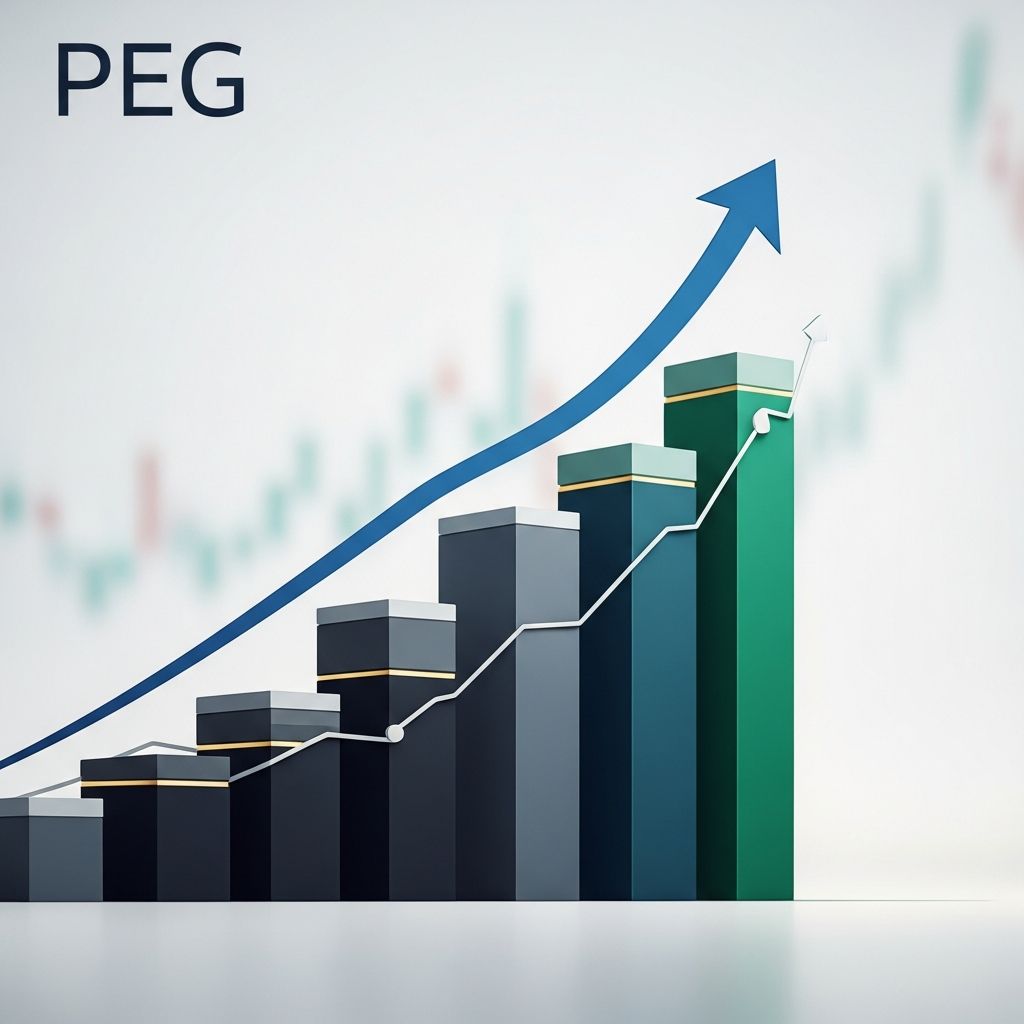
The PEG ratio, or Price/Earnings-to-Growth ratio, is a valuation metric that helps investors determine whether a stock is undervalued or overvalued by comparing its price-to-earnings (P/E) ratio to its expected earnings growth rate. This metric addresses one of the primary limitations of traditional P/E ratios by factoring in the company’s growth prospects. The PEG ratio provides a more nuanced view of whether a company’s valuation is justified by its growth potential, making it particularly useful for evaluating growth stocks that may have higher P/E ratios than the broader market.
Definition and Formula
The PEG ratio is calculated using a straightforward formula that divides the P/E ratio by the projected annual earnings growth rate, typically expressed as a percentage. The standard calculation is:
PEG Ratio = Price-to-Earnings Ratio ÷ Earnings Growth Rate
For example, if a company has a P/E ratio of 50 and an expected annual earnings growth rate of 25 percent, its PEG ratio would be 2.0 (50 ÷ 25 = 2.0). This simple calculation normalizes the P/E ratio relative to the company’s growth trajectory, allowing investors to compare valuations across different companies and industries more meaningfully.
How the PEG Ratio Works
The PEG ratio operates on the principle that faster-growing companies justify higher P/E ratios. A high P/E ratio might indicate a company is overvalued, but if that company is growing earnings at an exceptional rate, the higher valuation might be justified. Conversely, a company with a lower P/E ratio might appear attractive until you consider that its growth rate is also declining.
The beauty of the PEG ratio lies in its ability to standardize P/E ratios across different growth scenarios. A PEG ratio of 1.0 is often considered a fair valuation, suggesting that the market price fairly reflects the company’s growth prospects. A PEG ratio below 1.0 may indicate undervaluation, while a ratio above 1.0 might suggest overvaluation, though these thresholds can vary depending on market conditions and industry sectors.
PEG Ratio vs. P/E Ratio
While the P/E ratio is a widely used valuation metric, it has significant limitations when evaluating growth stocks. The P/E ratio alone doesn’t account for earnings growth, which means two companies with identical P/E ratios might be in very different valuation positions if one is growing much faster than the other.
Consider two technology companies:
- Company A: P/E ratio of 40, expected earnings growth of 5% annually
- Company B: P/E ratio of 40, expected earnings growth of 30% annually
Using only the P/E ratio, both companies appear equally valued. However, Company A’s PEG ratio would be 8.0 (40 ÷ 5), suggesting significant overvaluation, while Company B’s PEG ratio would be 1.33 (40 ÷ 30), indicating a more reasonable valuation. This comparison demonstrates why the PEG ratio provides superior insight for investors evaluating companies with different growth profiles.
Advantages of the PEG Ratio
The PEG ratio offers several compelling advantages for investors seeking to make more informed decisions:
- Growth-Adjusted Valuation: By incorporating growth expectations, the PEG ratio provides a more complete picture of whether a company’s valuation is justified relative to its earnings expansion potential.
- Comparative Analysis: The PEG ratio facilitates meaningful comparisons between companies of different sizes, industries, and growth rates, allowing investors to identify relative value opportunities more effectively.
- Reduced Distortion: The metric helps reduce the distortion created by cyclical industries or temporary earnings fluctuations that can skew P/E ratio interpretations.
- Growth Stock Evaluation: For investors interested in growth stocks, which typically trade at premium valuations, the PEG ratio offers a rational framework for assessing whether those premiums are warranted.
- Simple Interpretation: With a benchmark of 1.0, the PEG ratio is intuitive and easy to interpret, making it accessible to both professional and retail investors.
Limitations and Considerations
Despite its usefulness, the PEG ratio has notable limitations that investors should understand:
- Growth Rate Estimates: The PEG ratio relies heavily on projected earnings growth rates, which are inherently uncertain and subject to analyst forecasting errors. Small changes in growth estimates can significantly impact the PEG ratio.
- Historical vs. Forward-Looking: Different investors may use historical growth rates or forward-looking estimates, creating inconsistencies in PEG calculations. Forward estimates are more conceptually sound but more uncertain.
- Long-Term Growth Sustainability: The metric may not adequately account for the sustainability of projected growth rates or the quality of earnings driving that growth.
- Industry Variations: Different industries have different normalized growth rates and P/E multiples, making universal PEG benchmarks less reliable for cross-sector comparisons.
- Capital Structure Neglect: The PEG ratio doesn’t account for capital structure, debt levels, or cash flow quality, which are important considerations in comprehensive stock analysis.
- Cyclical Companies: For cyclical or mature companies with declining growth, the PEG ratio may be less informative and potentially misleading.
Calculating PEG Ratio: Step-by-Step Example
To illustrate the practical application of the PEG ratio, consider a real-world example:
Scenario: A software company trades at $100 per share with annual earnings of $4, and analysts project 20% annual earnings growth over the next five years.
Step 1: Calculate the P/E ratio: $100 ÷ $4 = P/E of 25
Step 2: Identify the earnings growth rate: 20% annually
Step 3: Divide P/E by growth rate: 25 ÷ 20 = PEG ratio of 1.25
A PEG ratio of 1.25 suggests the stock is slightly overvalued relative to its growth prospects, though reasonable valuations can extend above 1.0 in strong growth environments.
When to Use PEG Ratio in Investment Analysis
The PEG ratio is most valuable in specific investment scenarios:
- Growth Stock Screening: When identifying and evaluating high-growth companies, the PEG ratio helps distinguish between fairly valued growth stocks and those trading at excessive premiums.
- Sector Comparisons: When comparing companies within the same industry with different growth profiles, the PEG ratio provides normalized valuation insights.
- Market Correction Analysis: During market downturns, the PEG ratio can help identify quality growth companies trading at unusually attractive valuations.
- Transitional Companies: For companies transitioning from mature to growth phase or vice versa, the PEG ratio captures the valuation implications of changing growth dynamics.
PEG Ratio and Market Conditions
The interpretation of PEG ratios can vary based on broader market conditions. During bull markets or periods of optimism, investors typically accept higher PEG ratios as justified by growth expectations. Conversely, during bear markets or economic uncertainty, the market may demand PEG ratios closer to 1.0 or lower.
Interest rate environments also influence PEG ratio interpretation. When interest rates are low, investors are more willing to pay premium valuations for growth, potentially supporting higher acceptable PEG ratios. Rising interest rates tend to compress valuations for growth stocks, making lower PEG ratios more attractive.
Complementing PEG with Other Metrics
While the PEG ratio is valuable, it should not be used in isolation. Investors should combine PEG ratio analysis with other fundamental and technical metrics for comprehensive evaluation:
- Free Cash Flow Yield: Assess whether growth is supported by actual cash generation
- Return on Equity (ROE): Evaluate management’s effectiveness in deploying capital
- Debt-to-Equity Ratio: Determine financial stability and leverage levels
- Price-to-Sales Ratio: Provide an alternative valuation perspective less susceptible to accounting decisions
- Dividend Yield and Payout Ratio: Understand shareholder return policies
Frequently Asked Questions
Q: What is a good PEG ratio?
A: A PEG ratio of 1.0 is generally considered fair value, suggesting the stock price appropriately reflects growth expectations. Ratios below 1.0 may indicate undervaluation, while ratios above 1.0 could suggest overvaluation. However, context matters—strong growth companies may warrant PEG ratios above 1.0, and acceptable levels vary by industry and market conditions.
Q: How is PEG ratio different from P/E ratio?
A: The P/E ratio measures current valuation relative to earnings but ignores growth prospects. The PEG ratio incorporates expected earnings growth, providing a growth-adjusted valuation metric. This makes PEG particularly useful for evaluating high-growth companies where P/E ratios alone may be misleading.
Q: Can PEG ratio be negative or zero?
A: PEG ratios can be problematic for unprofitable companies or those with negative earnings, making the calculation impossible or meaningless. For companies with very low or negative projected growth, PEG ratios may also be unreliable as valuation guides.
Q: How do I find PEG ratios for stocks?
A: Many financial websites, investment research platforms, and stock analysis tools calculate and display PEG ratios. Popular sources include Yahoo Finance, Seeking Alpha, Morningstar, and brokerage research platforms. You can also calculate it manually using the formula: P/E ratio ÷ earnings growth rate.
Q: Is PEG ratio better than P/E for all stocks?
A: No. PEG is most useful for growth stocks. For mature, stable-dividend-paying companies, simpler metrics like P/E ratio, dividend yield, or price-to-book ratio may be more appropriate. The best approach combines multiple metrics for comprehensive analysis.
Q: What growth rate should I use for PEG calculation?
A: Most investors use analyst consensus estimates for next-year or forward earnings growth rates. Some prefer historical growth rates or use long-term projections. Consistency matters—ensure you’re using the same methodology across companies for meaningful comparisons.
References
- Investopedia: PEG Ratio Definition and Explanation — Investopedia. 2025. https://www.investopedia.com/terms/p/pegratio.asp
- Financial Accounting Standards Board (FASB): Earnings Per Share Standards — FASB Official Publications. 2023. https://www.fasb.org
- CFA Institute: Equity Valuation Methodologies — CFA Institute Research. 2024. https://www.cfainstitute.org
- Journal of Financial Economics: Growth Stock Valuation Metrics — Elsevier Academic Press. 2023. DOI: 10.1016/j.jfineco.2023.05.001. https://doi.org/10.1016/j.jfineco.2023.05.001
- U.S. Securities and Exchange Commission: Investment Analysis Guidance — SEC Investor Education. 2024. https://www.sec.gov/investor
Similar Articles








Read full bio of medha deb