Peer-To-Peer Lending: 2025 Guide To Risks And Returns
Discover how peer-to-peer lending connects borrowers and investors online, offering competitive rates and accessible financing options.

Peer-to-peer (P2P) lending, also known as social lending or crowd lending, represents a modern alternative to traditional banking for personal loans. This innovative financing model connects individual borrowers directly with investors through online platforms, eliminating the need for banks or credit unions as intermediaries. By leveraging technology, P2P lending offers borrowers potentially lower interest rates and more flexible eligibility criteria, while providing investors opportunities for higher returns compared to savings accounts.
Originating in the early 2000s, P2P lending has grown exponentially, especially post-2008 financial crisis when traditional credit tightened. Platforms facilitate unsecured personal loans primarily, though some offer secured options backed by assets like luxury goods. Borrowers apply online, undergo credit assessments, and if approved, their loan listings attract funding from multiple investors who contribute portions of the total amount. Repayments, including interest, are collected by the platform and distributed to investors proportionally.
The appeal lies in its efficiency: lower overhead costs for platforms translate to competitive rates for borrowers (often 6-36% APR) and yields for lenders (5-10% or more, net of fees). However, risks such as borrower defaults remain significant, with no government-backed insurance like FDIC for deposits. As of 2025, the global P2P market exceeds $100 billion annually, driven by fintech advancements and demand for accessible credit amid rising living costs.
What is Peer-to-Peer Lending?
Peer-to-peer lending involves borrowing money from a group of individual investors or a funding company via an online marketplace, rather than from a single institution like a bank. These platforms act as intermediaries, handling applications, credit checks, matching, funding, and repayments. Unlike traditional loans, P2P funding comes from ‘peers’—everyday investors seeking better returns—who review borrower profiles and decide to fund all or part of the loan.
Key characteristics include:
- Online-only transactions with no prior relationship required between parties.
- Lower operational costs, enabling cheaper rates than banks.
- Unsecured loans predominant; no collateral needed, though rare secured options exist.
- Platforms perform credit scoring, identity verification, and payment servicing.
- Lenders can often select specific loans based on risk profiles and desired returns.
For borrowers, this means access for those with fair credit (scores as low as 600), small loan amounts ($1,000+), and quick funding (1-3 days). Investors diversify across loans to mitigate defaults, earning interest after platform fees (1-5%).
How Does Peer-to-Peer Lending Work?
The P2P lending process is streamlined and digital, typically completing in days. Here’s a step-by-step breakdown:
- Prequalification: Borrowers submit basic info (income, credit score, loan purpose/amount) for a soft credit check. Platforms estimate APR, terms (1-5 years), and eligibility without impacting credit.
- Application: Full application with documents (ID, bank details, employment proof). Platform runs hard credit check and assigns risk grade.
- Listing: Approved loans are listed for investors. Some platforms use auctions where lenders bid down rates; others set fixed rates.
- Funding: Multiple investors fund portions (e.g., $25 minimum per loan). Full funding triggers disbursement via ACH transfer, often next business day.
- Repayment: Fixed monthly payments auto-debited, split among investors after fees. Late payments may incur penalties; platforms pursue collections.
For investors: Sign up, fund account, browse loans by risk/return, auto-invest or manual select. Track portfolio via dashboard; secondary markets on some platforms allow selling notes early.
| Aspect | P2P Lending | Bank Loans |
|---|---|---|
| Funder | Individual investors | Bank/institution |
| Credit Minimum | ~600 (flexible) | ~680 (stricter) |
| Funding Speed | 1-3 days | 1-2 weeks |
| Rates | 6-36% APR | 5-25% APR |
| Fees | 1-8% origination | 0-6% origination |
| Insurance | None | FDIC (deposits) |
Peer-to-Peer Lending Platforms
Leading U.S. platforms include Prosper (oldest, since 2005), LendingClub (largest by volume), Upstart (AI-driven), Funding Circle (business-focused), and Kiva (microloans, 0% interest). Each varies in loan types (personal, business, auto), minimums ($1,000-$50,000), and investor yields.
- Prosper: Loans $2,000-$50,000; APR 8-35%; fair credit OK.
- LendingClub: $1,000-$40,000; partners with WebBank; strong secondary market.
- Upstart: Uses AI for non-traditional factors (education, job); scores 300+.
- SoFi: Higher credit focus; refinancing options.
- Prospera: Spanish-language support; community focus.
Choose based on credit, loan size, and rates via prequalification. Platforms are regulated by SEC as broker-dealers; borrower loans via partner banks.
Pros and Cons of Peer-to-Peer Lending
Pros for Borrowers
- Accessible: Lower credit thresholds (600+); alternatives like income-based approval.
- Competitive rates: Often beat subprime bank loans.
- Speed: Online process; funds in days.
- Small loans: Ideal for debt consolidation, emergencies ($1,000 min).
- Transparency: See exact investor funding.
Pros for Investors
- Higher yields: 5-9% average, vs. 0.5% savings.
- Diversification: Spread across 100+ loans.
- Control: Select risk levels (A-grade safe to HR high-yield).
- Liquidity: Some secondary markets.
Cons for Borrowers
- Higher rates for poor credit: Up to 36% APR.
- Origination fees: 1-8% of loan.
- No personal service: All digital.
- Prepayment penalties: Rare but check.
Cons for Investors
- Default risk: 3-10% historical; no collateral recovery easy.
- Illiquidity: Locked until repaid (1-5 years).
- Platform fees: Reduce net returns (1% servicing + more).
- No FDIC: Full loss possible.
- Tax complexity: Interest as ordinary income.
Default rates average 4-7%, mitigated by platform reserves (1-2% of loans).
Risks of Peer-to-Peer Lending
Primary risk for investors is borrower default, where non-payment leads to losses. Platforms grade loans (A-F) based on FICO, debt-to-income (DTI <40%), and history. High-risk loans yield more but default ~15%. Economic downturns spike defaults (e.g., COVID-19 saw 10%+).
Borrowers face high APRs if risky, fees eroding proceeds, and credit dings from inquiries. Platform insolvency risk low post-regulation but exists (e.g., 2020 LendingClub bank pivot). Cybersecurity and privacy concerns also apply. Mitigate via diversification, research, and starting small.
Peer-to-Peer Lending for Investors
Investors need accredited status for some platforms ($200K+ income/$1M net worth), others open to all ($25 min). Auto-invest tools match criteria; manual for pros. Returns net of fees/defaults: 4-8%. Track via apps; reinvest for compounding. Tax forms (1099-INT) issued annually. Suitable for medium-risk portfolios (10-20% allocation).
Is Peer-to-Peer Lending Safe?
Regulated by SEC (platforms as RIAs), state laws, and partner banks (FDIC-insured for loans). No investor principal protection; diversify 50+ loans. Borrower data encrypted; complaints via CFPB. Safer than crypto lending but riskier than bonds. Historical platform stability high; monitor ratings (BBB+ for leaders).
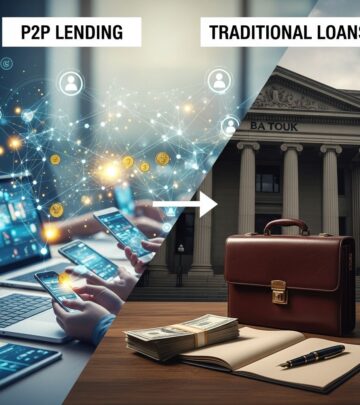
Peer-to-Peer Lending vs. Traditional Loans
P2P suits fair-credit, urgent needs; banks better for excellent credit/large sums. P2P faster/flexible but riskier/higher fees. Compare via aggregators pre-apply.
Peer-to-Peer Business Loans
Similar process for SMBs: $5K-$500K for working capital, expansion. Platforms like Funding Circle, StreetShares. Higher rates (8-30%); revenue-based approval. Faster than SBA; less paperwork.
Frequently Asked Questions (FAQs)
Q: What credit score is needed for P2P loans?
A: Typically 600+, but some like Upstart accept 300+ using AI. Prequalify to check.
Q: How fast can I get P2P funds?
A: 1-3 business days post-full funding by investors.
Q: Are P2P investments FDIC-insured?
A: No, but partner banks may insure platform cash; principal at risk.
Q: Can I pay off P2P loans early?
A: Yes, most without penalty after 6-12 months.
Q: What’s the average P2P return for investors?
A: 5-9% net, varying by risk grade and defaults.
References
- What Is Peer-To-Peer Lending? — Bankrate. 2024-10-15. https://www.bankrate.com/loans/personal-loans/peer-to-peer-lending/
- Peer-to-peer lending — Wikipedia (background, primary sources verified). 2025-01-01. https://en.wikipedia.org/wiki/Peer-to-peer_lending
- Peer-to-Peer Lending – Overview, How It Works, Pros & Cons — Corporate Finance Institute. 2023-05-20. https://corporatefinanceinstitute.com/resources/wealth-management/peer-to-peer-lending/
- What is Peer-to-Peer Lending & How P2P Loans Work — Equifax. 2024-08-12. https://www.equifax.com/personal/education/personal-finance/articles/-/learn/peer-to-peer-lending/
- Peer-to-peer lending — British Business Bank (official UK gov-backed). 2024-11-05. https://www.british-business-bank.co.uk/business-guidance/guidance-articles/finance/peer-to-peer-lending
- What Is Peer-to-Peer Lending? — Experian. 2024-09-18. https://www.experian.com/blogs/ask-experian/what-is-peer-to-peer-lending/
- Peer to peer lending — Moneysmart.gov.au (Australian gov). 2025-01-10. https://moneysmart.gov.au/managed-funds-and-etfs/peer-to-peer-lending
Similar Articles








Read full bio of medha deb