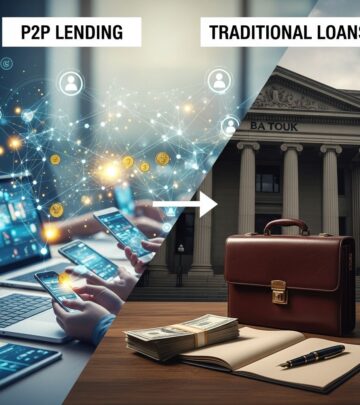
Peer-to-Peer Lending: Direct Borrowing From Individuals
Understand how P2P lending connects borrowers directly with individual investors for faster, alternative financing solutions.

Peer-to-peer (P2P) lending has emerged as a modern alternative to traditional banking, revolutionizing how individuals access credit and invest their money. Instead of borrowing from conventional financial institutions like banks or credit unions, P2P lending enables borrowers to obtain funds directly from individual investors through dedicated online platforms. This innovative financial model has transformed the lending landscape by making capital more accessible, reducing intermediary costs, and creating opportunities for investors to earn returns on their money.
What Is Peer-to-Peer Lending?
Peer-to-peer lending represents a fundamental shift in how credit is distributed and accessed. At its core, P2P lending is a financial arrangement where individuals borrow money directly from other individuals without involving traditional financial institutions as intermediaries. This contrasts sharply with conventional lending models where banks and credit unions act as gatekeepers, evaluating creditworthiness and determining loan terms.
In the P2P model, both borrowers and lenders participate through specialized online lending platforms designed to facilitate transactions, verify identities, and establish trust between parties. These platforms serve as marketplaces where borrower profiles meet investor capital, creating a decentralized lending ecosystem. Borrowers can use P2P loans for virtually any purpose, including medical expenses, home improvements, auto repairs, debt consolidation, vacations, moving costs, or wedding expenses, depending on the platform’s specific rules and restrictions.
The appeal of P2P lending lies in its accessibility and efficiency. For borrowers, it offers an alternative when traditional lending channels prove restrictive. For investors, it provides an opportunity to generate passive income by earning interest on their invested capital. The online nature of these platforms has democratized lending, allowing individuals to participate in the credit market without requiring institutional licenses or significant capital reserves.
How Peer-to-Peer Lending Works
The mechanics of P2P lending differ depending on whether you participate as a borrower or lender. Understanding both perspectives provides a comprehensive view of the ecosystem.
The Borrower’s Journey
For borrowers seeking funds through P2P platforms, the process typically begins with prequalification. Many platforms allow potential borrowers to obtain prequalification without triggering a hard credit inquiry, meaning your credit score remains unaffected. During prequalification, you’ll receive estimates of loan amounts and interest rates you might qualify for, helping you assess whether P2P lending suits your needs.
Once you decide to proceed, you’ll complete a formal loan application on the platform. This step involves submitting detailed financial information and specifying your loan requirements. At this stage, the platform typically performs a hard credit check—similar to what traditional lenders conduct—which may temporarily impact your credit score. The platform uses this information to assess your creditworthiness and determine your eligibility for funding.
Approval timelines vary significantly among platforms. While some lenders approve loans within hours, others may require days or weeks for processing and verification. Once approved by one or multiple lenders willing to fund your request, you can close the loan and receive your funds, usually through direct deposit to your bank account.
Repayment follows a structured schedule of fixed monthly payments, which include both principal and interest charges. The interest rate you’ll pay depends on factors including your credit score, loan amount, loan term, and the platform’s assessment of your risk profile. Unlike some alternative lending options, P2P loans typically don’t involve variable interest rates or balloon payments, providing predictability in your financial planning.
The Lender’s Perspective
For individuals interested in becoming P2P lenders, the process begins with research and platform selection. After choosing a platform that aligns with your investment goals and risk tolerance, you’ll open an account and deposit funds you’re willing to lend.
The platform presents you with various borrower profiles and loan requests, each detailing the borrower’s financial situation, loan purpose, and desired interest rate. As a lender, you review these profiles and decide which loans align with your investment strategy. Many platforms allow lenders to distribute capital across multiple borrowers, potentially reducing risk through diversification.
Once you select loans to fund, your capital is pooled with other investors’ contributions to meet the borrower’s funding needs. As borrowers make monthly payments, you receive your proportional share of principal and interest, creating a stream of passive income. However, lenders should understand that P2P investing carries inherent risks, particularly the possibility of borrower default, and there’s no guarantee of achieving anticipated returns.
Advantages of Peer-to-Peer Lending
P2P lending offers several compelling benefits for borrowers seeking alternative financing:
Flexible Credit Requirements
One of P2P lending’s most significant advantages is its flexibility regarding credit scores. Most P2P platforms accept borrowers across a wide range of credit profiles, including those with less-than-perfect credit histories. This inclusivity makes P2P lending accessible to individuals who might face rejection from traditional lenders due to poor credit scores or limited credit history.
Rapid Funding
Speed represents another major advantage of P2P lending. Many platforms can approve and fund loans within one to two days, matching or exceeding the efficiency of traditional personal loans. This rapid turnaround proves invaluable for borrowers facing urgent financial needs, such as emergency medical procedures or time-sensitive home repairs.
Lower Barrier to Entry for Investors
For investors, P2P lending eliminates traditional barriers to entering the credit market. Unlike bond investments or commercial lending opportunities, P2P platforms allow individuals to begin investing with modest amounts of capital. This democratization of lending creates income-generating opportunities for retail investors previously excluded from institutional lending markets.
Transparent Fee Structure
P2P platforms typically maintain transparent fee structures, clearly disclosing all costs associated with borrowing. Borrowers know exactly what interest rates they’ll pay and what fees the platform charges, enabling informed financial decision-making without hidden surprises.
Convenience and Accessibility
The entirely online nature of P2P lending eliminates geographic barriers and time constraints associated with traditional banking. Borrowers and lenders can access platforms 24/7 from any location with internet connectivity, making the lending process fundamentally more convenient than visiting physical bank branches.
Disadvantages and Risks of Peer-to-Peer Lending
Despite its advantages, P2P lending carries significant drawbacks and risks worthy of consideration.
Default Risk for Lenders
Lenders face the possibility that borrowers may default on their loans, resulting in partial or total loss of invested capital. Unlike bank deposits protected by federal insurance, P2P lending investments lack comparable protection. If a borrower defaults, lenders typically have limited recourse and cannot expect the platform to compensate them for losses.
Limited Consumer Protections
Borrowers facing difficulty repaying their loans discover that P2P lenders typically offer far fewer accommodations than traditional financial institutions. Traditional banks often work with struggling borrowers through loan modification, forbearance, or other relief options. P2P platforms rarely provide equivalent support, leaving borrowers with fewer options during financial hardship.
Higher Interest Rates
Despite P2P lending’s accessibility benefits, interest rates can sometimes exceed those offered by traditional lenders, particularly for borrowers with marginal credit profiles. The premium rates compensate investors for the elevated default risk they assume.
Variable Platform Quality
Not all P2P lending platforms operate with equal integrity and sophistication. Platform quality varies significantly, affecting borrower experience, fee structures, and likelihood of successful loan funding. Poor platform choices can result in delayed funding, unexpected fees, or inadequate borrower verification processes.
Market Volatility
P2P lending markets can experience volatility, particularly during economic downturns when default rates increase. Lenders may find their investment returns significantly diminished during recessions or periods of economic stress.
Is Peer-to-Peer Lending Safe?
P2P lending is generally considered safe when borrowers and lenders use reputable, well-established platforms. However, safety depends largely on selecting platforms with strong regulatory compliance, transparent operations, and robust verification processes.
For borrowers, safety concerns primarily involve ensuring their personal and financial information is protected through secure platforms with encryption and data protection standards. Reputable platforms implement multi-factor authentication, secure payment processing, and privacy protocols that safeguard sensitive data.
For lenders, safety involves understanding the platforms’ underwriting standards, default rates, and risk management practices. Examining a platform’s historical performance data, borrower default rates, and loss recovery mechanisms helps lenders assess safety and make informed investment decisions.
Conducting thorough research before selecting any P2P platform is essential. Reviewing independent reviews, checking regulatory status with financial authorities, and understanding platform fee structures all contribute to safer P2P lending experiences.
Comparing P2P Lending to Traditional Lending
| Factor | P2P Lending | Traditional Lending |
|---|---|---|
| Credit Requirements | Flexible; accepts wide range of credit scores | Stricter; typically requires good to excellent credit |
| Approval Speed | 1-2 days in many cases | 3-7 business days typical |
| Interest Rates | Variable based on risk assessment | Generally lower for qualified borrowers |
| Accessibility | Online only; 24/7 availability | Limited to business hours; branch-dependent |
| Borrower Support | Limited hardship assistance | Extensive modification and forbearance options |
| Investor Protection | No insurance protection | FDIC insurance for deposits |
Key Considerations Before Using P2P Lending
Before committing to P2P lending, whether as a borrower or lender, consider these important factors:
– Thoroughly research multiple platforms and compare fees, interest rates, and terms- Review independent ratings and user reviews from reputable financial websites- Understand all fees, including origination fees, platform fees, and servicing charges- For borrowers: assess whether you can comfortably meet monthly payment obligations- For lenders: diversify investments across multiple borrowers to reduce default risk- Verify the platform’s regulatory compliance and licensing status- Read all terms and conditions carefully before committing funds- Consider your alternative options and compare total costs across lending sources
Frequently Asked Questions About P2P Lending
Q: What credit score do I need for P2P lending?
A: P2P lending platforms typically accept borrowers with a broader range of credit scores than traditional lenders. While specific requirements vary by platform, many accept credit scores as low as 580-600, though better rates apply to higher scores. Prequalification helps determine your likelihood of approval without affecting your credit score.
Q: How long does P2P loan approval take?
A: Approval timelines vary by platform, ranging from a few hours to several weeks. Many established platforms can approve loans within 1-2 business days. After approval, funding typically occurs through direct deposit within 1-3 additional business days.
Q: What happens if I default on a P2P loan?
A: Defaulting on a P2P loan has consequences similar to traditional loan defaults, including damage to your credit score, potential collection actions, and difficulty obtaining future credit. However, P2P lenders typically offer fewer options than traditional banks for borrowers experiencing financial hardship.
Q: Is P2P lending a good investment for generating income?
A: P2P lending can generate passive income through interest payments, but it carries risks including borrower default and potential total loss of capital. Diversifying across multiple loans reduces individual default risk, but investors should only commit capital they can afford to lose.
Q: What fees are associated with P2P lending?
A: Borrowers typically pay origination fees (1-8% of loan amount) and platform servicing fees. Lenders may face account maintenance fees or transaction fees. Fee structures vary significantly among platforms, making comparison essential before selecting a lender.
Q: Can I prepay my P2P loan without penalties?
A: Most P2P lending platforms allow prepayment without penalty, though policies vary. Check your specific loan agreement and platform terms to confirm whether you can make early payments without additional charges.
Q: How is P2P lending regulated?
A: P2P lending platforms operate under state and federal regulations that vary by jurisdiction. They typically must register with financial regulatory agencies, implement Know Your Customer (KYC) procedures, and comply with anti-money laundering (AML) requirements. However, regulatory oversight is less comprehensive than traditional banking.
Conclusion
Peer-to-peer lending has fundamentally transformed the lending landscape by creating direct connections between borrowers and individual investors through innovative online platforms. For borrowers, P2P lending offers flexibility, accessibility, and speed that traditional banks often cannot match, particularly for those with less-than-perfect credit. For investors, P2P platforms provide opportunities to generate passive income and participate in the credit market with modest capital investments.
However, P2P lending is not without risks. Borrowers must understand that lenders offer minimal hardship assistance, and investors must accept the possibility of borrower defaults and potential capital loss. Selecting reputable, well-regulated platforms and conducting thorough research remains essential for safe and successful P2P lending experiences.
Whether P2P lending is right for your financial situation depends on your individual circumstances, risk tolerance, and financial goals. By understanding how P2P lending works, weighing its advantages and disadvantages, and carefully evaluating available platforms, you can make informed decisions that align with your broader financial strategy.
References
- What Is Peer-to-Peer Lending? — OneMain Financial. October 15, 2025. https://www.onemainfinancial.com/resources/loan-basics/what-is-peer-to-peer-lending
Similar Articles








Read full bio of Sneha Tete