Peak Debt and Income
Understanding how peak debt levels and stagnant incomes trap households in financial distress and paths to recovery.
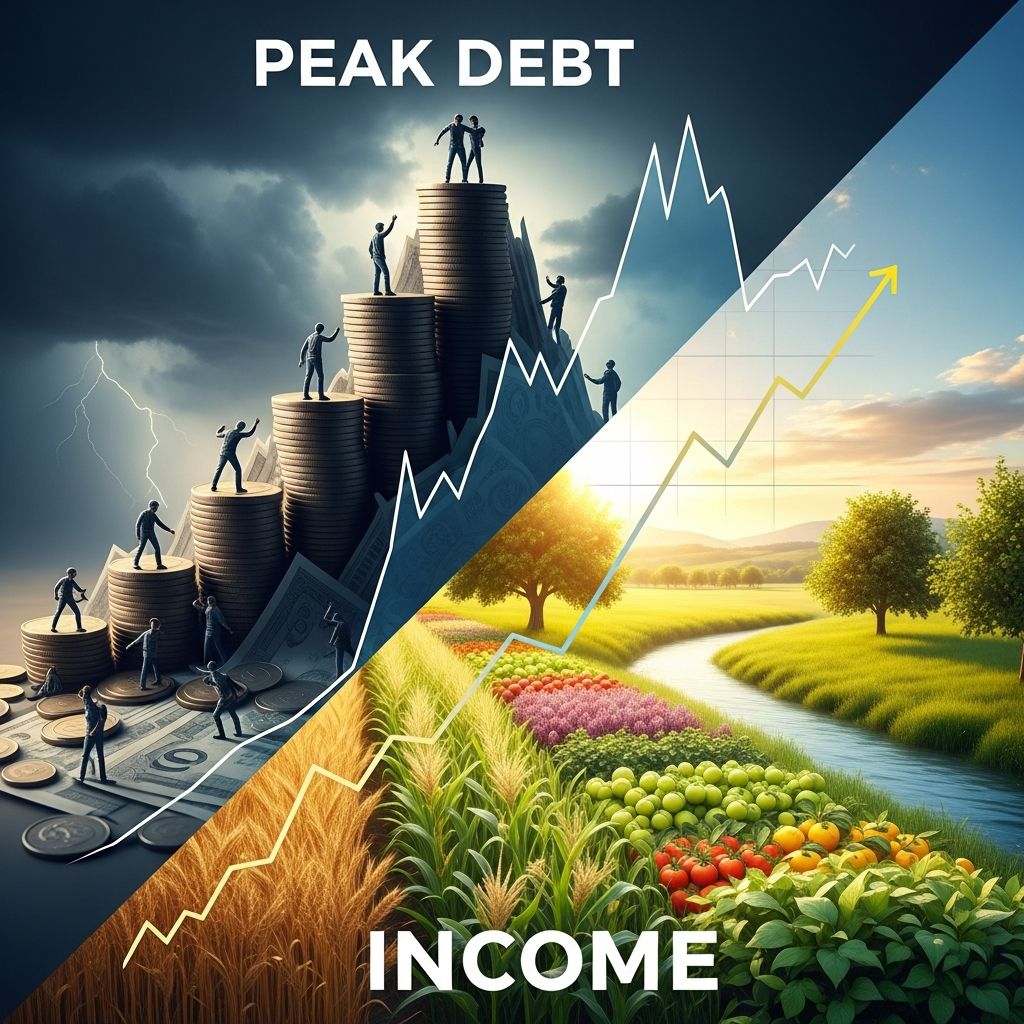
Household debt in the United States has reached unprecedented levels, often referred to as ‘peak debt,’ where consumers can no longer sustain additional borrowing. This situation creates a spending limit defined by income minus savings and debt service, plus any new debt—which at peak levels, grinds to a halt. Understanding this dynamic is crucial for individuals and the broader economy, as it explains why recovery from financial crises takes time and why alternative paths like higher incomes could accelerate healing.
The Spending Limit: Income, Savings, Debt Service, and New Debt
At its core, consumer spending is constrained by a simple equation: what you earn minus what you save and pay on existing debts, plus whatever new debt you can take on. During normal times, new borrowing fuels consumption, but at peak debt, households hit a wall. Credit dries up because lenders see risk, and borrowers recognize they can’t afford more. This ‘peak debt’ concept, popularized in economic discussions, highlights how over-leveraged balance sheets prevent further expansion.
For many families, daily expenses including mortgage, car payments, and credit card minimums leave no room for additional obligations. Data from the Bureau of Economic Analysis shows wages and salaries as a share of national income have declined, exacerbating the issue. In recent years, an extra $2.2 trillion in wages could have transformed household balance sheets, allowing faster deleveraging.
The Long Slow Fix: Frugality and Debt Paydown
The traditional path to recovery is the ‘long slow fix’: everyone spends less than they earn, directing surpluses to savings or debt reduction. This approach works but is protracted and painful. Serious frugality might free up 10-20% of income, but with debt loads at 100-130% of disposable income for many households, progress is glacial.
Challenges include:
- Disproportionate pain: Lower-income and middle-class families bear the brunt, as they have less buffer between expenses and earnings.
- Economic contraction: As households deleverage, consumer spending drops, leading to job losses, wage stagnation, and reduced profits, prolonging the downturn.
- Asset sales: Distressed sales of homes, cars, and businesses provide relief to sellers but flood markets, delaying full recovery.
Individual stories illustrate this: families slashing budgets, paying down modest remaining debts like mortgages, and surviving income drops through prior paranoia and preparation.
Debt Trap Factors: How We Got Here
America’s debt epidemic stems from multiple intertwined factors, turning a nation of savers into borrowers. Easy credit in the 2000s—0% APR cards, balance transfer offers, subprime loans, and jumbo mortgages—encouraged arbitrage schemes where consumers borrowed cheap to invest in stocks or fund lifestyles.
| Cause | Description | Impact |
|---|---|---|
| Easy Credit Access | Prepaid 0% cards and cash advances flooded mailboxes | Led to over-leveraging and arbitrage failures post-2008 |
| Keeping Up with Joneses | Consumerism pressure to match neighbors’ spending | Diversion of savings to status purchases |
| Mindset and Environment | ‘Debt gene’ or upbringing normalizing borrowing | Failure to fear bad debt, perpetuating cycles |
Structural issues compound this: three big debt drivers—cars, education, housing—plus medical emergencies and inadequate insurance. Mismanaged debt snowballs; student loans lead to credit card use, car breakdowns prompt negative equity rollovers.
8 Common Causes of Debt — And How to Avoid Them
Debt doesn’t strike randomly; predictable triggers push millions into the red. Here’s a breakdown:
- Medical Expenses: Uninsured or underinsured bills wipe out savings. Avoidance: Maximize insurance, build health-focused emergency funds.
- Loss of Income: Layoffs, business downturns, or caregiving force borrowing. Avoidance: Diversify income, maintain 6-12 months’ expenses in reserves.
- College Costs: Graduates exit with $37,172 average debt (2016 data), chaining them to payments. Avoidance: Scholarships, community college, employer tuition aid.
- Unexpected Emergencies: HVAC failures, crashes, illnesses exceed insurance. Avoidance: Robust emergency fund covering 3-6 months.
- Being Poorly Insured: Gaps in coverage amplify costs. Avoidance: Annual policy reviews, umbrella insurance.
- Credit-Fueled Lifestyle: Rewards chasing and impulse buys. Avoidance: Cash-only envelopes, no rewards cards.
- Family Pressures: Weddings, childcare opting for debt over cuts. Avoidance: Prioritize, DIY solutions.
- Economic Stagnation: 40 years of flat 99% incomes vs. soaring top 1%.
Preparation is key: those with emergency funds and low debt weather storms, as one commenter noted surviving income cuts with only a small mortgage.
Another Path to Recovery: Higher Incomes
Beyond austerity, boosting incomes offers a faster fix. Redirecting profits from top earners to the bottom 99%—via wage hikes, policy shifts—could inject trillions into strained households. Bureau of Economic Analysis data via St. Louis Fed reveals wages as a shrinking national income share; reversing this pumps cash directly to debtors.
Benefits include:
- Quicker deleveraging without deep cuts.
- Stimulated spending sustains jobs.
- Fairer burden distribution.
Occupy Wall Street highlighted this: 99% incomes stagnant for decades while 1% soared, fueling inequality and debt reliance.
Frequently Asked Questions (FAQs)
Q: What is ‘peak debt’?
A: Peak debt occurs when households reach maximum borrowing capacity, where new debt can’t support further spending due to high existing obligations and lender caution.
Q: How long does the ‘slow fix’ take?
A: Years to decades, depending on debt levels; frugality alone struggles against systemic contraction.
Q: Can higher wages really speed recovery?
A: Yes, an extra $2.2 trillion annually could rapidly rebuild balance sheets for the middle and working classes.
Q: What’s the top cause of personal debt?
A: Medical expenses top the list, followed by job loss and education costs; prevention via savings and insurance is essential.
Q: How to avoid the debt trap?
A: Fear bad debt, build emergency funds, live below means, and prioritize needs over wants shaped by consumerism.
Conclusion: Paths Forward
Peak debt and income woes demand dual strategies: personal frugality for stability and systemic income boosts for speed. Individuals succeed by avoiding common traps—emergency funds, wise insurance, cash discipline—while advocating fairer wage shares accelerates collective recovery. Debt-free living, as some achieve, proves possible amid adversity.
References
- Another Path to Recovery: Higher Incomes — Wise Bread. 2009-approx. https://www.wisebread.com/another-path-to-recovery-higher-incomes
- The Debt Trap: Factors That Have Led Us To Our Debt — Wise Bread. 2009-approx. https://www.wisebread.com/the-debt-trap-factors-that-have-led-us-to-our-debt
- 8 Common Causes of Debt — And How to Avoid Them — Wise Bread. 2016-approx. https://www.wisebread.com/8-common-causes-of-debt-and-how-to-avoid-them
- Peak Debt — Wise Bread. 2009-approx. https://www.wisebread.com/peak-debt
- Occupy Wall Street, the 99%, and All That — Wise Bread. 2011-approx. https://www.wisebread.com/occupy-wall-street-the-99-and-all-that
- National Income and Product Accounts — Bureau of Economic Analysis (via St. Louis Fed). Ongoing. https://fred.stlouisfed.org/series/WASCUR
Similar Articles







Read full bio of Sneha Tete