Paying Tax on CD Interest: A Complete Guide
Understand CD interest taxation and discover strategies to minimize your tax liability.
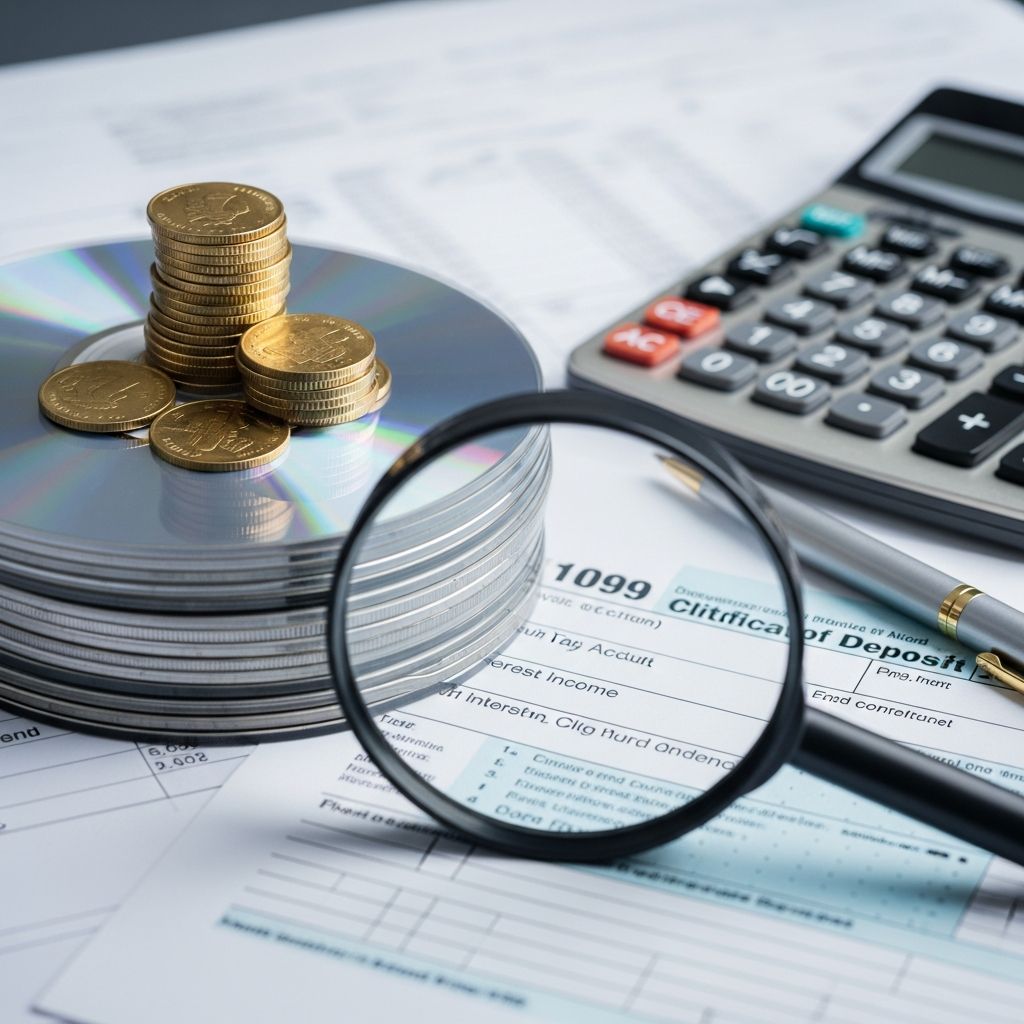
Certificates of deposit (CDs) offer guaranteed returns and predictable growth, making them an attractive option for conservative investors. However, many CD investors overlook a critical aspect of their investment: taxation of CD interest. The IRS requires you to pay taxes on CD interest earnings annually, even before your CD matures and you can access the funds. Understanding how CD taxes work is essential for accurate financial planning and avoiding unexpected tax surprises.
This comprehensive guide covers everything you need to know about CD interest taxation, including how the IRS treats CD earnings, when taxes are due, and practical strategies to minimize or eliminate your tax burden.
Key Takeaways
- You pay taxes on CD interest every year it’s earned, regardless of whether the CD has matured
- CD interest is taxed as ordinary income at your regular tax rate, not at the lower capital gains rate
- The IRS requires Form 1099-INT reporting if you earn $10 or more in annual CD interest
- Early withdrawal penalties can be deducted from your taxes, potentially reducing your tax liability
- Tax-advantaged accounts like IRAs, HSAs, and 529 plans can shield CD interest from taxation
How CD Interest Gets Taxed
The IRS classifies CD interest as ordinary income, identical to wages earned from employment. This classification has significant implications for your tax burden. Unlike capital gains on stock sales or long-term investments, which may be taxed at preferential rates of 15% or 20%, CD interest is taxed at your full ordinary income tax rate.
Your effective tax rate on CD interest depends entirely on your total income and tax bracket. Federal tax rates for ordinary income range from 10% to 37%, depending on your filing status and total income. Additionally, you may owe state income taxes on CD interest, which can further increase your effective tax rate.
The Tax Rate Structure
When you earn CD interest, it gets added to your other income and taxed accordingly. For example, if you earn $50,000 in wages and $500 in CD interest, your taxable income becomes $50,500. The entire amount is subject to taxation based on your marginal tax bracket. This stacking effect means that CD interest is effectively taxed at your highest marginal rate, not your average rate.
Your bank will report CD interest earnings on Form 1099-INT if your annual interest exceeds $10. Box 1 of this form shows your taxable interest income. Even if you don’t receive a 1099-INT form, the IRS still requires you to report any interest earnings of $10 or more on your tax return.
Do You Pay Taxes on CD Interest Before Maturity?
One of the most misunderstood aspects of CD taxation is that you owe taxes on CD interest in the year it’s earned, even if your CD hasn’t matured and you cannot access the money. This creates a unique situation where you must pay taxes from other funds while the CD interest remains locked within your investment.
Long-Term CDs (Longer Than One Year)
For CDs with terms exceeding one year, you’ll receive a separate 1099-INT form each calendar year showing the interest earned during that specific year. Consider a five-year CD earning 4% annually on a $10,000 investment:
- Year 1: Approximately $400 in interest (taxable)
- Year 2: Approximately $400 in interest (taxable)
- Year 3: Approximately $400 in interest (taxable)
- Year 4: Approximately $400 in interest (taxable)
- Year 5: Approximately $400 in interest (taxable)
You’ll owe taxes on each year’s interest when you file your annual tax return, even though you cannot withdraw these funds until the CD matures.
Short-Term CDs (One Year or Less)
For CDs with one-year terms or shorter, you typically pay taxes once when the CD matures or in the year you earned the interest, whichever comes first. However, if a short-term CD spans two calendar years, you may owe taxes in both years based on when the interest was actually earned.
This annual tax obligation is frustrating for many investors because you cannot access the CD interest to pay the taxes owed. However, this is how the IRS treats all accrued interest on fixed-income investments, and there’s no exception for locked-in CD funds.
What Counts as Taxable Income When You Cash In a CD?
An important distinction exists between your principal investment and the interest earned. When your CD matures, only the interest you earned is considered taxable income. Your original principal investment is not taxed because you already paid taxes on that money when you initially earned it.
Understanding Principal vs. Interest
If you invested $10,000 in a CD that earned $500 in interest, you’ll receive $10,500 when it matures. Here’s the tax breakdown:
| Component | Amount | Tax Treatment |
|---|---|---|
| Original Principal | $10,000 | Not taxable (return of your own money) |
| Interest Earned | $500 | Taxable income |
| Total at Maturity | $10,500 | Mixed treatment |
The bank will report the $500 in interest on your 1099-INT, and you’ll include this amount on your tax return. If you’ve been paying taxes on the interest each year as it accrued, you should have already paid taxes on most or all of this amount when the CD finally matures.
This principle applies regardless of what you do with the money when the CD matures—whether you withdraw it, transfer it to another account, or immediately roll it into a new CD.
How to Avoid Taxes on CD Interest
While you cannot eliminate taxes on regular CDs held in taxable accounts, several proven strategies can help you avoid or substantially defer taxes on CD interest.
Retirement Accounts
Traditional IRAs and Roth IRAs: CDs held within an IRA are not subject to annual taxation on interest. With traditional IRAs, taxes are deferred until withdrawal in retirement. With Roth IRAs, qualified withdrawals are entirely tax-free.
401(k) Plans and Other Employer Plans: CDs within workplace retirement plans receive the same tax-deferral benefits as IRAs. Interest accrues tax-free until you withdraw the funds.
Health Savings Accounts (HSAs)
CDs held in HSAs offer triple tax advantages: contributions are tax-deductible, growth is tax-free, and qualified withdrawals for medical expenses avoid taxation entirely. This makes HSAs an exceptional vehicle for CD investments if you’re eligible.
Education Savings Plans (529 Plans)
CDs within 529 education savings plans grow tax-free. When funds are used for qualified education expenses, withdrawals avoid federal taxation entirely. This makes 529 plans ideal for parents and grandparents saving for education costs.
High-Income Earners and Tax-Loss Harvesting
While not directly reducing CD taxes, high-income earners can use tax-loss harvesting strategies with other investments to offset CD interest income. This advanced strategy requires careful planning and professional guidance.
State Tax Considerations
State tax treatment of CD interest varies dramatically based on your residence, creating significant opportunities for tax optimization.
No State Income Tax States
Residents of no state income tax states like Florida, Texas, Washington, Nevada, Tennessee, and others enjoy a substantial advantage: CD interest is not subject to state taxation. You only owe federal taxes on your CD earnings. This can result in effective tax savings of 5-13% depending on your state’s tax rate.
States with Income Tax
States with income taxes generally treat CD interest the same as ordinary income. However, tax rates vary significantly:
- Flat-tax states: Apply a single tax rate to all income, including CD interest
- Progressive-tax states: Use tax brackets similar to federal taxes, with rates increasing based on income levels
- Special considerations: Some states offer limited interest income exemptions or deductions for seniors
Understanding your state’s specific tax rules is crucial for comprehensive tax planning. Residents of high-tax states may benefit from maximizing tax-advantaged account contributions to shelter CD interest from state taxation.
Early Withdrawal Penalties and Tax Deductions
If you withdraw funds from a CD before the maturity date, you’ll typically incur an early withdrawal penalty. The good news is that this penalty can be deducted from your taxable income, potentially reducing your overall tax burden.
For example, if a CD earns $500 in interest and you pay a $100 early withdrawal penalty, you can deduct that $100 from your taxable interest income, reducing your taxable CD earnings to $400. This deduction appears on Schedule 1 of your Form 1040.
Planning Your CD Strategy for Tax Efficiency
Effective tax planning requires considering CD interest taxation before you invest. Strategies include laddering CDs across multiple accounts, timing purchases to manage taxable income across years, and prioritizing tax-advantaged accounts for CD investments.
Calculate your potential after-tax CD returns by considering your marginal tax rate, state taxes, and available tax-advantaged account space. This holistic approach ensures you maximize your after-tax returns and minimize unnecessary tax liability.
Frequently Asked Questions
Q: When must I report CD interest on my tax return?
A: You must report CD interest in the tax year it’s earned, even if the CD hasn’t matured. If you earn $10 or more in annual interest, you’ll receive a 1099-INT form. Report this amount on your Form 1040 tax return when filing for that tax year.
Q: Can I avoid paying taxes on CD interest?
A: You can eliminate current-year taxes on CD interest by holding CDs in tax-advantaged accounts like traditional IRAs, Roth IRAs, HSAs, or 529 plans. Regular taxable accounts cannot avoid CD interest taxation, though you can offset some taxes with deductions or losses.
Q: What if my CD interest is less than $10?
A: The $10 threshold only applies to Form 1099-INT reporting requirements. You must still report all interest earnings of any amount on your tax return, even if less than $10. Failure to report can result in penalties.
Q: Is CD interest taxed differently than other interest income?
A: No, the IRS treats CD interest identically to savings account interest, money market account interest, and other forms of interest income. All are taxed at ordinary income rates rather than preferential capital gains rates.
Q: Do I pay taxes on CD interest if it’s automatically reinvested?
A: Yes, you owe taxes on reinvested CD interest in the year it’s earned, even though you haven’t received the money. This applies to all accrued interest, regardless of whether it’s paid out or reinvested into the CD.
Q: How do I deduct early withdrawal penalties from my taxes?
A: Report your early withdrawal penalty on Schedule 1 (Form 1040) on the line for “Other income.” Use a negative number to indicate this is a deduction. Your tax software will typically have a field for this adjustment.
References
- Paying Tax On CD Interest — Bankrate. 2025. https://www.bankrate.com/banking/cds/paying-tax-on-cd-interest/
- Internal Revenue Service Form 1099-INT Instructions — U.S. Department of Treasury. 2025. https://www.irs.gov/forms-pubs/about-form-1099-int
- Tax Brackets and Rates — Internal Revenue Service. 2025. https://www.irs.gov/newsroom/irs-provides-tax-inflation-adjustments-for-tax-year-2025
- Individual Retirement Accounts (IRAs) — U.S. Department of Labor Employee Benefits Security Administration. 2024. https://www.dol.gov/agencies/ebsa/retirement-and-benefits/faqs-about-iras
- Coverdell Education Savings Account and 529 Plans — Internal Revenue Service. 2024. https://www.irs.gov/publications/p970
Similar Articles








Read full bio of Sneha Tete