Paying Estimated Taxes: Lump Sum or Quarterly?
Discover if you can pay all estimated taxes at once, understand IRS rules, penalties, and best strategies for freelancers and self-employed individuals.
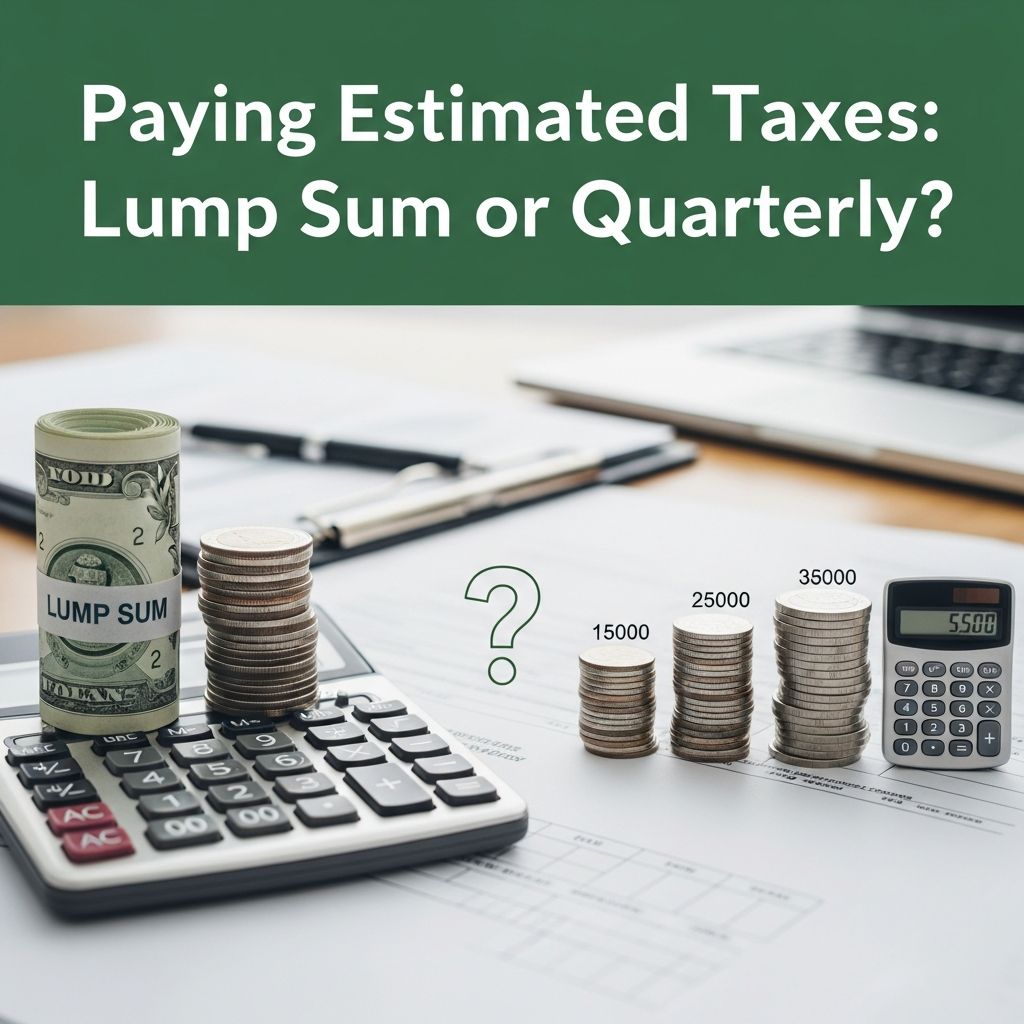
Estimated taxes represent a critical obligation for individuals whose income sources lack automatic withholding, such as freelancers, investors, and business owners. The Internal Revenue Service (IRS) requires these payments to cover income not subject to standard payroll deductions. While quarterly installments are the norm, certain scenarios allow for consolidated payments, potentially simplifying the process but carrying risks of penalties if not handled correctly.
Understanding Estimated Tax Obligations
Estimated taxes apply to income from self-employment, interest, dividends, rentals, or other non-wage sources. The IRS mandates payments if you anticipate owing at least $1,000 in tax for the year after subtracting withholdings and credits, and if withholdings cover less than 90% of the current year’s tax or 100% of the prior year’s tax.
Form 1040-ES serves as the primary tool for calculating and remitting these taxes. It helps estimate quarterly amounts based on projected annual income, ensuring alignment with actual earnings. Failure to meet these thresholds triggers underpayment penalties, calculated on the shortfall for each period.
Standard Quarterly Payment Schedule
The tax year divides into four periods, each with a fixed due date. Payments must reflect a proportionate share of your expected annual liability to avoid penalties.
| Income Period | Due Date |
|---|---|
| January 1 – March 31 | April 15 |
| April 1 – May 31 | June 15 |
| June 1 – August 31 | September 15 |
| September 1 – December 31 | January 15 (next year) |
Fiscal year taxpayers follow adjusted schedules outlined in IRS Publication 505. Adhering to this timeline keeps you penalty-free, even if a year-end refund materializes.
Can You Pay Everything in One Go?
Generally, no—lump-sum payments do not excuse the quarterly requirement. The IRS penalizes underpayments per period, regardless of overpayment later. However, exceptions exist:
- Farmers and Fishermen: Pay 100% by January 15 of the following year, or file by March 1 and settle the full amount then.
- Annualized Income Method: For uneven income, like capital gains, use the Annualized Estimated Tax Worksheet in Publication 505. Attach Form 2210 with Schedule AI to your return, proving payments matched income timing.
- Self-Employment Taxes: Quarterly payments are standard, but you may pay the full amount on the first due date if preferred, though penalties could still apply if prior periods are short.
Partnerships and S corporations have unique rules: Partners handle personal estimated taxes via Form 1040-ES, while S corps pay for specific taxes like built-in gains if over $500.
Risks of Skipping Quarterly Payments
Paying all at once risks penalties computed from each missed due date until settled. The penalty rate, based on the federal short-term rate plus 3%, accrues daily on the underpaid amount. Even a year-end overpayment doesn’t retroactively cover earlier shortfalls.
For example, missing the April 15 payment incurs charges from that date, escalating with time. Use Form 2210 to calculate and report any penalties, or opt for safe harbor by paying 100% of last year’s tax.
Secure Payment Methods for Estimated Taxes
The IRS offers diverse, efficient options to remit payments, prioritizing electronic methods for speed and record-keeping.
Free Bank Transfers
- IRS Direct Pay: No fees, direct from bank account. Supports estimated taxes up to $10 million; schedule in advance.
- EFTPS: Enrollment required; ideal for recurring payments and business deposits.
Card and Digital Wallet Options
Convenient but with processor fees. Pay1040 charges 1.75%-2.89% for credit/debit, minimums apply.
| Payment Amount | Debit Card Fee | Credit Card Fee (Pay1040) |
|---|---|---|
| $2,500 | $2.15 | $43.75 |
| $10,000 | $2.15 | $175.00 |
Mail Payments
Checks or money orders payable to ‘United States Treasury.’ Include SSN/EIN, tax year, form number, and daytime phone. Use certified mail for proof.
Other methods: Online account, IRS2Go app, electronic funds withdrawal with e-filing.
Special Considerations for Businesses and Partners
Partners in partnerships receive K-1 forms and must compute personal estimated taxes, as no withholding occurs on distributions. S corporations pay estimated taxes only on select items exceeding $500.
Self-employed individuals include both income and self-employment taxes (15.3% for Social Security/Medicare) in estimates.
Reporting Payments on Your Tax Return
Enter all estimated payments on Form 1040, line 26, including prior-year credits. This reconciles against your total liability, applying overpayments to refunds or next year’s estimates.
Strategies to Minimize Penalties
- Increase withholdings from W-2 jobs to cover non-wage income—treated as evenly paid.
- Monitor income quarterly; adjust using Form 1040-ES worksheets.
- Safe harbor: Pay 90%/100%/110% of prior year’s tax (higher for AGI over $150,000).
- Use annualized method for irregular income.
Frequently Asked Questions (FAQs)
Who needs to pay estimated taxes?
Those expecting $1,000+ owed and withholdings under 90% current or 100% prior year tax.
What if my income is uneven?
Annualize using Publication 505 worksheet and Form 2210 Schedule AI.
Can I pay by credit card?
Yes, via processors like Pay1040, with fees.
How do farmers handle estimated taxes?
One payment by Jan. 15 or file by March 1.
What’s the penalty for late payments?
Interest-based rate on underpaid amounts per period.
Planning for the 2026 Tax Year
With due dates approaching—April 15, 2026, for Q1—review last year’s return for safe harbor amounts. Download Form 1040-ES and use IRS tools for projections. Consistent quarterly payments ensure compliance and peace of mind.
Consult IRS Publication 505 for detailed worksheets. Electronic payments provide confirmations, reducing errors.
References
- Estimated tax | Internal Revenue Service — IRS. 2026. https://www.irs.gov/faqs/estimated-tax
- Payments – IRS (PDF) — IRS. 2026. https://www.irs.gov/pub/irs-utl/OC-DirectPayESPayments.pdf
- Payments | Internal Revenue Service — IRS. 2026. https://www.irs.gov/payments
- About Form 1040-ES, Estimated Tax for Individuals – IRS — IRS. 2026. https://www.irs.gov/forms-pubs/about-form-1040-es
- Individuals | Internal Revenue Service — IRS. 2026. https://www.irs.gov/faqs/estimated-tax/individuals/individuals
- Pay your taxes by debit or credit card | Internal Revenue Service — IRS. 2026. https://www.irs.gov/payments/pay-your-taxes-by-debit-or-credit-card
- Pay by check or money order | Internal Revenue Service — IRS. 2026. https://www.irs.gov/payments/pay-by-check-or-money-order
Similar Articles








Read full bio of medha deb