Payable on Death (POD) Account: Complete Guide
Understand POD accounts: Estate planning benefits, tax implications, and how to set one up.
Payable on Death (POD) Account: Definition and Overview
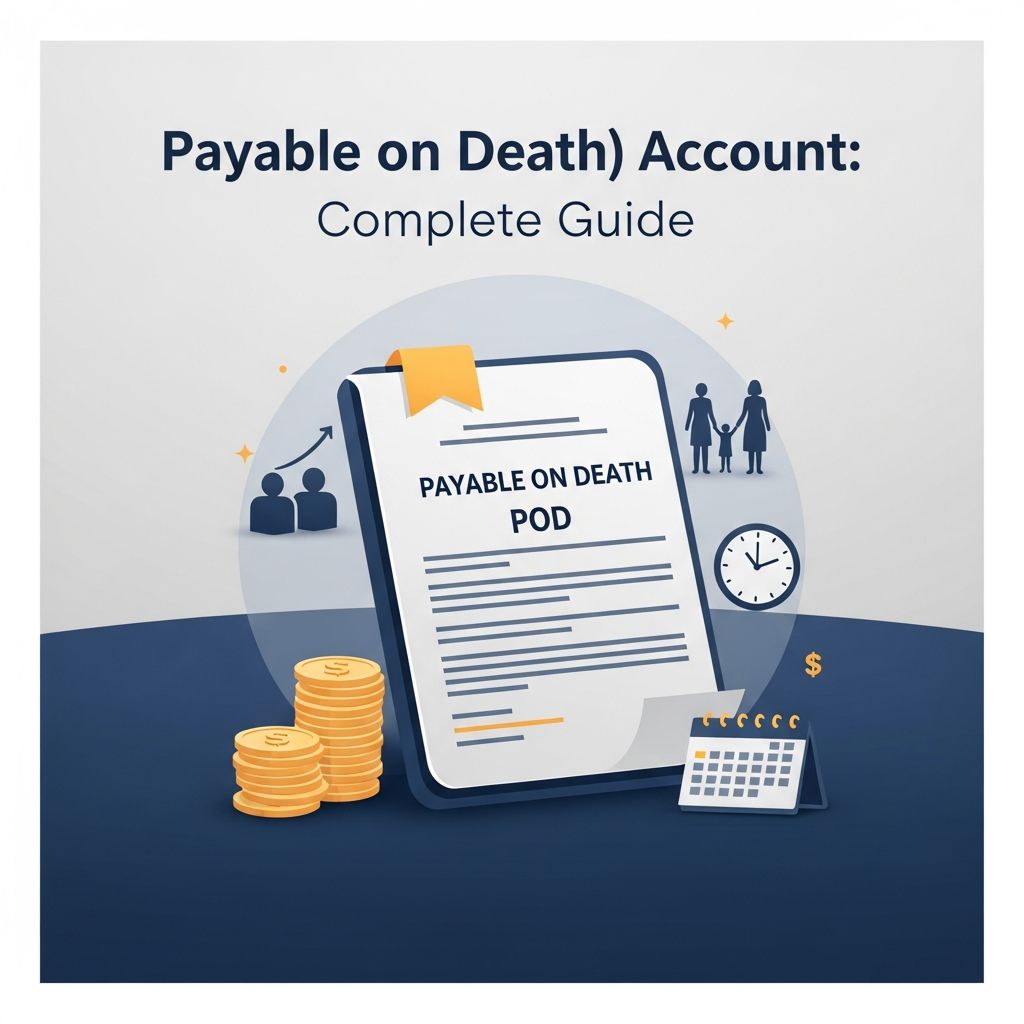
A payable on death (POD) account is a bank account arrangement that allows account owners to designate specific beneficiaries who will automatically receive the account’s assets upon the owner’s death. This financial tool represents a straightforward approach to estate planning, enabling direct transfer of funds to named beneficiaries while bypassing the probate process. Unlike traditional inheritance methods that require lengthy legal proceedings, POD accounts streamline the distribution of assets, making them an increasingly popular choice for individuals seeking efficient wealth transfer strategies.
The primary advantage of a POD account lies in its simplicity and efficiency. When an account owner passes away, the designated beneficiary can claim the funds by presenting the account holder’s death certificate and proof of their own identity to the financial institution. This direct transfer mechanism eliminates the need for court involvement, reducing costs and timeframes typically associated with probate proceedings.
How Payable on Death Accounts Work
POD accounts operate on a straightforward principle: the account owner maintains complete control and access to all funds during their lifetime, while the beneficiary has no rights to the money until the owner’s death. The account holder can deposit funds, withdraw money, earn interest, and manage the account exactly as they would with any standard bank account. This revocable nature means account owners retain the flexibility to change beneficiaries, modify account terms, or close the account entirely at any time without restriction.
The mechanics become clearer when examining the transfer process. Upon the account owner’s death, the financial institution is notified, and the beneficiary must provide documentation to claim the funds. The transfer typically occurs quickly, often within weeks rather than the months or years probate proceedings might require. If multiple beneficiaries are named, the funds are generally divided equally among them, though some states permit unequal distributions if the account owner specifies this arrangement during setup.
For joint accounts, the process differs slightly. If an account is jointly owned, the beneficiary cannot access funds until all joint account owners have deceased. At that point, the surviving joint owner may name their own beneficiaries, who would then inherit the account after the final owner passes away.
Alternative Names for POD Accounts
POD accounts are known by several alternative names in the financial industry, each referencing the same basic account structure:
- Totten trust
- Tentative trust
- Informal trust
- Revocable bank account trust
- Transfer on death (TOD) account
- In-Trust-For bank account
Understanding these alternative designations is important when working with financial institutions, as different banks may use different terminology for the same product. Regardless of the name used, the fundamental mechanics and benefits remain consistent.
Advantages of Payable on Death Accounts
Probate Avoidance
The most significant advantage of POD accounts is their ability to bypass probate entirely. Probate is the legal process required to validate a will and distribute an estate, which can be expensive and time-consuming—often requiring six months to several years to complete. By designating beneficiaries through a POD arrangement, account owners ensure their funds transfer directly to intended recipients without court involvement, saving substantial time and legal fees.
Enhanced FDIC Insurance Coverage
POD designations provide expanded Federal Deposit Insurance Corporation (FDIC) protection compared to standard bank accounts. While regular deposits are insured up to $250,000 per depositor per bank, POD-designated accounts receive enhanced coverage of up to $1,250,000 total across up to five separate accounts with different beneficiaries. This increased protection makes POD accounts attractive for individuals with larger account balances seeking comprehensive deposit insurance.
Control and Flexibility
Account owners maintain complete control over POD accounts throughout their lifetime. They can withdraw funds, deposit additional money, earn interest, and make all standard account management decisions. Importantly, account owners can change beneficiaries at any time, close the account, or modify terms without restriction. This flexibility ensures that POD accounts can adapt to changing life circumstances and family situations.
Superseding Will Provisions
POD accounts override provisions in a last will and testament. If a beneficiary is named in both a POD account and a will, the POD designation takes precedence. This can be advantageous when account owners want specific assets to transfer directly to particular beneficiaries outside of their overall estate distribution plan.
Disadvantages of Payable on Death Accounts
No Alternate Beneficiary Protection
A primary limitation of POD accounts is the inability to name alternate or backup beneficiaries. If the designated beneficiary dies before the account owner, the account remains part of the owner’s estate and passes through probate according to state intestacy laws or the terms of their will. This creates a significant planning gap for individuals who want to ensure their funds reach secondary beneficiaries if their first choice predeceases them.
Inflexible Asset Division
When multiple beneficiaries are designated on a POD account, they typically receive equal shares of the account balance. While some states allow account owners to specify unequal distributions, this option is not universally available. Account owners seeking different distribution percentages among beneficiaries may find POD accounts inadequate for their planning objectives.
Creditor and Tax Complications
POD accounts can create complications regarding debt, taxes, and creditor claims. If the account owner has unpaid taxes or outstanding debts at death, creditors may make claims against the POD account before beneficiaries can access the funds. Beneficiaries may also be responsible for state inheritance taxes on the transferred amounts, and interest earned within the account is subject to income taxation.
Joint Account Restrictions
For jointly owned POD accounts, beneficiaries cannot access funds until all account owners have died. This delay in asset transfer can be problematic for beneficiaries who need immediate access to inheritance funds for expenses or obligations.
Tax Implications and Creditor Considerations
Understanding the tax treatment of POD accounts is essential for effective estate planning. While there is no federal income tax on the transfer itself, beneficiaries may face state inheritance taxes depending on their state of residence. Some states do not impose inheritance taxes, while others apply graduated rates based on the beneficiary’s relationship to the deceased and the amount inherited.
Interest earned within the POD account during the owner’s lifetime remains subject to federal income tax and must be reported on annual tax returns. Additionally, if the account owner had unpaid federal or state taxes at death, the IRS and state revenue departments may place claims on the account to settle these obligations.
Creditors retain the right to pursue claims against POD accounts if the deceased had outstanding debts. This means that even though POD accounts avoid probate, they are not necessarily protected from creditor claims. Account beneficiaries should be aware that creditors may pursue collection efforts before funds are distributed.
Setting Up a Payable on Death Account
Establishing a POD account is a relatively straightforward process requiring minimal paperwork:
- Contact your bank or credit union and request payable on death account paperwork. This form may be called a Totten trust application.
- Complete the required forms with your beneficiary’s information, including their full legal name, Social Security number, address, and date of birth.
- Provide any additional information requested by your financial institution.
- Sign the documentation and submit it to the bank.
- Some institutions may require in-person completion at a branch location.
The process typically incurs no additional fees, though individual banks may vary in their specific requirements. After setup, the account functions identically to any standard bank account, with the POD designation simply marking the account for automatic transfer upon the owner’s death.
POD Accounts vs. Joint Tenants with Right of Survivorship (JTWROS)
While both POD accounts and joint tenants with right of survivorship (JTWROS) accounts bypass probate, they operate on fundamentally different principles. JTWROS accounts give both owners equal rights to all account assets during their lifetimes, meaning either owner can access and withdraw funds without the other’s permission. Upon one owner’s death, the remaining owner automatically inherits the full account balance.
POD accounts, by contrast, provide the account owner with exclusive control during their lifetime. The designated beneficiary has no rights to the funds until after the owner’s death. This distinction makes POD accounts more appropriate for individuals who want to designate specific beneficiaries without granting those individuals access to funds during the owner’s lifetime.
| Feature | POD Account | JTWROS Account |
|---|---|---|
| Control During Lifetime | Sole owner controls account | Both owners have equal control |
| Beneficiary Access | No access until owner’s death | Co-owner has immediate access |
| Asset Transfer | To designated beneficiary | To surviving co-owner |
| Probate Status | Bypasses probate | Bypasses probate |
| Multiple Beneficiaries | Possible with equal or unequal splits | Only one surviving owner |
FDIC Insurance Coverage for POD Accounts
Federal Deposit Insurance Corporation protection for POD accounts provides substantial security for account holders and beneficiaries. The standard FDIC insurance limit of $250,000 per depositor per bank applies to regular savings and checking accounts. However, POD designations receive special treatment under FDIC rules. Each beneficiary designation receives its own $250,000 insurance limit, meaning an account owner can have up to $1,250,000 in total FDIC coverage by naming five different beneficiaries on separate POD accounts at the same institution.
This enhanced coverage makes POD accounts particularly attractive for individuals with substantial liquid assets who want to maintain FDIC protection without spreading their accounts across multiple banks. Understanding these insurance limits is important when planning account structures to ensure complete protection of deposits.
Community Property State Considerations
Account owners living in community property states should be aware of special implications for POD accounts. In these states, spouses typically have legal claims to half of community property assets unless the assets were inherited or acquired before marriage. This means that even with a POD designation naming a different beneficiary, a spouse may have rights to a portion of the account. Individuals in community property states should consult with estate planning professionals to understand how these laws interact with POD designations.
Frequently Asked Questions
Q: Can I change the beneficiary on a POD account after it’s established?
A: Yes, you can change the beneficiary at any time during your lifetime. Simply contact your bank with a new beneficiary designation form and update the information.
Q: What happens if I name multiple beneficiaries on a POD account?
A: Multiple beneficiaries typically receive equal shares of the account unless you specifically arrange with your bank for unequal distribution, if your state permits this option.
Q: Do POD accounts avoid all probate-related expenses?
A: Yes, POD accounts bypass probate entirely, eliminating court fees, attorney fees, and the time required for probate proceedings. However, potential creditor claims and tax obligations may still apply.
Q: Are POD accounts suitable for large estates?
A: While POD accounts are useful for specific assets, they should be part of a comprehensive estate plan. For large estates, individuals should work with estate planning attorneys to coordinate POD accounts with wills, trusts, and other planning tools.
Q: What documentation does a beneficiary need to claim a POD account?
A: The beneficiary must provide the bank with a certified copy of the account owner’s death certificate and proof of their own identity, such as a driver’s license or passport.
Q: Can I set up a POD account for minor children?
A: While you can designate minor children as beneficiaries, accessing the funds may require court involvement or guardianship arrangements. Consider consulting an estate planning attorney for appropriate structures.
References
- Payable on Death (POD) Account: Definition, Uses — NerdWallet. 2025. https://www.nerdwallet.com/estate-planning/learn/payable-on-death
- Payable on Death Bank Account | Overview, Taxes & Creditors — Study.com. 2025. https://study.com/academy/lesson/what-is-a-payable-on-death-bank-account.html
- Payable on Death (POD) Beneficiary — Bank of America. 2025. https://www.bankofamerica.com/deposits/beneficiaries-faqs/
- Federal Deposit Insurance Corporation Coverage — FDIC Official Website. 2024. https://www.fdic.gov/resources/deposit-insurance/
- Estate Planning and Asset Transfer — American College of Trust and Estate Counsel (ACTEC). 2025. https://www.actec.org/resource-center/
Similar Articles








Read full bio of Sneha Tete