Pay Off Car Loan Early?
Explore the financial upsides and pitfalls of settling your auto loan ahead of schedule to make an informed decision.

Deciding whether to accelerate payments on your auto loan involves balancing immediate financial relief against long-term consequences. This choice can lead to substantial interest savings and full vehicle ownership but may introduce fees or temporary credit setbacks. Understanding these dynamics helps tailor the decision to your unique situation.
Financial Advantages of Accelerating Your Auto Loan Repayment
One primary incentive for early payoff is the reduction in total interest costs. Auto loans typically employ simple interest, calculated daily on the remaining principal. By shrinking the principal faster, you minimize accruing charges over time. For instance, on a $20,000 loan at 5% interest over 60 months, completing payments in 48 months could save approximately $500, as extra principal reductions curb interest buildup early when balances are highest.
Full ownership arrives sooner, eliminating monthly obligations and freeing budget space for investments or other debts. This shift enhances cash flow flexibility, allowing redirection toward higher-yield opportunities like retirement accounts or emergency reserves.
Another key benefit is mitigating negative equity risk, where loan balances exceed vehicle value due to rapid depreciation. Vehicles often lose 20-30% value in the first year, outpacing loan amortization on extended terms. Early payoff builds equity swiftly, safeguarding against shortfalls in trade-ins, sales, or insurance claims from accidents.
Potential Drawbacks and Hidden Costs
Not every scenario favors early settlement. Prepayment penalties appear in some contracts, imposing fees to compensate lenders for lost interest income. These charges, often 1-3% of the balance or a fixed sum, can offset savings—review your agreement meticulously.
Credit profiles may experience a brief dip post-payoff. Closing the account shortens payment history length and alters credit mix, as installment loans contribute positively alongside revolving credit. Scores typically rebound within months if other accounts remain strong, with overall debt reduction providing a net positive.
Liquidity concerns arise if payoff depletes savings. Prioritizing an auto loan over high-interest credit cards (often 15-25% APR) or emergency funds risks financial strain. Affordable payments on low-rate loans might better serve by preserving capital for superior returns elsewhere.
Key Factors Influencing Your Decision
Loan structure matters: simple interest loans reward extra payments without recalculation penalties, unlike precomputed variants where full interest is front-loaded. Credit unions frequently offer penalty-free terms, enhancing early payoff viability.
| Factor | Supports Early Payoff | Discourages Early Payoff |
|---|---|---|
| Interest Rate | High (>6%) | Low (<4%) |
| Emergency Fund | 6+ months expenses | Inadequate reserves |
| Other Debts | None higher-rate | Credit cards or payday loans |
| Loan Term Remaining | >24 months | <12 months |
| Prepayment Clause | Absent | Present with high fee |
This table outlines decision triggers. High rates amplify savings potential, while low rates or penalties diminish it.
Step-by-Step Guide to Executing Early Payoff
- Review Contract: Confirm no penalties and specify extra payments target principal.
- Calculate Savings: Use online calculators to project interest avoided versus fees. Break-even analysis determines if benefits exceed costs within your timeline.
- Build Lump Sum: Direct windfalls like bonuses toward principal, maintaining minimums on other debts.
- Contact Lender: Request payoff quote reflecting current balance and daily interest.
- Finalize and Verify: Pay via wire for immediacy; monitor credit reports for accurate closure reporting.
Post-payoff, obtain the title promptly and update insurance, as liability-only coverage often suffices for owned vehicles.
Real-World Examples and Projections
Consider a $25,000 loan at 7% over 72 months with $500 monthly payments. Standard term incurs $5,800 interest. Doubling to $1,000 monthly shaves 36 months and saves $3,200. If a 2% prepayment penalty applies on $10,000 remaining, the $200 fee nets $3,000 gain—still worthwhile.
Conversely, a 3% 48-month loan on $15,000 with $350 payments yields $1,200 interest. With $5,000 saved but $8,000 credit card debt at 20%, redirecting to cards saves $1,600 annually, outperforming auto payoff.
Alternatives to Full Early Payoff
Refinancing into shorter terms or lower rates preserves liquidity while cutting costs. Balance transfers for high-interest debts or investing extras at 5-7% market returns may exceed auto loan rates. Leasing anew or public transit could suit if usage patterns shift, though ownership equity vanishes.
Frequently Asked Questions
Does paying off early hurt my credit score?
Temporarily yes, due to reduced mix and history, but recovery is swift with responsible habits.
Are prepayment penalties common?
Rare in credit union or simple interest loans, more prevalent in subprime or dealer financing—always check terms.
How do I ensure extra payments reduce principal?
Specify “principal only” in writing or online portal instructions.
What’s the impact on taxes?
Minimal for personal auto loans; business-use deductions may lessen without interest payments.
Should I pay off if upside down?
Yes, to halt negative equity growth, but address root causes like long terms first.
Strategic Timing for Maximum Benefit
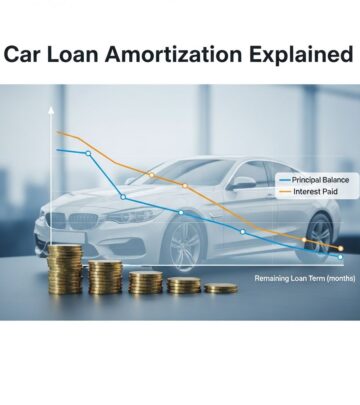
Target payoffs early in the term when interest dominates payments (amortization front-loading). Align with income surges like tax refunds or raises. Seasonal vehicle values peak in spring, aiding equity if selling post-payoff.
Holistic financial health trumps isolated decisions. Stress-test scenarios: model payoff against investment growth or debt avalanches. Tools from federal reserve sites or calculators aid precision.
References
- Early Auto Loan Payoff: Pros, Cons, and Strategies — Metro FCU. 2025-06-23. https://www.metrofcu.org/resources/blog/metro-blog/2025/06/23/early-auto-loan-payoff-pros-cons-and-strategies
- Should You Pay Off Your Auto Loan Early? The Pros and Cons — Ouachita Valley FCU. N/A. https://ouachitavalleyfcu.org/blog/should-you-pay-off-your-auto-loan-early-the-pros-and-cons
- Pros & Cons Of Paying Your Car Loan Off Early — Aschenbach Auto Group. N/A. https://www.aschenbachautogroup.com/blog/pros-and-cons-of-paying-your-car-loan-off-early
- Should You Pay Off Your Car Loan Early? — Bankrate. N/A. https://www.bankrate.com/loans/auto-loans/should-you-pay-your-car-loan-off-early/
- Should You Pay Off Your Car Loan Early? — Affinity FCU. N/A. https://www.affinityfcu.com/financial-wellbeing/blog/auto-buying/should-you-pay-off-your-car-loan-early
Similar Articles








Read full bio of medha deb