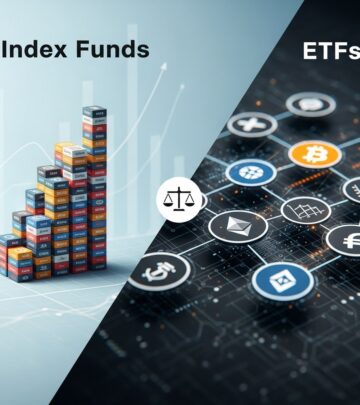
Passive Market Investing Through Index Funds
Master the fundamentals of index-based investing and grow wealth systematically

Index funds represent a foundational approach to modern portfolio construction, enabling investors to gain systematic exposure to broad market segments with minimal intervention. Rather than relying on individual security selection or market timing, these investment vehicles track predetermined market benchmarks, providing a straightforward pathway to wealth accumulation for diverse investor profiles.
Understanding the Core Mechanism
An index fund operates as a collection of securities—typically stocks or bonds—assembled to replicate the composition and performance of an established market benchmark. The fund manager does not attempt to select winning securities or time market movements; instead, the fund’s holdings mirror those of its target index with precision.
The mechanics are elegantly simple. When an investor purchases shares in an index fund, they acquire a proportional stake in all securities within the fund’s tracked index. For instance, investing in an S&P 500 index fund grants exposure to 500 of America’s largest public companies across multiple industries, with each holding weighted according to its representation in the official index. This approach eliminates the need for investors to research individual companies, assess financial statements, or make complex stock-picking decisions.
Fund adjustments occur only when the underlying index itself changes—such as when a company is added, removed, or reweighted within the benchmark. This minimal turnover distinguishes index funds from actively managed alternatives, which frequently restructure portfolios in pursuit of outperformance.
The Architecture of Market Benchmarks
Index funds track various market indicators depending on investor objectives and preferred market segments. Common benchmarks include:
- Broad equity indices: S&P 500, Russell 2000, and total market indices covering numerous companies across sectors
- International indices: FTSE 100, DAX, and Nikkei 225 providing geographic diversification
- Bond indices: Aggregate bond market and treasury indices for fixed-income exposure
- Sector-specific indices: Technology, healthcare, and financial indices for targeted exposure
- Dividend-focused indices: Collections of consistent dividend-paying companies for income-oriented investors
Each benchmark serves distinct investor needs, from growth-oriented young professionals to retirees seeking stable income streams.
Cost Efficiency as a Core Advantage
Perhaps the most compelling feature of index funds is their exceptional cost structure. Passive management—replicating an index rather than actively selecting securities—requires substantially fewer resources than traditional active management. Fund managers need not employ extensive research teams, conduct fundamental analysis, or monitor markets for trading opportunities.
This operational simplicity translates directly to lower expense ratios. While actively managed mutual funds typically charge annual fees ranging from 0.5% to 2% or higher, index funds commonly charge 0.05% to 0.20% annually. Over decades of investing, this seemingly modest difference compounds dramatically. An investor might pay $5,000 in total fees on a $100,000 investment through an index fund versus $50,000 through a higher-cost actively managed alternative, assuming similar investment periods and performance.
Lower costs directly enhance net investor returns. Rather than surrendering substantial portions of gains to management fees, investors retain more of the market’s returns for themselves and their families.
Diversification: Risk Distribution Across Markets
Diversification represents the fundamental principle underlying index fund benefits. By holding dozens, hundreds, or thousands of securities simultaneously, index funds distribute investment risk across numerous assets, sectors, and sometimes geographic regions.
Consider the protection this offers: if an individual stock within an S&P 500 index fund declines 50%, the fund’s value falls by only approximately 0.1% (assuming equal weighting). A single underperforming company cannot materially damage overall portfolio performance. This characteristic makes index funds substantially less volatile than concentrated portfolios or individual stock positions.
Broader diversification also provides exposure to multiple industries. An S&P 500 index fund includes technology firms, healthcare companies, financial institutions, consumer goods manufacturers, and industrial enterprises. Economic weakness affecting one sector may be offset by strength in others, creating a natural hedging effect within the portfolio itself.
Tax Efficiency and After-Tax Returns
Tax considerations profoundly affect investment outcomes, particularly for high-income individuals and those holding investments in taxable accounts. Index funds possess inherent tax advantages compared to actively managed alternatives.
Active managers frequently buy and sell securities throughout the year, triggering capital gains distributions—some short-term, which face taxation at ordinary income rates. Index funds, maintaining static or minimally adjusted portfolios, generate far fewer taxable events. This lower turnover reduces the capital gains distributions passed to shareholders and the resulting tax liability.
The tax efficiency benefit extends throughout the investment timeline. Instead of paying taxes annually on capital gains, investors can allow returns to compound untaxed within their portfolio, substantially increasing long-term wealth accumulation. This effect proves particularly valuable for investors in higher tax brackets, where tax efficiency can enhance after-tax returns by 1% or more annually.
Transparency and Predictability
Index funds operate with complete transparency. Since they replicate publicly available indices, investors can instantly identify every holding within a fund and verify its correlation to the benchmark. No mysterious stock selections or undisclosed strategies obscure the fund’s composition.
This transparency enables investors to understand precisely what they own and evaluate portfolio overlap across multiple funds. An investor holding three different S&P 500 index funds would recognize the complete overlap and perhaps consolidate holdings to avoid unnecessary redundancy.
Furthermore, performance is entirely predictable relative to the index. Index funds do not promise outperformance; they promise performance tracking. Investors know that a fund tracking the S&P 500 will deliver returns aligned with the S&P 500, minus only the small expense ratio. This clarity eliminates surprises about strategy or performance expectations.
Suitability Across Investor Demographics
Early-Career and Young Investors
Young professionals beginning their investment journey benefit substantially from index funds’ simplicity and low barriers to entry. Minimum investment requirements rarely exceed $100 to $1,000, making index funds accessible to those with modest savings. Without requiring extensive market knowledge or constant monitoring, young investors can establish disciplined long-term investing habits while maintaining focus on career and personal development.
Long-Term Retirement Savers
Retirement-focused investors find index funds particularly suitable for accumulation-phase strategies. The combination of low costs, tax efficiency, and broad diversification creates an ideal foundation for decades of compounding. Whether investing through individual brokerage accounts, IRAs, or 401(k) plans, index funds support consistent wealth building toward retirement objectives.
Hands-Off Investors
Investors preferring minimal portfolio management appreciate index funds’ set-and-forget characteristics. Once established, index fund portfolios require virtually no maintenance beyond periodic rebalancing or additional contributions. No need to monitor individual stock performance, adjust allocations based on company news, or second-guess investment timing.
Cost-Conscious Investors
Those prioritizing investment efficiency gravitate toward index funds naturally. Individuals committed to maximizing returns net of costs find that index funds’ expense ratios allow far greater wealth accumulation than higher-cost alternatives over extended periods.
Comparing Index Funds and Individual Stock Investing
| Characteristic | Index Funds | Individual Stocks |
|---|---|---|
| Risk Level | Lower through diversification | Higher due to concentration |
| Required Knowledge | Minimal; benchmarks are objective | Substantial; requires financial analysis |
| Time Commitment | Minimal monitoring needed | Ongoing research and analysis |
| Expense Ratios | Typically 0.05–0.20% annually | Varies; brokerage commissions apply |
| Tax Efficiency | High; minimal capital gains distributions | Variable; depends on trading frequency |
| Performance Consistency | Predictable relative to benchmark | Highly variable; depends on stock selection |
Market Safety and Risk Considerations
Index funds are generally considered safer than individual stock investments due to their inherent diversification. By spreading investments across numerous securities, index funds substantially mitigate the impact of any single underperforming asset.
However, index funds retain full exposure to systematic market risk—the risk affecting entire markets or broad segments. During significant market downturns, index funds decline along with the broader market, though typically less dramatically than concentrated or leveraged portfolios.
The specific index being tracked influences relative safety. A broad market index fund typically exhibits lower volatility than a sector-specific index fund focused exclusively on technology or biotechnology companies. Investors should align index selection with their risk tolerance and investment timeline.
Addressing Common Investor Questions
Can index funds outperform the market?
Index funds are designed to track market performance, not exceed it. By definition, they cannot outperform the indices they follow—they can only underperform by their expense ratio amount. This is intentional; the goal is capturing market returns efficiently, not attempting to beat the market.
How frequently should index fund portfolios be rebalanced?
Rebalancing frequency depends on individual circumstances and asset allocation targets. Some investors rebalance annually, others quarterly. After contributions to index funds, portfolio weights naturally drift as different index components appreciate at different rates. Periodic rebalancing maintains desired asset allocation proportions.
Are index funds suitable for all investment goals?
While index funds work well for most long-term wealth-building objectives, investors with specific tactical goals—such as timing market cycles or concentrating in undervalued sectors—may pursue alternative strategies. Index funds suit investors prioritizing consistent market participation over active management.
What is tracking error?
Tracking error describes the difference between an index fund’s performance and its target benchmark performance. Small tracking errors result from expense ratios and minor timing differences in acquiring securities. Quality index funds typically track within 0.1% of their benchmarks.
Constructing a Portfolio Foundation
Index funds serve as excellent portfolio building blocks. An investor might construct a diversified portfolio through just three to five index funds: a U.S. equity index fund, an international developed markets index fund, an emerging markets index fund, a bond index fund, and possibly a real estate investment trust (REIT) index fund. This simple allocation provides global diversification across asset classes with minimal complexity.
Alternatively, single all-in-one target-date index funds automatically allocate across equity and bond indices, adjusting the mix as investors approach retirement. These simplify decision-making for those uncomfortable making allocation choices independently.
The Long-Term Wealth Accumulation Case
Index funds excel at supporting long-term financial goals through consistent market participation. Investors benefit from compounding returns over decades, enhanced by tax efficiency and low costs. The evidence consistently demonstrates that low-cost index fund investors outperform the majority of actively managed fund investors after accounting for fees and taxes, particularly over extended periods.
Whether building retirement savings, establishing college funding, or accumulating generational wealth, index funds provide a proven, efficient mechanism for translating market returns into personal financial security.
References
- What are index funds? Definition and examples — StoneX Financial Glossary. 2025. https://www.stonex.com/en/financial-glossary/index-funds/
- What are Index Funds? Meaning, Benefits & How They Work — Kotak Mahindra Mutual Fund. 2025. https://www.kotakmf.com/Information/blogs/what-are-index-funds_
- What is an index fund? — Vanguard Investor Resources. 2025. https://investor.vanguard.com/investor-resources-education/understanding-investment-types/what-is-an-index-fund
- Index Funds — Investor.gov (U.S. Securities and Exchange Commission). 2025. https://www.investor.gov/introduction-investing/investing-basics/investment-products/mutual-funds-and-exchange-traded-4
Similar Articles








Read full bio of Sneha Tete