Partially Amortized Loan: Definition and How It Works
Understand partially amortized loans: lower payments now, balloon payment later.
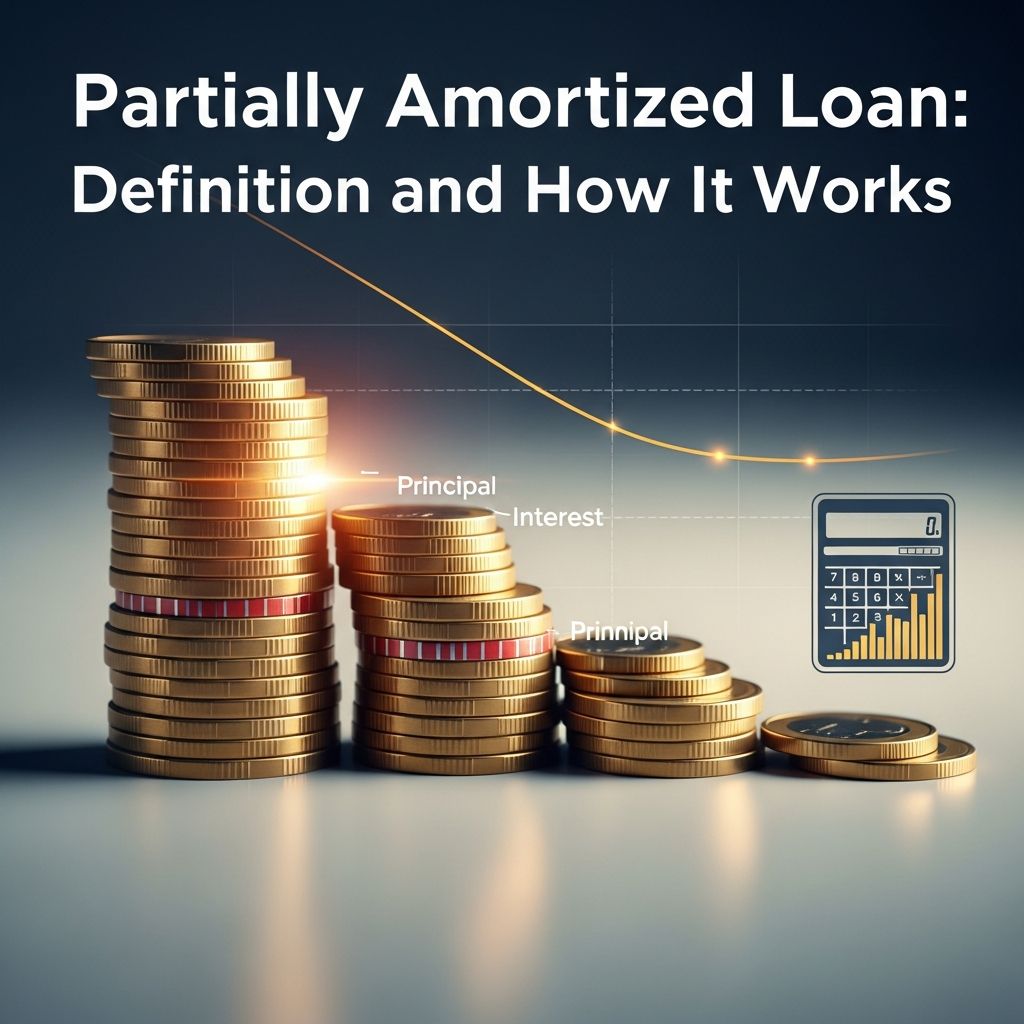
What Is a Partially Amortized Loan?
A partially amortized loan is a financing structure where a borrower makes regular monthly payments of principal and interest throughout the loan term, but the loan is not fully paid off by the end of that term. Unlike fully amortized loans where the final payment clears all remaining debt, partially amortized loans require a large lump-sum payment at the conclusion of the loan period. This final payment is known as a balloon payment and represents the remaining unpaid principal balance.
The defining characteristic of a partially amortized loan is the mismatch between the actual loan term and the amortization period used to calculate monthly payments. For example, a borrower might make payments based on a 30-year amortization schedule, but the loan term itself is only 10 years. This structure allows for significantly lower monthly payments during the loan period, but borrowers must be prepared for the substantial balloon payment due at maturity.
Understanding Amortization
Amortization refers to the systematic process of gradually paying off a loan through regular, scheduled payments over a predetermined period. Each payment typically consists of two components: interest and principal. In the early stages of an amortized loan, most of each payment goes toward interest, with a smaller portion reducing the principal. As time progresses, this ratio shifts, with larger portions of later payments going toward principal reduction.
There are two primary types of amortized loans: fully amortized and partially amortized. Understanding the distinction between these two structures is crucial for borrowers evaluating financing options, as each has different implications for monthly cash flow and total cost.
How Partially Amortized Loans Work
In a partially amortized loan structure, borrowers make regular monthly payments throughout the loan term. These payments are calculated based on a longer amortization period than the actual loan duration. For instance, the amortization schedule might span 30 years, while the actual loan term is only 7 to 10 years.
The mechanics operate as follows:
- Regular monthly payments are made that reduce the principal balance but not completely
- Each payment includes both interest charges and a portion of the principal
- The amortization schedule specifies exactly how much of each payment applies to interest versus principal
- At the end of the loan term, the remaining unpaid balance becomes due as a balloon payment
This structure is particularly common in commercial real estate financing, where lenders benefit from the ability to set fixed interest rates over specified periods while maintaining flexibility in their loan portfolios. For borrowers, this arrangement can provide better cash flow management during the loan term, though it requires planning for the eventual balloon payment.
Calculating Partially Amortized Loans
To calculate a partially amortized loan, you need to understand several key components:
- Principal: The total amount borrowed
- Interest Rate: The annual interest rate applied to the loan
- Amortization Period: The time span (typically 20-30 years) over which the loan would be fully paid if only regular payments were made
- Loan Term: The actual duration of the loan (often 5-10 years), which is shorter than the amortization period
- Balloon Payment: The lump sum due at the end, representing the remaining unpaid principal
Example Calculation
Consider a loan with these parameters:
- Loan Amount (Principal): $200,000
- Interest Rate: 5% annually
- Amortization Period: 30 years (360 months)
- Loan Term: 10 years (120 months)
Using standard amortization formulas, the monthly payment would be calculated based on the 30-year period. After 120 months of payments, the remaining balance would be due as the balloon payment. The specific amounts depend on the amortization schedule calculations, but this structure demonstrates how regular payments remain manageable while a significant payment awaits at the loan’s conclusion.
Fully Amortized Loans vs. Partially Amortized Loans
Understanding the differences between these two loan structures is essential for making informed borrowing decisions.
| Feature | Fully Amortized Loan | Partially Amortized Loan |
|---|---|---|
| Monthly Payments | Higher, structured to pay off entire balance by term end | Lower, based on longer amortization period |
| Final Payment | No balloon payment; debt fully cleared | Large balloon payment required at end |
| Principal Paydown | Complete payoff during loan term | Partial payoff; remainder due at maturity |
| Payment Predictability | Steady, predictable payments throughout | Lower predictable payments plus large final payment |
| Ideal For | Long-term borrowers who want complete debt elimination | Short-term owners or investors planning to sell/refinance |
Fully Amortized Loan Characteristics
A fully amortized loan requires monthly payments that are structured to completely pay off the loan’s entire balance by the end of the term. There is no balloon payment, meaning the borrower owes nothing further after making the final scheduled payment. This approach is ideal for borrowers who prefer steady, predictable payments and want the psychological benefit of completely clearing their debt by a specific date.
Partially Amortized Loan Characteristics
Partially amortized loans feature lower monthly payments since they cover only a portion of the loan’s balance during the term. However, this benefit comes with the requirement for a substantial balloon payment at the end. This structure suits borrowers who need lower monthly payments but expect to have funds available or refinancing options to cover the final payment.
Advantages of Partially Amortized Loans
Partially amortized loans offer several compelling benefits for certain borrowers and situations:
Lower Monthly Payments
The most immediate advantage is reduced monthly payment obligations. Because payments are calculated based on a longer amortization period, monthly costs are substantially lower than with fully amortized loans. This can significantly improve cash flow for businesses and investors.
Short-Term Ownership or Investment Strategies
If you plan to sell or refinance the property before the balloon payment is due, a partially amortized loan can be an excellent option. The large final payment never needs to be addressed because the property sale or refinancing handles the remaining balance.
Refinancing Opportunities
If interest rates decline or your financial situation improves before the balloon payment comes due, you may be able to refinance the loan into new terms that avoid the large one-time cost. This flexibility can provide significant financial advantages.
Disadvantages of Partially Amortized Loans
Despite their advantages, partially amortized loans present several significant risks and challenges:
Higher Total Interest Costs
Because you’re paying off less principal during the loan term, more of your payments go toward interest. This results in higher total interest costs over the life of the loan compared to fully amortized alternatives.
Limited Flexibility with Market Changes
If real estate markets shift or your financial situation worsens, refinancing or selling the property to cover the balloon payment may become impossible. This lack of flexibility can create serious financial stress.
Not Ideal for Long-Term Borrowers
If you plan to hold the property for an extended period, the balloon payment will eventually become a significant burden. For long-term ownership, a fully amortized loan is typically a better choice.
Refinancing Risk
When the balloon payment comes due, you’ll need to refinance or sell. If property values have declined or your creditworthiness has decreased, refinancing may be difficult or come with unfavorable terms.
Who Uses Partially Amortized Loans?
Partially amortized loans are popular in commercial real estate financing and among property investors who have specific exit strategies. Real estate professionals, developers planning property sales within a defined timeframe, and investors seeking to maximize cash flow during the holding period commonly utilize this loan structure. The arrangement allows lenders to maintain fixed interest rates over specified periods while providing borrowers with the cash flow benefits of lower monthly payments.
Is a Partially Amortized Loan Right for You?
Determining whether a partially amortized loan suits your situation requires honest assessment of your financial position and plans:
Consider a partially amortized loan if:
- You have a clear exit strategy (sale or refinancing) before the balloon payment is due
- Lower monthly payments are critical to your cash flow management
- You expect your financial situation to improve significantly
- You’re investing in a property you plan to hold for a limited time period
- You anticipate property appreciation that will provide equity for refinancing
Avoid a partially amortized loan if:
- You plan to keep the property long-term
- You lack confidence in your ability to refinance or sell when needed
- You prefer the predictability of fully clearing debt by a specific date
- You’re risk-averse regarding large future payment obligations
- Market conditions in your area are uncertain or declining
Frequently Asked Questions
What is the difference between a partially amortized loan and a balloon loan?
A partially amortized loan and a balloon loan are essentially the same thing. Both involve regular monthly payments based on a longer amortization period than the actual loan term, with a large balloon payment due at the end. The terms are used interchangeably in lending.
How long are partially amortized loans typically?
Partially amortized loan terms typically range from 5 to 10 years, though they can vary based on the lender and specific agreement. The amortization period used for payment calculations is usually much longer, often 20 to 30 years.
Can I pay off a partially amortized loan early without penalty?
This depends on the specific loan terms. Some partially amortized loans include prepayment penalties, while others allow early repayment without penalty. Always review your loan documentation or discuss this with your lender before committing.
What happens if I can’t make the balloon payment when it’s due?
If you’re unable to make the balloon payment, you may be able to refinance the remaining balance into a new loan, provided your creditworthiness and property value support refinancing. However, if refinancing isn’t possible, you could face default and potential foreclosure or asset seizure.
Are partially amortized loans common in residential mortgages?
Partially amortized loans are far more common in commercial real estate financing than in residential mortgages. Most residential mortgages are fully amortized, though some specialty residential loans may include balloon payments.
How do I calculate the balloon payment amount?
The balloon payment is calculated by determining the remaining principal balance after all regular payments have been made. This can be found on your amortization schedule or calculated using loan amortization formulas by subtracting total principal paid from the original loan amount.
References
- What Is a Partially Amortized Loan? Definition and How to Calculate — The Muse. 2025. https://www.themuse.com/advice/partially-amortized-loan
- Partially Amortized Loans Explained: A Guide for Real Estate Professionals — Talk to Annie. 2025. https://talktoannie.com/partially-amortized-loans-explained-a-guide-for-real-estate-professionals/
- Partially Amortized Loan vs Fully Amortized Commercial Loans — Commercial Loan Direct. 2025. https://www.commloan.com/research/partially-amortized-loan/
- How to Understand Partially Amortized Loans in Real Estate — Rentana. 2025. https://www.rentana.io/glossary/in-real-estate-what-is-a-partially-amortized-loan-key-insights
Similar Articles








Read full bio of Sneha Tete