Parent PLUS vs Private Loans: Key Choices
Discover which loan type—Parent PLUS or private—best fits your family's college funding needs with detailed rate, fee, and repayment breakdowns.
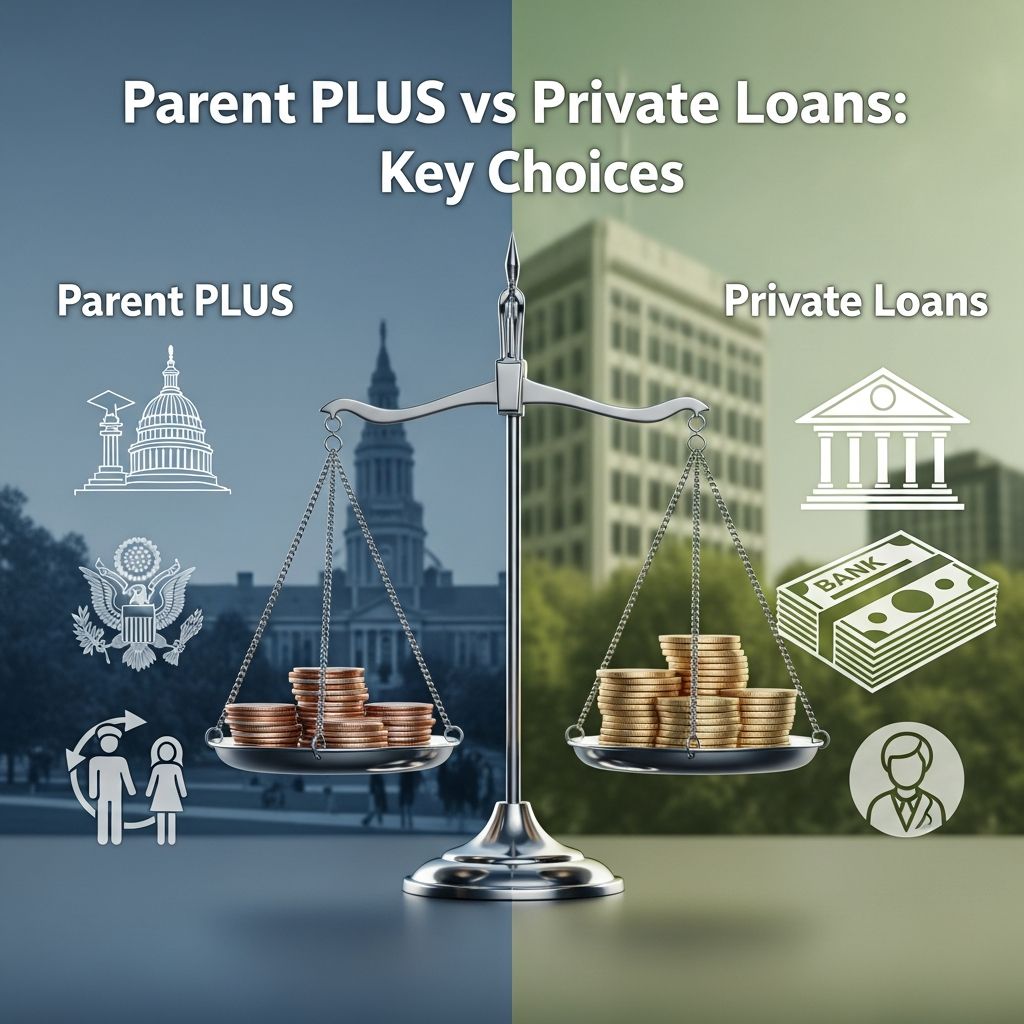
Parents seeking to fund their child’s undergraduate education often face a critical decision between federal Parent PLUS loans and private student loans. Federal options provide borrower protections and flexible repayment, while private loans may offer lower rates for those with strong credit. This guide breaks down eligibility, costs, terms, and strategies to determine the optimal path, drawing on current 2025-2026 data.
Understanding Federal Parent PLUS Loans
Federal Parent PLUS loans enable parents of dependent undergraduates to cover college costs not met by other aid. Issued directly by the U.S. Department of Education, these loans prioritize accessibility over strict credit checks.
Borrowers must complete the FAFSA, confirming the student is enrolled at least half-time in an eligible program. Parents can borrow up to the school’s cost of attendance minus grants, scholarships, and other aid. For the 2025-2026 academic year, the fixed interest rate stands at 8.94%, applied to loans disbursed after July 1, 2025.
These loans include a 4.228% origination fee for disbursements between October 1, 2025, and September 30, 2026, deducted from the principal. Repayment typically begins within 60 days of full disbursement, though deferment until the student graduates is available. Options span standard (10 years), extended (up to 25 years for balances over $30,000), and graduated plans.
Exploring Private Student Loans for Parents
Private loans come from banks, credit unions, or specialized lenders like Ascent or Citizens Bank. They target parents or students, with flexible terms based on creditworthiness.
No FAFSA is required, and borrowing limits often match cost of attendance minus aid, though some lenders cap amounts. Interest rates range widely: fixed from 3.19% to 17.99%, variable similarly, depending on credit scores above 600 and cosigner strength. Top-tier borrowers secure rates below the 8.94% Parent PLUS benchmark.
Origination fees vary—many lenders charge 0% to 5%, but options like Ascent impose none. Repayment terms range 5-25 years, with in-school deferment common. Cosigners boost approval and rates; some loans allow release after payments.
Side-by-Side Comparison of Loan Features
The table below highlights core differences for informed decision-making.
| Feature | Parent PLUS Loan | Private Student Loan |
|---|---|---|
| Interest Rate (2025-26) | Fixed 8.94% | 3.19%-25.96% fixed/variable |
| Origination Fee | 4.228% | 0%-5% or none |
| Credit Check | Adverse history check only | Full credit evaluation |
| FAFSA Required | Yes | No |
| Borrower | Parent only | Parent or student |
| Repayment Start | 60 days or defer | In-school options vary |
| Protections | Forgiveness, IDR plans | Lender-specific |
Financial Impact: Rates, Fees, and Total Costs
Interest rates drive long-term expenses. At 8.94% fixed, Parent PLUS outperforms variable private rates if markets rise but lags fixed private rates under 7%.
Fees amplify costs: a $20,000 Parent PLUS loan incurs $845.60 fee, disbursing $19,154.40. Private loans without fees preserve full principal.
Example costs for $20,000 over varying terms (assuming 5% private rate):
| Loan Type | Term | Monthly Payment | Total Interest |
|---|---|---|---|
| Parent PLUS (8.94% + fee) | 10 years | $207 | $2,438 |
| Private (5% no fee) | 5 years | $377 | $2,620 |
| Private (5% no fee) | 10 years | $212 | $5,440 |
| Private (5% no fee) | 15 years | $158 | $8,440 |
Strong credit unlocks savings; average parents pay more via PLUS.
Eligibility and Application Processes
Parent PLUS suits most: citizenship, no default, manageable debt-to-income. Adverse credit blocks unless endorser found or appeal succeeds.
- Complete FAFSA and PLUS application via studentaid.gov.
- School certification required.
- Processing: 3-5 days.
Private demands FICO 700+ ideally, income proof. Cosigners (often the student) help. Applications involve soft pulls first.
- Shop multiple lenders for rates.
- Prequalification avoids hard inquiries.
- Approval: days to weeks.
Repayment Flexibility and Protections
Federal loans excel: Income-Driven Repayment caps at 10-20% discretionary income, forgiveness after 20-25 years. Deferment/forbearance for hardship; Public Service Loan Forgiveness possible.
Private offers autopay discounts (0.25-0.50%), refinancing, but fewer forbearance options. Cosigner release after 24-48 on-time payments common.
Death discharge: federal covers parent or student death; private varies.
Pros and Cons of Each Option
Parent PLUS Advantages
- Easy approval.
- Federal benefits like PSLF.
- No cosigner needed usually.
Parent PLUS Drawbacks
- High rate/fee.
- Parent fully responsible.
- Credit impact from borrowing.
Private Loan Advantages
- Potentially lower costs.
- Flexible terms.
- Cosigner release options.
Private Loan Drawbacks
- Risk of denial.
- Variable rate volatility.
- Fewer protections.
Strategic Tips for Parents
Prioritize free aid via FAFSA. Exhaust student federal loans first. Compare rates: use calculators, check credit (free weekly at AnnualCreditReport.com).
Mix options: PLUS for base, private for gaps if rates beat 8.94%. Refinance PLUS later if rates drop. Discuss family finances openly.
Frequently Asked Questions
Can I use Parent PLUS for graduate school?
No, only dependent undergrads; grad students use Direct PLUS.
Does private loan approval affect my credit?
Hard inquiries do, temporarily; shop within 14-45 days.
Are Parent PLUS loans forgivable?
Yes, via IDR or PSLF if eligible.
Should I cosign my child’s private loan?
Only if prepared to repay; it builds their credit too.
What’s the 2025-2026 PLUS rate cap?
8.94% fixed, set annually by Congress.
Final Thoughts on Choosing Wisely
Assess credit, total need, and risk tolerance. Federal PLUS offers security; private promises savings for qualified borrowers. Consult financial advisors and run personalized scenarios for clarity.
References
- Parent PLUS Loans vs Private Student Loans – Edvisors — Edvisors. 2025. https://www.edvisors.com/student-loans/parent-student-loans/compare/
- Parent PLUS loans vs. private student loans for parents – Bankrate — Bankrate. 2025. https://www.bankrate.com/loans/student-loans/parent-student-loans/
- Private Parent Loans vs. Parent PLUS Loans | Ascent Funding — Ascent Funding. 2025. https://www.ascentfunding.com/blog/parent-plus-loans-vs-private-parent-loans/
- Federal Direct PLUS Loan or Private Student Loan for Parents? — Citizens Bank. 2025. https://www.citizensbank.com/learning/parent-plus-loan-vs-private-loan.aspx
- Comparing PLUS and Private Loans – WVU Financial Aid — West Virginia University. 2025. https://financialaid.wvu.edu/loans/comparing-plus-and-private
- Federal Versus Private Loans | Federal Student Aid — U.S. Department of Education. 2025-10-01. https://studentaid.gov/understand-aid/types/loans/federal-vs-private
Similar Articles








Read full bio of medha deb