P2P Lending vs Traditional Loans
Discover how peer-to-peer lending stacks up against conventional bank loans in speed, costs, accessibility, and risks for borrowers and investors.
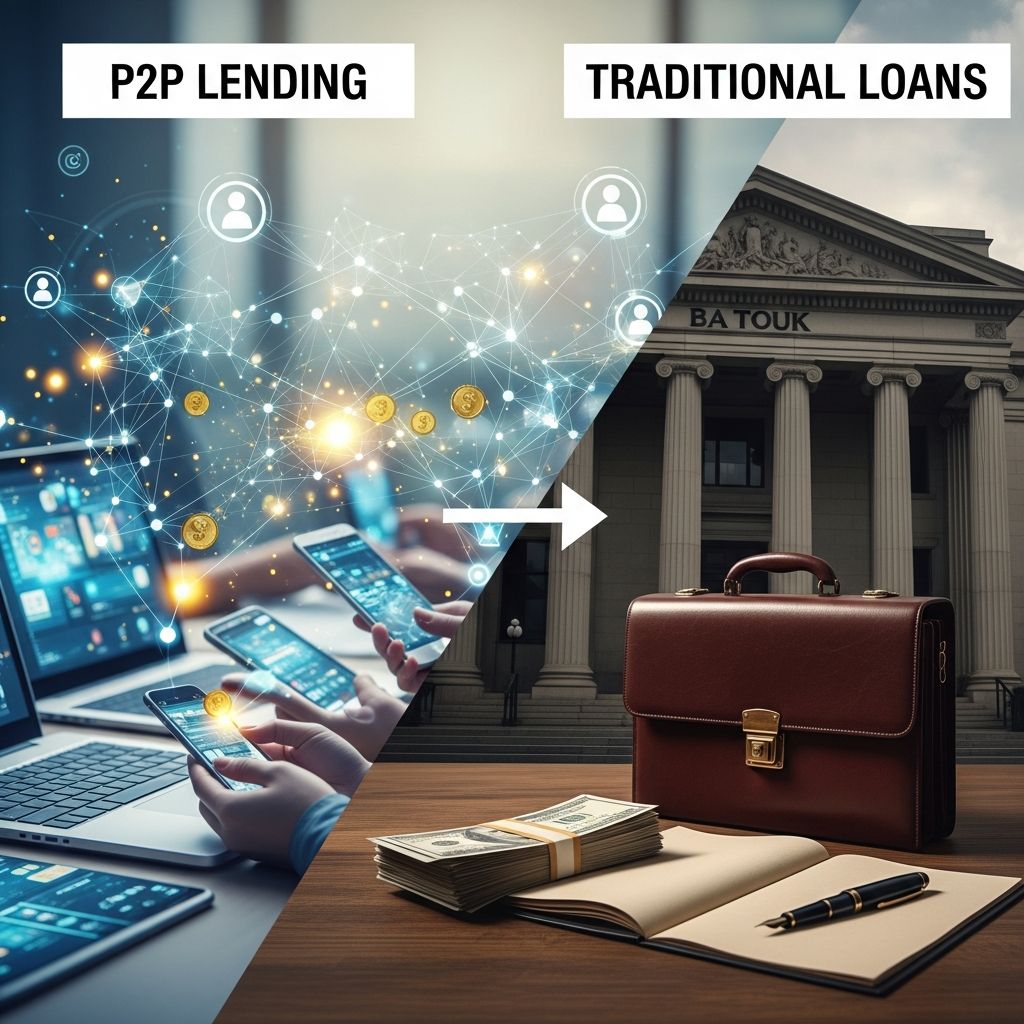
Peer-to-peer (P2P) lending has emerged as a disruptive force in the financial sector, enabling direct connections between borrowers and individual investors via online platforms. In contrast, traditional loans rely on established banks or credit unions to fund and manage credit. This article delves into the mechanics, advantages, drawbacks, and practical considerations of both approaches to help you navigate borrowing and investing options effectively.
The Evolution of Lending Models
The lending landscape has transformed dramatically with digital innovation. Traditional lending, rooted in brick-and-mortar institutions, has long dominated by providing structured loans backed by institutional capital. P2P lending, popularized since the mid-2000s, leverages technology to match supply and demand without intermediaries, fostering efficiency and broader access.
Platforms such as LendingClub and Prosper exemplify P2P by using algorithms to assess borrower risk and attract investor funds. While traditional banks offer stability through regulatory oversight, P2P models prioritize speed and customization, appealing to tech-savvy users underserved by conventional systems.
Core Mechanisms: How Funding Works
At its heart, the distinction lies in funding origins. Traditional lenders deploy their own balance sheets or deposits to issue loans, subjecting them to strict capital requirements and risk assessments. P2P platforms act as marketplaces, where investors pool funds to back borrower requests, often in small increments across multiple loans to diversify risk.
This intermediary-free model in P2P reduces overhead costs, potentially lowering rates for borrowers and boosting yields for lenders. However, platforms may partner with banks for initial funding before transferring loans to investors, blending elements of both worlds.
Key Comparison Table
| Feature | P2P Lending | Traditional Loans |
|---|---|---|
| Funding Source | Individual/institutional investors via platform | Bank’s own capital or deposits |
| Approval Speed | Days (fully online) | Days to weeks (online or in-branch) |
| Loan Types | Mostly personal; some business | Personal, auto, mortgage, business |
| Credit Check | Required; alternative data possible | Required; strict FICO focus |
| Regulation | Moderate (platform-specific) | Strict (federal banking rules) |
This table highlights structural variances, with P2P emphasizing digital agility and traditional methods offering diverse products.
Borrower Perspectives: Accessibility and Costs
For borrowers, P2P often shines in accessibility. Platforms evaluate credit using broader data, accommodating freelancers or those with thin files who face rejection from banks. Approval can occur within days, with funds disbursed quickly online. Interest rates are competitive, frequently lower for prime borrowers due to reduced operational costs—sometimes 1-5% below bank equivalents.
Traditional loans provide larger sums and specialized options like secured mortgages, backed by collateral for better terms. Yet, they impose rigid criteria, higher fees (e.g., origination charges), and slower processing, deterring those needing urgent cash.
- P2P Benefits: Faster funding, flexible terms, transparent offers.
- Traditional Drawbacks: Stringent qualifications, potential prepayment penalties.
Investor Angles: Returns and Risks
Investors flock to P2P for yields often exceeding 5-10% annually, surpassing savings accounts or bonds, thanks to direct lending without bank spreads. Diversification across loans mitigates defaults, with platforms providing risk grades.
Traditional investments via banks yield predictable but lower returns (e.g., CDs at 2-4%), protected by FDIC insurance up to $250,000. P2P lacks such guarantees, exposing investors to platform failures or borrower defaults, though historical recovery rates hover around 80-90% via collections.
- Higher potential ROI in P2P, but with volatility.
- Bank stability prioritizes capital preservation.
Risks and Regulatory Landscape
P2P carries elevated risks: borrower defaults (5-10% averages), platform insolvency, and limited insurance. Regulations vary; U.S. platforms register with SEC for securities, but oversight lags banking standards. Traditional loans benefit from comprehensive rules, deposit insurance, and recourse options.
Recent studies indicate P2P complements rather than replaces banks, thriving in niches like small personal loans amid economic shifts. In Israel, P2P’s minor role underscores adoption barriers like trust and scale.
Real-World Applications and Trends
P2P suits short-term personal needs or business startups, with global volumes surpassing $100 billion annually. Traditional lending dominates housing and large-scale finance. Hybrid models emerge, where banks acquire P2P tech for efficiency.
Post-pandemic, P2P grew 20-30% yearly, driven by digital natives, though economic downturns amplify defaults. Borrowers should compare APRs, fees, and reviews across platforms.
Who Should Choose What?
| Profile | Best Option | Reason |
|---|---|---|
| Strong credit, urgent need | P2P | Speed and low rates |
| Poor credit, small loan | P2P (if eligible) | Flexible criteria |
| Large secured loan | Traditional | Higher limits, collateral perks |
| Risk-averse investor | Traditional | Insurance and stability |
| Yield-seeking investor | P2P | Higher returns |
Frequently Asked Questions (FAQs)
What is the main advantage of P2P lending?
P2P offers quicker approvals and potentially lower rates by cutting out bank middlemen, ideal for accessible personal financing.
Are P2P loans safe for investors?
They involve default risks without FDIC protection, but diversification and platform tools help manage exposure.
Can I get a P2P loan with bad credit?
Possible via lenient scoring, though rates will be higher; traditional banks are stricter.
How do interest rates compare?
P2P averages 7-15% for qualified borrowers vs. 6-12% traditional, varying by profile and market.
Is P2P regulated like banks?
Partially, via SEC and state laws, but less comprehensively than federal banking oversight.
Navigating Your Financing Future
Choosing between P2P and traditional loans hinges on your priorities: speed and innovation versus security and scale. As fintech evolves, both will coexist, empowering informed decisions in a competitive market. Always review terms, assess risks, and consider consulting advisors for personalized strategies.
References
- P2P Lending Vs Traditional Loans — Meegle. 2023. https://www.meegle.com/en_us/topics/p2p-lending/p2p-lending-vs-traditional-loans
- P2P Lending vs. Traditional Lending — Experian. 2023. https://www.experian.com/blogs/ask-experian/p2p-vs-traditional-lending/
- Banks vs. P2P Lending: Traditional Finance Meets Modern Alternatives — 1Finance. 2024. https://1finance.co.in/blog/banks-vs-p2p-lending-traditional-finance-meets-modern-alternatives/
- Direct Lenders vs. Lending Marketplace vs. P2P Lenders — Business.org. 2023. https://www.business.org/finance/loans/direct-lenders-vs-lending-marketplace-vs-p2p-lenders/
- A Comparison between Peer-to-Peer Lending and Traditional Banks — FGV Repository (Academic). 2018. https://repositorio.fgv.br/bitstreams/5f862994-eed4-4ff5-a35e-53b0ee2d04fd/download
- P2P Lending vs Traditional Banks: Threat or Complement — Maclear. 2023. https://www.maclear.ch/blog/is-p2p-lending-a-threat-or-complement-to-traditional-banking
- Why do peer-to-peer (P2P) lending platforms fail? — PMC (Peer-reviewed). 2021. https://pmc.ncbi.nlm.nih.gov/articles/PMC8210520/
Similar Articles








Read full bio of Sneha Tete