Overdraft Fees vs NSF Fees: Key Differences
Understand the critical differences between overdraft and NSF fees to protect your finances.
Understanding Overdraft Fees vs. NSF Fees: How They Differ
If you’ve ever spent more than what’s in your checking account, you’ve likely encountered one of two penalties: an overdraft fee or a nonsufficient funds (NSF) fee. While many people use these terms interchangeably, they’re actually different fees charged in different situations. Understanding the distinction between these two fees is crucial for managing your finances effectively and avoiding unnecessary banking charges that can quickly deplete your account.
Key Takeaways
- Overdraft fees average $26.77 and are charged when banks cover transactions that exceed your account balance
- NSF fees average $16.82 and apply when banks decline transactions due to insufficient funds
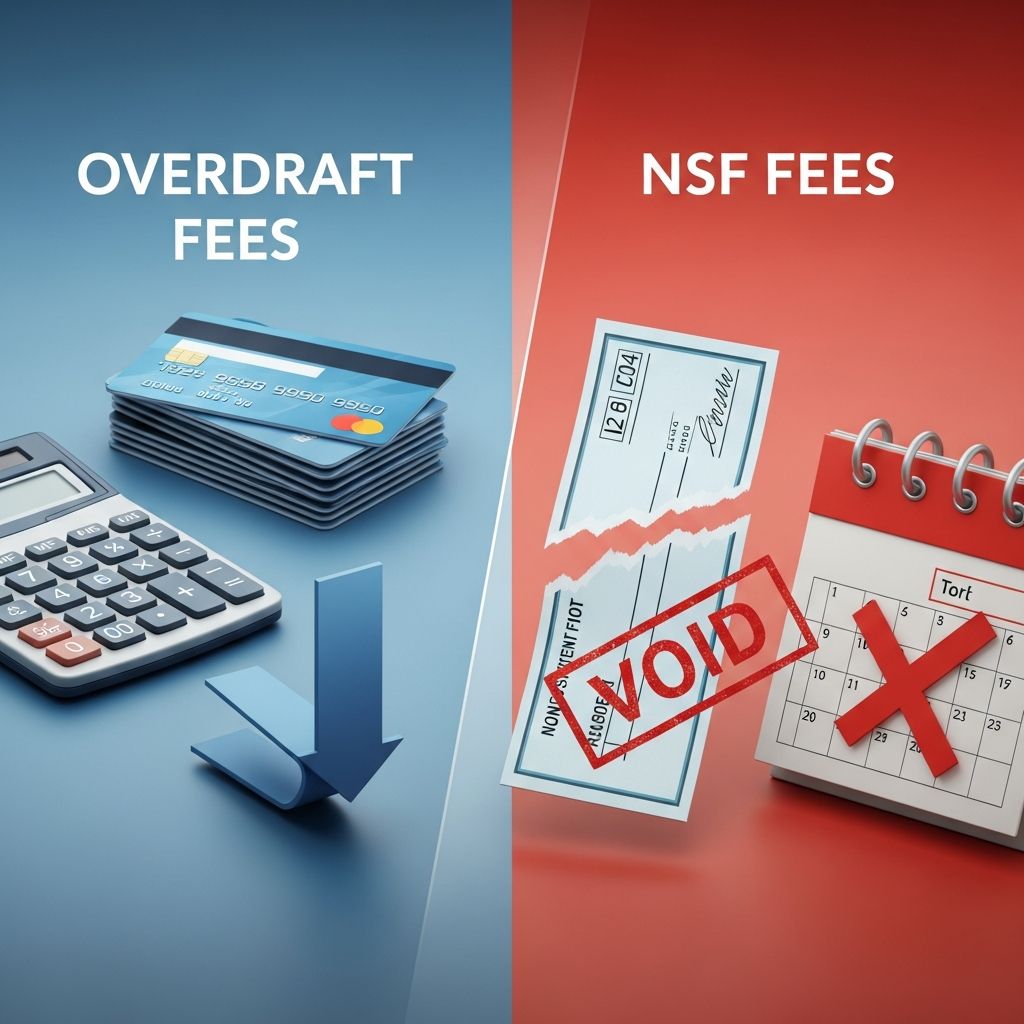
- The main difference: overdraft fees mean your transaction goes through while NSF fees mean your payment bounces
- Both fees are expensive, but overdraft fees at least ensure your payment clears
- Multiple overdraft fees can be charged in a single day, potentially costing $80-$100
- Many banks now offer overdraft protection and fee-free accounts to help customers avoid these penalties
The Key Difference: Does Your Transaction Go Through?
The distinction between overdraft fees and NSF fees is straightforward and depends on whether your bank allows the transaction to process. Understanding this fundamental difference will help you better manage your account and anticipate potential fees.
Overdraft Fee
Your bank covers the transaction, it goes through, and you’re charged a fee. Additionally, you owe the bank the amount they covered. Think of it as a very expensive short-term loan from your financial institution. When your bank allows a transaction to process even though you don’t have enough money in your account to cover it, they’re essentially extending you credit at a significant cost.
NSF Fee
Your bank declines the transaction, it doesn’t go through, and you’re still charged a fee. This means your payment bounces, potentially triggering additional late fees from merchants. You face a double penalty: both the NSF fee from your bank and potential consequences from whoever you were trying to pay.
Comparing Overdraft Fees and NSF Fees
| Fee Type | Average Cost | Transaction Clears? | What Happens |
|---|---|---|---|
| Overdraft Fee | $26.77 | Yes | Bank covers the shortfall temporarily. You must repay the amount plus the fee. |
| Non-Sufficient Funds Fee | $16.82 | No | Bank declines the transaction. You pay the fee and your payment bounces, potentially triggering late fees from merchants. |
Both fees are expensive, but at least with an overdraft fee your payment goes through. With an NSF fee, you pay a penalty and your bill still doesn’t get paid, creating additional problems with creditors or service providers.
What Is an Overdraft Fee?
An overdraft fee is charged when your bank allows a transaction to process even though you don’t have enough money in your account to cover it. Think of it as a very expensive short-term loan. For example, if your account has $75 and you make a $100 debit card purchase, your bank covers that extra $25 and charges you an overdraft fee—typically around $27. You’ll need to deposit $52 ($25 for the shortfall plus $27 for the fee) to bring your account positive again.
Important Facts About Overdraft Fees
- Average fee: $26.77, based on recent checking account fee surveys
- Multiple fees possible: Banks can charge 3-4 overdraft fees per day, potentially costing you $80-$100 in a single day
- Widespread practice: Approximately 90% of banks still assess overdraft fees on their checking accounts
- Rapid accumulation: A single day of heavy spending could result in multiple overdraft charges that compound quickly
The most troubling aspect of overdraft fees is that they can accumulate rapidly. If you make several purchases on a day when your account is low, each transaction could trigger a separate overdraft fee, resulting in substantial charges in just 24 hours.
What Is an NSF Fee?
An NSF (nonsufficient funds) fee is charged when your bank declines a transaction because you don’t have enough money to cover it. For instance, if you write a $600 rent check but only have $500 in your account, when your landlord tries to cash it, your bank declines the check and charges you an NSF fee—typically around $17. This creates a ripple effect of problems that extends beyond just the fee itself.
Important Facts About NSF Fees
- Average fee: $16.82, according to banking data
- Declining trend: 39% of checking accounts no longer charge NSF fees, reflecting a shift in banking practices
- Double penalty: Beyond the bank fee, you may face returned check fees, late fees and interest charges from whoever you were trying to pay
- Automatic payment impact: Your car insurance, streaming services and other auto-debits can trigger NSF fees
- Record low: NSF fees have fallen for four consecutive years to historic lows
One of the most frustrating aspects of NSF fees is that they’re essentially a penalty for being unable to pay, yet the payment still doesn’t go through. This means you face both the bank fee and the original debt remains unpaid, potentially affecting your credit score and relationships with creditors.
The Real Cost: How These Fees Add Up
The impact of overdraft and NSF fees extends far beyond individual transactions. Consumers who experience frequent overdrafts can face substantial cumulative charges. For example, households with more than 10 overdraft fees in a year could be charged a minimum of $267 or more, based on current average fee amounts. When combined with NSF fees, the total annual cost can exceed $300 for financially struggling households.
Research shows that there’s substantial overlap between consumers charged overdraft fees and those charged NSF fees. Many individuals who experience one type of fee are likely to experience the other, indicating that these fees disproportionately affect certain populations.
How to Avoid Overdraft and NSF Fees
Fortunately, there are several practical strategies you can employ to keep more of your money in your account and avoid these expensive penalties.
1. Monitor Your Account Balance
The most fundamental way to avoid both overdraft and NSF fees is to keep track of your account balance. Regularly checking your balance through your bank’s mobile app or website ensures you know exactly how much money you have available before making purchases. Set up account alerts to notify you when your balance falls below a certain threshold.
2. Set Up Overdraft Protection
Overdraft protection automatically transfers money from a linked savings account to cover shortfalls. While some banks charge a small transfer fee ($10-12), it’s considerably better than a $27 overdraft fee. Even better, many banks now offer free overdraft protection transfers. This service provides a safety net that prevents transactions from being declined while costing significantly less than traditional overdraft fees.
3. Opt Out of Overdraft Coverage
You can tell your bank not to cover overdrafts, in which case you won’t be charged the associated overdraft fee. However, it’s important to note that the bank will then likely deny transactions that would have overdrawn your account, meaning you’ll face NSF fees instead. This option is best for disciplined account holders who prefer declined transactions over the risk of overdraft fees.
4. Choose a Bank with Eliminated or Reduced Fees
Many major banks have taken steps to reduce or eliminate overdraft and NSF fees entirely. Capital One, Citibank, and Ally Bank have completely eliminated overdraft fees. Bank of America reduced overdraft fees to $10 and eliminated NSF fees. BMO Harris eliminated NSF fees and reduced overdraft fees to $15. U.S. Bank stopped charging NSF fees and increased the no-fee overdraft threshold to $50. These alternatives work just as well as traditional banks and often provide better value for your money.
5. Maintain a Buffer in Your Account
Consider maintaining a small buffer of funds in your checking account specifically to prevent overdrafts. This cushion—even if it’s just $100-200—can prevent the cascade of fees that result from unexpected expenses or timing delays in deposits.
6. Use Direct Deposit
Setting up direct deposit ensures that your paycheck or other regular income hits your account consistently. This reduces the likelihood of overdrafts due to delayed deposits and provides more predictable cash flow management.
Why Banks Charge These Fees
Banks justify overdraft and NSF fees as compensation for the administrative costs of processing declined transactions or covering shortfalls. However, critics argue that these fees disproportionately impact lower-income consumers who are more likely to experience overdrafts. The Consumer Financial Protection Bureau has increasingly scrutinized these fees, leading many banks to voluntarily reduce or eliminate them.
Recent Changes in Banking Practices
The landscape of overdraft and NSF fees has been shifting in recent years. Many banks have responded to consumer pressure and regulatory scrutiny by reducing or eliminating these charges. The average NSF fee has fallen for four consecutive years to a record low of $16.82, while 39% of checking accounts no longer charge NSF fees at all. Similarly, major banks have reduced overdraft fees from the historical average of $35 to as low as $10.
These changes represent a significant shift in the banking industry, suggesting that financial institutions are recognizing the negative impact these fees have on consumer relationships and financial wellness. However, most banks—approximately 90%—still charge overdraft fees, indicating that these penalties remain a common practice despite the trend toward elimination.
The Impact on Different Populations
Overdraft and NSF fees disproportionately affect lower-income consumers and those with less stable employment or income. Individuals experiencing financial difficulties are more likely to overdraft their accounts and face repeated fees, creating a cycle that deepens financial hardship. Research indicates that consumers with lower credit scores are more likely to experience overdraft and NSF fees, suggesting these penalties exacerbate existing financial inequalities.
Frequently Asked Questions
Q: What’s the difference between overdraft and NSF fees?
A: Overdraft fees are charged when your bank allows a transaction to go through even though you lack sufficient funds. NSF fees are charged when your bank declines a transaction due to insufficient funds. With overdraft fees, your payment processes; with NSF fees, it bounces.
Q: How much do overdraft and NSF fees typically cost?
A: Overdraft fees average $26.77 per transaction, while NSF fees average $16.82. However, these amounts vary by bank, and multiple fees can be charged in a single day.
Q: Can I be charged multiple overdraft fees in one day?
A: Yes, banks can charge 3-4 overdraft fees per day, potentially costing you $80-$100 in a single day if you make multiple transactions while overdrawn.
Q: Is overdraft protection worth it?
A: Overdraft protection can be worth it if your bank offers it free or for a small transfer fee ($10-12). This is generally cheaper than paying $26.77 for an overdraft fee.
Q: Which banks don’t charge overdraft fees?
A: Capital One, Citibank, and Ally Bank have completely eliminated overdraft fees. Bank of America, BMO Harris, and U.S. Bank have significantly reduced these fees or eliminated NSF fees entirely.
Q: Can overdraft fees affect my credit score?
A: Overdraft fees themselves don’t directly impact your credit score, but if overdrafts lead to unpaid bills or accounts sent to collections, these can negatively affect your credit.
Q: What should I do if I’m charged an overdraft or NSF fee?
A: Contact your bank immediately. Many banks will waive one or two fees per year, especially if you have a good account history. Explain your situation and ask if they can reverse the charge.
Bottom Line
Overdraft fees and NSF fees are both expensive penalties for spending money you don’t have, but they work differently. Overdraft fees let your transaction clear while NSF fees bounce your payment. Either way, you’re wasting money that could be better used for your financial goals and needs. You don’t have to accept these fees as inevitable. Banks that have eliminated overdraft and NSF fees entirely are widely available, and they work just as well as traditional banks—often better. By choosing the right financial institution, monitoring your account balance, setting up overdraft protection, and maintaining a spending buffer, you can keep these fees from draining your resources. The key is being proactive about your banking practices and choosing a bank that aligns with your financial needs and values.
References
- Overdraft Fees Vs. NSF Fees: How They Differ — Bankrate. 2025. https://www.bankrate.com/banking/checking/overdraft-fees-vs-nsf-fees/
- Overdraft and Nonsufficient Fund Fees Report — Consumer Financial Protection Bureau. December 2023. https://files.consumerfinance.gov/f/documents/cfpb_overdraft-nsf-report_2023-12.pdf
- Survey: ATM Fees Hit Record High For Third Straight Year — Bankrate Checking Account Survey. 2025. https://www.bankrate.com/banking/checking/checking-account-survey/
- Banks That Have Cut Or Eliminated Overdraft Fees — Bankrate. 2025. https://www.bankrate.com/banking/checking/banks-eliminated-overdraft-fees/
- Bank Overdraft Protection: Do You Need It? — Bankrate. 2025. https://www.bankrate.com/banking/checking/bank-overdraft-protection-do-you-need-it/
Similar Articles








Read full bio of medha deb