Organizational Structure: Definition, Types & Examples
Master organizational structures: frameworks that define roles, responsibilities, and communication hierarchies.
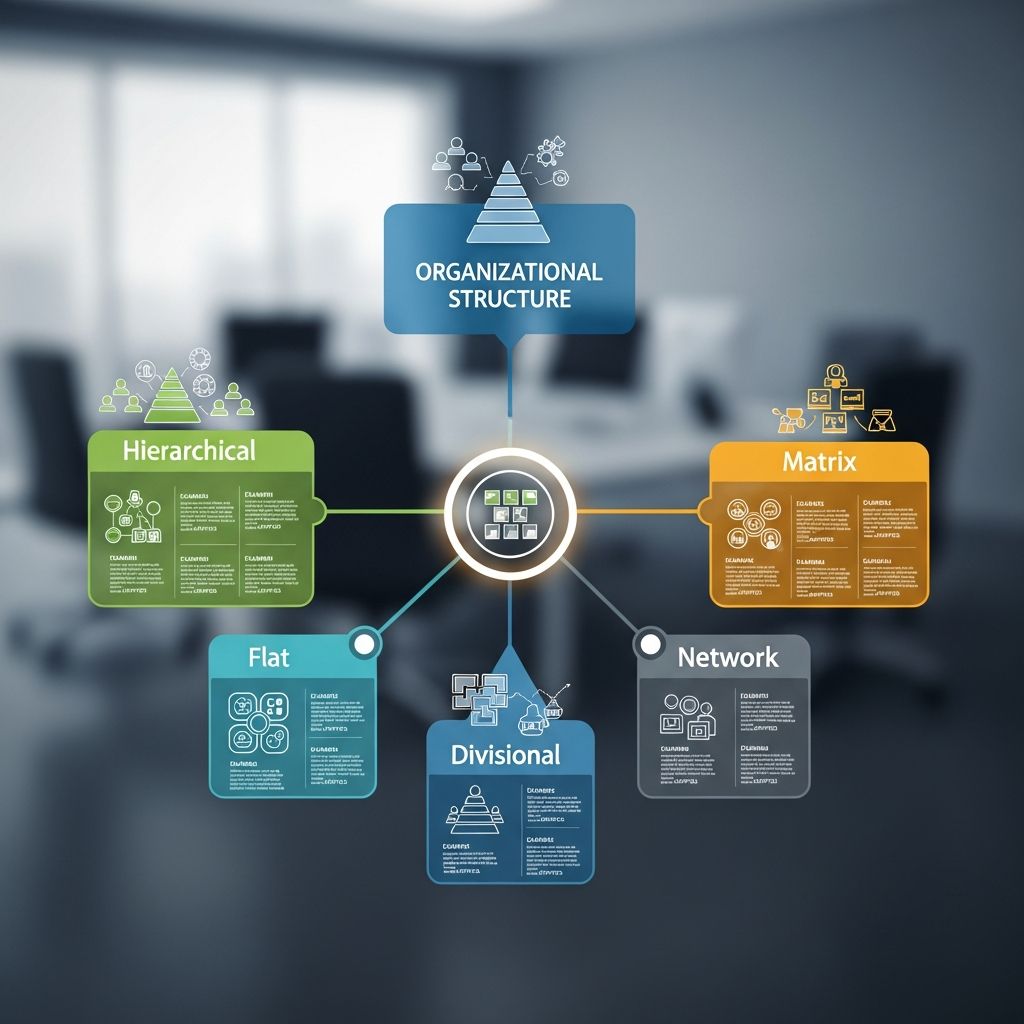
What Is an Organizational Structure?
An organizational structure is the backbone of any company, defining how roles, responsibilities, and authority are distributed among employees and departments. It represents the framework through which a company organizes its workforce, establishes communication channels, and coordinates activities to achieve business objectives. Think of it as the skeleton that holds together all the moving parts of an organization, ensuring that everyone understands their role and how they contribute to the overall mission.
The organizational structure serves multiple critical functions within a company. It clarifies reporting relationships, defines job responsibilities, establishes communication protocols, and creates accountability mechanisms. Without a clear organizational structure, even small companies can descend into chaos, with overlapping responsibilities, unclear authority, and inefficient communication channels.
Why Organizational Structure Matters
Organizations invest considerable time and resources in designing their structures because the right framework can significantly impact performance, employee satisfaction, and operational efficiency. A well-designed organizational structure:
- Clarifies roles and responsibilities, reducing confusion and overlap
- Establishes clear lines of communication and reporting relationships
- Facilitates decision-making by defining who has authority in different areas
- Promotes accountability by making clear who is responsible for specific outcomes
- Enables efficient resource allocation and workflow management
- Supports scalability as the company grows
- Improves employee morale by providing clear career paths
Types of Organizational Structures
Companies adopt different organizational structures based on their size, industry, strategic goals, and operational needs. Each structure has distinct advantages and disadvantages.
Hierarchical Structure
The hierarchical or bureaucratic structure is the most traditional and widely used organizational model. In this structure, authority flows from top to bottom in a clear chain of command. The CEO sits at the apex, with various departments and divisions organized beneath them in descending levels.
Characteristics of hierarchical structures include:
- Clear chain of command with defined authority levels
- Specialized departments based on function (sales, marketing, operations, finance)
- Formal communication channels and protocols
- Well-defined job descriptions and roles
- Multiple layers of management
This structure works particularly well for large, established organizations where standardization and control are essential. However, it can be slow to adapt to change and may stifle creativity due to rigid hierarchies.
Flat Structure
In contrast to hierarchical organizations, flat structures minimize the number of management levels between frontline employees and executives. These organizations typically have just one or two management layers, with most employees reporting directly to senior leadership or department heads.
Characteristics of flat structures include:
- Minimal management hierarchy
- Greater employee autonomy and decision-making authority
- Direct communication between management and staff
- Faster decision-making processes
- More flexible and adaptable to change
Flat structures are popular in startup companies and creative industries where agility and innovation are valued. However, they can become unwieldy as organizations scale beyond a certain size.
Matrix Structure
Matrix organizational structures combine elements of both hierarchical and flat structures. In a matrix organization, employees report to multiple managers—typically a functional manager and a project manager. This creates a grid-like structure where authority flows both vertically and horizontally.
Characteristics of matrix structures include:
- Dual reporting relationships
- Collaboration across departments and functions
- Flexible resource allocation
- Enhanced communication and information sharing
- Project-based organization alongside functional departments
Matrix structures are common in consulting firms, pharmaceutical companies, and technology organizations where projects require cross-functional collaboration. The main drawback is the potential for confusion regarding authority and responsibility.
Divisional Structure
Large corporations with diverse product lines or geographic markets often adopt divisional structures. In this model, the organization is divided into semi-autonomous divisions based on products, markets, or geographic regions. Each division operates like its own business with its own functional departments.
This structure enables:
- Autonomy for individual divisions
- Customization to specific market needs
- Clear accountability for divisional performance
- Easier comparison of divisional performance
Network Structure
Modern organizations increasingly adopt network structures, particularly in the digital age. Rather than maintaining all functions in-house, network organizations coordinate activities with external partners, contractors, and service providers. This creates a web-like structure of interconnected organizations.
Network structures offer:
- Greater flexibility and scalability
- Access to specialized expertise and resources
- Lower fixed costs compared to traditional structures
- Ability to rapidly adapt to market changes
Advantages and Disadvantages of Different Structures
| Structure Type | Advantages | Disadvantages |
|---|---|---|
| Hierarchical | Clear authority, standardized processes, easy to understand | Slow decision-making, rigid, may stifle innovation |
| Flat | Quick decisions, flexible, promotes creativity | Can become chaotic at scale, unclear responsibility |
| Matrix | Cross-functional collaboration, efficient resource use | Confusion about authority, complex management |
| Divisional | Autonomy, market responsiveness, clear accountability | Potential duplication of functions, less shared knowledge |
| Network | Flexible, cost-efficient, access to expertise | Control challenges, coordination complexity |
How to Choose the Right Organizational Structure
Selecting an appropriate organizational structure requires careful consideration of several factors:
Company Size: Startups typically benefit from flat structures, while larger enterprises often require hierarchical or divisional structures.
Industry and Market: Fast-moving industries like technology may favor flatter, more agile structures, while regulated industries like finance may require more hierarchical controls.
Strategic Goals: If the company prioritizes innovation and speed, a flatter structure works better. If standardization and control are priorities, hierarchical structures are more appropriate.
Workforce Characteristics: Younger, more technologically savvy employees often prefer flatter structures with greater autonomy, while more traditional employees may prefer clear hierarchies.
Geographic Distribution: Companies with multiple locations may need divisional structures or network approaches to manage regional operations effectively.
Implementation and Change Management
Changing organizational structure is a significant undertaking that requires careful planning and management. Key steps include:
- Clearly communicating the reasons for restructuring to all stakeholders
- Defining new roles and responsibilities explicitly
- Establishing new reporting relationships and approval authorities
- Providing training to help employees adapt to new structures
- Monitoring the transition and making adjustments as needed
- Maintaining open communication channels throughout the process
Common Challenges in Organizational Structure
Organizations often face challenges related to their structures. Hierarchical organizations may struggle with slow decision-making and resistance to change. Flat organizations can experience growing pains as they scale. Matrix structures sometimes create confusion about authority and accountability. Divisional structures may result in silos that prevent knowledge sharing. Network structures can struggle with coordination and control issues.
The most successful organizations regularly review and adjust their structures to ensure they remain aligned with business strategy and market conditions.
Frequently Asked Questions (FAQs)
Q: What is the difference between organizational structure and organizational design?
A: Organizational structure refers to the formal framework of roles and reporting relationships, while organizational design encompasses the broader process of creating this structure, including decision-making processes, communication systems, and job design.
Q: Can an organization use multiple structure types simultaneously?
A: Yes, many organizations use hybrid structures. For example, a company might have a hierarchical overall structure with matrix teams within specific departments, or divisional structure combined with flat teams within each division.
Q: How often should a company review its organizational structure?
A: Most organizations review their structure annually or when significant business changes occur, such as mergers, rapid growth, or market shifts. Regular reviews ensure the structure remains aligned with strategy and operational needs.
Q: What role does technology play in modern organizational structures?
A: Technology enables new structures by facilitating remote work, virtual teams, and global collaboration. Cloud computing, collaboration tools, and communication platforms make flat and network structures more feasible at scale.
Q: How does organizational structure impact company culture?
A: Structure significantly influences culture. Flat structures tend to foster collaborative, innovative cultures. Hierarchical structures emphasize order and standardization. Matrix structures promote cross-functional teamwork. The structure should support the desired organizational culture.
Q: What is a span of control?
A: Span of control refers to the number of direct reports a manager oversees. Narrow spans (few direct reports) allow for closer supervision, while wide spans enable faster decision-making but may reduce oversight quality.
Q: How should organizations handle restructuring resistance?
A: Organizations should involve employees in the restructuring process when possible, clearly communicate the reasons and benefits, provide training and support, acknowledge concerns, and maintain transparency throughout the transition.
References
- Investopedia Video: Understanding A Company’s Corporate Structure — Investopedia. 2010-10-22. https://www.investopedia.com/video/
- Fundamentals of Organizational Structure — Society for Human Resource Management (SHRM). https://www.shrm.org/
- Organizational Design and Effectiveness — Harvard Business Review. https://hbr.org/
- Types of Organizational Structures — U.S. Small Business Administration (SBA). https://www.sba.gov/
Similar Articles








Read full bio of Sneha Tete