Options Trading Essentials: Beginner Strategies & Risk Control
Master the fundamentals of options trading to enhance your investment strategies with leverage and risk management tools.

Options trading offers investors a versatile way to speculate on price movements or hedge positions without owning the underlying asset directly. These contracts provide the right, but not the obligation, to buy or sell an asset at a predetermined price within a set timeframe, enabling strategies for various market conditions.
Core Components of Options Contracts
Every options contract specifies key elements that define its terms and potential outcomes. The underlying asset forms the foundation, typically a stock, ETF, index, or commodity whose price influences the option’s value.
The strike price, also called the exercise price, is the fixed level at which the asset can be bought or sold if the option is exercised. It serves as the benchmark for profitability.
Expiration dates mark the contract’s end, after which it becomes worthless if not exercised or sold. Contracts usually cover 100 shares and come in American (exercisable anytime) or European (only at expiration) styles.
Traders pay or receive a premium, the contract’s cost or income, determined by market forces like supply, demand, and underlying conditions.
- Underlying asset: Drives the option’s value through its price fluctuations.
- Strike price: Fixed buy/sell level for potential exercise.
- Expiration date: Deadline for action or contract voidance.
- Premium: Upfront cost reflecting time value and intrinsic worth.
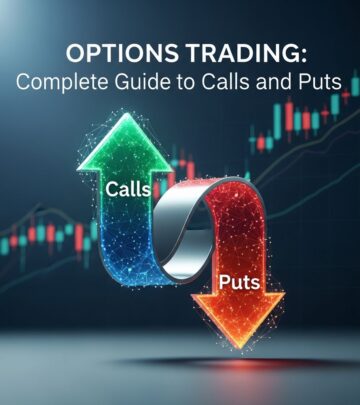
Call Options: Betting on Upside Potential
Call options grant the buyer the right to purchase the underlying asset at the strike price before expiration. Buyers anticipate price rises, profiting if the asset exceeds the breakeven point (strike plus premium).
For example, if a stock trades at $100 and you buy a call with a $105 strike for a $3 premium, breakeven is $108. If the stock hits $115 at expiration, intrinsic value is $10 per share, yielding $7 profit after premium ($10 – $3).
Sellers, or writers, of calls collect the premium but must deliver the asset if exercised, facing unlimited loss if prices surge dramatically.
| Scenario | Stock at Expiration | Buyer Outcome | Seller Outcome |
|---|---|---|---|
| Strong Rise | $120 | Profit: $12 | Loss: $12 |
| Moderate Rise | $107 | Loss: $1 | Profit: $1 |
| Decline | $90 | Loss: $3 (premium) | Profit: $3 |
Put Options: Profiting from Declines
Put options allow the buyer to sell the underlying at the strike price, ideal for bearish outlooks. Profit occurs if the asset falls below breakeven (strike minus premium).
Consider a $100 stock with a $95 put bought for $2 premium; breakeven is $93. At $85 expiration, intrinsic value is $10, netting $8 profit ($10 – $2). Put sellers receive premium but buy the asset if exercised, with losses capped at the strike minus premium.
Long puts limit buyer risk to premium, while short puts offer income with obligation to purchase at strike.
- Buyers: Right to sell high, protection against drops.
- Sellers: Premium income, but buy-low risk.
Decoding Premium Pricing Dynamics
Option premiums blend intrinsic value—the immediate exercise profit—and time value, reflecting potential until expiration. Intrinsic value for calls is max(0, current price – strike); for puts, max(0, strike – current price).
Time value erodes as expiration nears (theta decay), influenced by volatility (higher boosts premiums via vega), interest rates, and dividends. Models like Black-Scholes quantify these, but market bidding sets actual prices.
Intrinsic-rich options suit directional trades; time-value heavy ones favor volatility plays.
Navigating Moneyness States
Options are in-the-money (ITM), at-the-money (ATM), or out-of-the-money (OTM) based on strike versus current price. ITM calls have strikes below spot (positive intrinsic); ITM puts above.
| Type | Call ITM | Put ITM | Delta Range |
|---|---|---|---|
| ITM | Strike < Spot | Strike > Spot | 0.7-1.0 / -1.0 to -0.7 |
| ATM | Strike ≈ Spot | Strike ≈ Spot | ≈0.5 / ≈-0.5 |
| OTM | Strike > Spot | Strike < Spot | 0-0.3 / -0.3 to 0 |
Delta approximates price sensitivity to underlying moves; gammas measure delta changes.
Popular Beginner Strategies
Combine options for defined risk-reward. Covered calls overlay calls on owned stock for income. Protective puts hedge holdings like insurance.
Straddles buy call and put at same strike for volatility bets, profiting big swings. Spreads like bull call (buy low strike call, sell high) cap costs.
- Covered Call: Own stock, sell call—enhances yield.
- Protective Put: Long stock, long put—limits downside.
- Long Straddle: Call + put—volatility winner.
Risk Management Imperatives
Options amplify gains but magnify losses; buyers max out at premium, sellers face extremes (unlimited for naked calls).
Leverage demands discipline: position sizing, stop-losses, and diversification. Volatility crushes underperformers; liquidity gaps trap trades.
Approval levels from brokers match experience; start paper trading.
Executing Trades Efficiently
Choose brokers with robust platforms, low commissions, and education. Select contracts via chains listing strikes, expirations, bids/asks.
Monitor Greeks: delta (direction), theta (time), vega (volatility), rho (rates). Exit before expiration to capture time value.
Regulatory and Tax Framework
U.S. options trade on exchanges like CBOE under SEC oversight, clearing via OCC for standardization.
Taxes treat short-term gains as ordinary income; 60/40 rule applies to section 1256 contracts (indexes). Consult professionals.
Frequently Asked Questions
What is the main difference between calls and puts?
Calls bet on price increases; puts on decreases.
Can options lose more than the premium?
No for buyers; yes for uncovered sellers.
How do I start trading options?
Get broker approval, study basics, practice virtually.
What causes premium changes?
Underlying price, time decay, volatility, rates.
Are options suitable for all investors?
No—high risk requires knowledge and tolerance.
References
- Beginner’s guide: Understanding Options Trading — Ally. 2023. https://www.ally.com/stories/invest/trading-options-for-beginners/
- What is Options Trading and How Does it Work? — Wealthsimple. 2023. https://www.wealthsimple.com/en-ca/learn/what-is-a-stock-option
- What is Options Trading? Basics, Types & Examples Explained — QuantInsti. 2023. https://www.quantinsti.com/articles/basics-options-trading/
- What are options, and how do they work? — Fidelity Investments. 2023. https://www.fidelity.com/learning-center/smart-money/what-are-options
- Options Basics — The Options Industry Council. 2023. https://www.optionseducation.org/optionsoverview/options-basics
- Introduction to Options — Charles Schwab. 2023. https://www.schwab.com/options/what-is-trading-options
Similar Articles








Read full bio of Sneha Tete