Options Basics Tutorial: Complete Beginner’s Guide
Master the fundamentals of options trading with this comprehensive beginner's guide to calls, puts, and strategies.
Understanding Options: A Beginner’s Guide to Financial Derivatives
Options represent one of the most versatile and powerful tools available to investors and traders in modern financial markets. Despite their reputation for complexity, options are fundamentally straightforward once you understand the core concepts. Whether you’re looking to hedge your existing portfolio, generate additional income, or speculate on price movements, options provide flexible mechanisms that traditional stocks and bonds cannot offer. This comprehensive tutorial breaks down everything you need to know about options trading, from basic terminology to practical applications.
What Are Options?
An option is a financial contract that gives the holder the right, but not the obligation, to buy or sell an underlying asset at a predetermined price on or before a specific date. Think of an option as a reservation on an asset. Just as you might put a down payment on a house to reserve it while you decide whether to complete the purchase, an option allows you to reserve the right to buy or sell a stock without committing to the transaction immediately.
Options are derivatives, meaning their value derives from an underlying asset such as a stock, index, or commodity. They trade on exchanges and can be bought and sold just like stocks, making them liquid and accessible through most brokerage accounts. Options exist across multiple asset classes including equities, commodities, currencies, and interest rate products.
The Two Types of Options: Calls and Puts
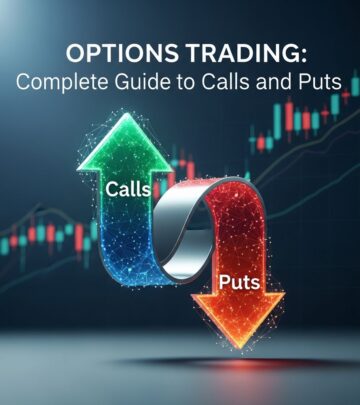
All options fall into one of two categories: calls and puts. Understanding the distinction between these two types is fundamental to options trading.
Call Options Explained
A call option grants the buyer the right to purchase an underlying asset at a specified price, called the strike price, on or before the expiration date. Think of a call option as a down payment on a stock purchase. When you buy a call, you pay an upfront cost called the premium. This premium represents your maximum risk—you cannot lose more than the premium paid, regardless of how far the stock price falls.
The seller of a call option, known as the call writer, receives the premium payment. In exchange, the call writer assumes the obligation to sell the underlying asset at the strike price if the buyer exercises the option. The call writer’s profit is limited to the premium received, but their potential loss is theoretically unlimited if the stock price rises significantly.
Investors typically buy call options when they expect the underlying asset’s price to rise. By paying a relatively small premium, they gain exposure to larger price movements. Call options are particularly useful for bullish trading strategies, including speculation on upward price movement or protecting against missed opportunities in a rising market.
Put Options Explained
A put option grants the buyer the right to sell an underlying asset at the strike price on or before expiration. If a call is like reserving the right to buy, a put reserves the right to sell. Put buyers pay a premium to acquire this right, and this premium represents their maximum loss.
The put seller receives the premium and assumes the obligation to buy the underlying asset at the strike price if the buyer exercises the option. Put sellers benefit from the premium but face theoretically unlimited risk if the stock price falls significantly.
Investors purchase put options when they expect prices to decline or when they want to protect existing holdings against downside risk. Puts are essential components of hedging strategies and can be used to generate income in range-bound or declining markets.
Key Options Terminology
Understanding options terminology is essential for navigating the options market effectively. Here are the critical terms every options trader should know:
Strike Price
The strike price, also called the exercise price, is the predetermined price at which the option can be exercised. For calls, this is the price at which you have the right to buy. For puts, this is the price at which you have the right to sell. The relationship between the current stock price and the strike price significantly influences the option’s value.
Premium
The premium is the price paid to purchase an option. This upfront cost is paid by the option buyer to the option seller and represents the buyer’s maximum potential loss. Premium prices reflect the probability of profitability, time remaining until expiration, volatility of the underlying asset, and interest rates.
Expiration Date
Every option has an expiration date, after which the option becomes worthless. American-style options can be exercised any time before expiration, while European-style options can only be exercised at expiration. Expiration dates typically fall on the third Friday of each month for equity options, though weekly and monthly variations exist.
In-the-Money, At-the-Money, and Out-of-the-Money
These terms describe an option’s moneyness, or its intrinsic value relative to the current stock price. For call options, in-the-money means the stock price exceeds the strike price, at-the-money means they’re equal, and out-of-the-money means the stock price is below the strike. For puts, the relationships are reversed. Understanding moneyness helps investors assess the probability of profitability.
How Options Pricing Works
Option prices fluctuate based on multiple factors. The primary influences on option premiums include:
Time Value
Options lose value as their expiration date approaches, a phenomenon called time decay. Options further from expiration command higher premiums because there’s more time for profitable price movement. As expiration nears, time value erodes more rapidly, particularly for out-of-the-money options.
Intrinsic Value
For in-the-money options, intrinsic value represents the immediate profit if exercised. A call option with a strike of $50 on a stock trading at $55 has $5 of intrinsic value. Out-of-the-money options have zero intrinsic value, consisting entirely of time value.
Volatility
Implied volatility measures the market’s expectation of future price fluctuations. Higher volatility increases option premiums for both calls and puts because larger price swings increase the probability of significant gains. Volatility is a critical factor for options traders because changes in volatility can significantly impact position profitability independent of actual stock price movement.
Interest Rates and Dividends
Rising interest rates slightly increase call values and decrease put values. Dividends paid on the underlying stock reduce call values and increase put values because dividends benefit stock owners but not option holders.
Basic Options Strategies
Options can be used individually or combined into multi-leg strategies to achieve specific investment objectives.
Long Call Strategy
Buying a call option is the simplest bullish options strategy. You profit if the stock price rises above your strike price plus the premium paid. Your maximum loss equals the premium paid, making this strategy capital-efficient for bullish bets.
Long Put Strategy
Buying a put option profits if the stock price falls below your strike price minus the premium paid. This strategy provides downside protection for existing holdings or speculation on price declines.
Covered Call Strategy
Selling calls on stocks you already own generates income through premium collection. You keep the premium but limit upside potential if the stock rises significantly. This strategy works best in flat or moderately bullish markets.
Protective Put Strategy
Buying puts on stocks you own creates insurance against significant declines while preserving upside potential. You pay the put premium as insurance, similar to homeowner’s insurance protecting against catastrophic losses.
Risk Management in Options Trading
Successful options trading requires disciplined risk management. Options leverage amplifies both gains and losses, making position sizing critical. Always define your maximum acceptable loss before entering a trade, use stop-loss orders when appropriate, and avoid risking more than a small percentage of your account on any single position.
Understanding your specific risk profile is essential. A covered call strategy has limited downside risk but capped upside. A naked put has theoretically unlimited risk. A long call has defined risk equal to the premium paid but requires the stock to move significantly to profit.
Why Options Matter for Investors
Options provide several advantages over traditional stock investing. They offer leverage, allowing controlled exposure to larger price movements with smaller capital. They provide flexibility to profit in rising, falling, or flat markets. They enable precise risk management through hedging. They generate income through premium collection. And they allow for sophisticated strategies impossible with stocks alone.
Getting Started with Options Trading
Before trading options, ensure your brokerage account is approved for options. Most brokers offer different approval levels based on experience and risk tolerance. Start with simple strategies like long calls or puts before advancing to more complex multi-leg strategies. Paper trade to practice without risking real money. Keep detailed records of all trades to evaluate performance and identify patterns in your decision-making.
Common Mistakes Options Traders Make
Many beginning options traders make predictable mistakes. These include buying too many options too far out-of-the-money seeking cheap premiums, ignoring time decay effects, failing to close losing positions, trading without defined exit plans, and using excessive leverage. Learning from these common errors can accelerate your path to consistent profitability.
Frequently Asked Questions About Options
Q: What’s the difference between American and European options?
A: American options can be exercised any time before expiration, providing greater flexibility. European options can only be exercised at expiration. American options typically command higher premiums due to this additional flexibility.
Q: How much capital do I need to start options trading?
A: Capital requirements vary by broker and strategy. Some brokers allow options trading with as little as $500-$1,000. However, maintaining adequate capital reserves for margin requirements and position management is advisable.
Q: Can I lose more money than I invest in a call option?
A: No. When you buy a call, your maximum loss equals the premium paid. However, selling naked calls (without owning shares) exposes you to theoretically unlimited losses.
Q: What happens to my option if the stock is delisted?
A: If the underlying stock is delisted, the option typically becomes worthless and is settled in cash based on the final stock price.
Q: How do I choose between calls and puts?
A: Buy calls when you expect prices to rise, puts when you expect prices to fall. Your market outlook determines which direction to trade.
Q: What is implied volatility and why does it matter?
A: Implied volatility represents the market’s expectation of future price swings. Higher implied volatility increases option premiums, making options more expensive to buy but more profitable to sell.
Q: Can I exercise my option before expiration?
A: Yes, if you hold American-style options. However, early exercise is rarely optimal because options typically retain time value that would be forfeited upon early exercise.
References
- Options Basics Tutorial — Investopedia. Updated 2024. https://www.investopedia.com/options-basics-tutorial-4583012
- Options Trading 101: Understanding Basic Option Concepts — Securities and Exchange Commission (SEC). https://www.sec.gov/investor/pubs/optionsmatter.htm
- The Greeks: Understanding Options Pricing — Chicago Board Options Exchange (CBOE). https://www.cboe.com/education/
- Derivatives Markets and Risk Management — Financial Industry Regulatory Authority (FINRA). https://www.finra.org/investors/learn-to-invest/types-investments/options
- Options Strategies for Different Market Conditions — Options Clearing Corporation (OCC). https://www.theocc.com/education
Similar Articles








Read full bio of medha deb