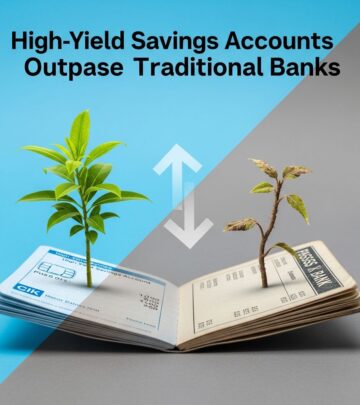
Optimize Your Savings: Ditch Low-Yield Accounts Now
Discover why traditional savings accounts are costing you money and how high-yield options can supercharge your financial growth in 2026.

Many individuals leave their hard-earned money in basic savings accounts that offer minimal returns, unaware that better options exist. In today’s financial landscape, high-yield savings accounts from online providers deliver annual percentage yields (APYs) far exceeding the national average, potentially multiplying savings over time.
Why Your Current Savings Strategy Might Be Failing
Traditional savings accounts at brick-and-mortar banks typically pay around 0.6% APY, which barely keeps pace with inflation.High-yield alternatives can offer 4% or more, making a significant difference for emergency funds or long-term goals.
Inflation erodes purchasing power, so low rates mean your money loses value yearly. For instance, $10,000 at 0.6% grows to just $10,060 after one year, while at 4.35%, it reaches $11,435.
- Limited access to funds due to withdrawal restrictions in some accounts.
- Monthly maintenance fees that eat into balances.
- Missed compounding opportunities from higher interest rates.
High-Yield Savings Accounts: The Smart Upgrade
These accounts, often from online-only banks, provide competitive APYs with FDIC insurance up to $250,000. No physical branches mean lower overhead, passed on as better rates to customers.
Key benefits include no monthly fees, low or no minimum deposits, and easy digital access. Rates fluctuate with the federal funds rate but remain attractive in 2026.
| Bank | APY | Minimum Deposit | Key Features |
|---|---|---|---|
| Newtek Bank | 4.35% | None | No fees; NerdWallet’s top pick for 2026 |
| Axos Bank | 4.21% | None | No minimum balance; up to 7x national average |
| Varo Bank | 5.00% (on up to $5,000) | None | Requires direct deposit for max rate |
| Zynlo Bank | 3.85% | None | FDIC insured; highly rated |
| Openbank | 4.09% | $500 | Competitive entry-level option |
This comparison highlights options for various needs, from no-minimum accessibility to boosted rates with conditions.
Comparing Account Types for Maximum Growth
Beyond basic high-yield savings, consider these variants to match your saving style.
Money Market Accounts (MMAs)
MMAs blend savings and checking features, often yielding higher rates than standard savings. They may include check-writing or debit cards but require higher balances to waive fees.Money market accounts offer flexibility with potentially superior APYs.
- Higher minimum balances (e.g., $1,000+).
- Limited transactions (typically 6 per month).
- Check and ATM access in many cases.
Standard Savings vs. High-Yield: A Head-to-Head
| Feature | Standard Savings | High-Yield Online |
|---|---|---|
| Average APY | 0.6% | 3.85%-5% |
| Fees | Often $5+/month | Usually none |
| Minimum Balance | Varies, often high | None or low |
| Accessibility | Branches + apps | App-only, transfers |
High-yield wins for most savers focused on growth over convenience.
Steps to Switch to a Better Savings Account
- Assess your goals: Emergency fund? Vacation? Use separate accounts or ‘vaults’ like SoFi offers.
- Research current rates: Check sites like NerdWallet or Bankrate for latest APYs.
- Open a new account: Online process takes minutes; link external accounts for transfers.
- Transfer funds: Move money in batches to avoid downtime; automate deposits.
- Close old account: Once confirmed, shut it down to eliminate fees.
Expect 1-2 business days for transfers via ACH. Maintain some cash in checking for liquidity.
Maximizing Earnings: Pro Tips for Savers
To get the most from high-yield accounts:
- Shop around monthly—rates change.
- Leverage sign-up bonuses where available.
- Use multiple accounts for goals (e.g., 3-6 months expenses in HYSA).
- Monitor for rate drops; be ready to switch.
- Combine with CDs for locked-in rates on portions of savings.
Direct deposit requirements, like Varo’s, can unlock top tiers—worth it for larger balances.
Common Myths About High-Yield Savings Debunked
Myth 1: Online banks aren’t safe. Reality: FDIC-insured just like big banks.
Myth 2: Rates too good to be true. Reality: Sustainable due to low costs.
Myth 3: Can’t access money easily. Reality: Transfers to linked accounts are quick, often same-day.
Long-Term Impact: Compound Interest Magic
Compounding turns small rate differences into big gains. $20,000 at 0.6% vs. 4.35% over 5 years:
- Standard: ~$20,606.
- High-yield: ~$25,120—a $4,514 difference.
Use calculators from bank sites to project your scenario.
FAQs
What is a high-yield savings account?
An FDIC-insured deposit account from online banks offering APYs of 3-5%, far above traditional rates.
Are there fees with these accounts?
Most have none, but check for withdrawal limits (federal rule: 6/month).
How do I choose the best one?
Prioritize APY, no fees, low minimums, and strong mobile apps. Compare via NerdWallet or Bankrate.
Can I lose money?
No, principal is protected up to $250,000 per depositor via FDIC.
What’s the current top rate?
As of March 2026, up to 5% on limited balances at Varo; 4.35% at Newtek.
Take Control of Your Finances Today
Switching takes little effort but yields substantial rewards. Review your accounts now and prioritize growth-oriented options for 2026 and beyond.
References
- Best High-Yield Savings Accounts for March 2026 — NerdWallet. 2026-03. https://www.nerdwallet.com/banking/best/high-yield-online-savings-accounts
- Best High-Yield Savings Accounts Of March 2026 — Bankrate. 2026-03. https://www.bankrate.com/banking/savings/best-high-yield-interests-savings-accounts/
- Understanding the Different Types of Savings Accounts — Simmons Bank. N/A. https://www.simmonsbank.com/learning-center/understanding-the-different-types-of-savings-accounts
- Compare Savings Accounts — Citizens Bank. N/A. https://www.citizensbank.com/savings/overview.aspx
- Which Type of Savings Account is Best for You? — Washington Trust. N/A. https://www.washtrust.com/blog/which-type-of-savings-account-is-best-for-you
Similar Articles








Read full bio of Sneha Tete