Operating Income: Definition, Calculation, and Importance
Understanding operating income: Key metric for measuring business profitability and operational efficiency.
Operating Income: Definition and Overview
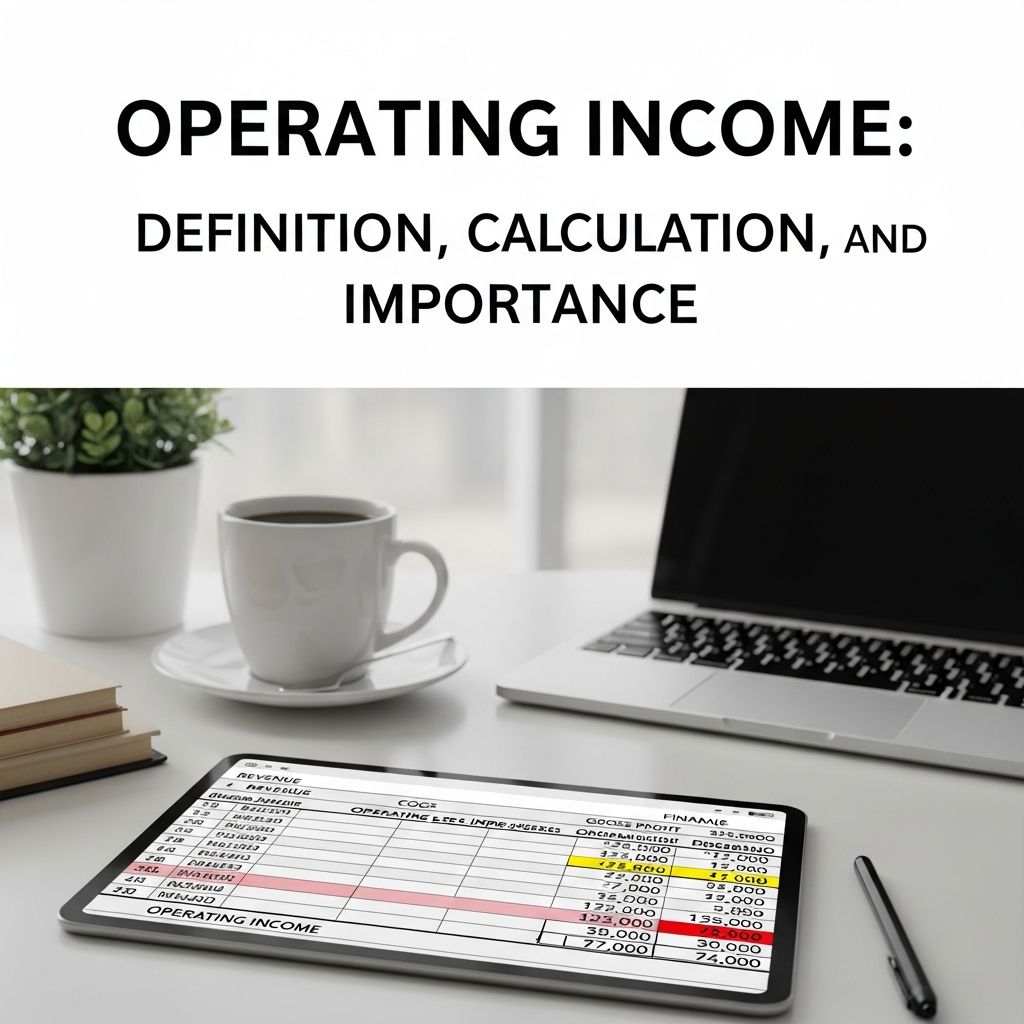
Operating income, also referred to as operating profit or earnings before interest and taxes (EBIT), represents the profit generated from a company’s core business operations. It reflects the revenue remaining after deducting all operating expenses but before accounting for interest expenses and income taxes. This financial metric provides investors and analysts with a clear picture of how efficiently a company manages its day-to-day operations without the influence of financing decisions, tax structures, or non-operational activities.
Operating income is calculated at a specific point on the income statement, serving as a crucial intermediate step between gross profit and net income. By isolating operational performance from other financial factors, operating income allows stakeholders to evaluate the true earning power of a business’s core activities. This metric is particularly valuable for comparing companies within the same industry or assessing a company’s operational performance over multiple periods.
How Operating Income is Calculated
Understanding how to calculate operating income is essential for financial analysis. The calculation process involves several straightforward steps that can be performed using data from a company’s income statement.
Method One: Starting from Revenue
The most direct approach to calculating operating income begins with total revenue and systematically deducts operating expenses:
- Start with total revenue (also called net sales)
- Subtract cost of goods sold (COGS)
- Calculate gross profit
- Subtract operating expenses (selling, general, and administrative expenses)
- Subtract depreciation and amortization
- The result is operating income
Formula: Operating Income = Revenue – COGS – Operating Expenses – Depreciation & Amortization
Method Two: Starting from Net Income
An alternative approach works backward from net income to arrive at operating income:
- Begin with net income (bottom line)
- Add back income taxes paid
- Add back interest expenses
- The result is operating income
Formula: Operating Income = Net Income + Income Taxes + Interest Expenses
Practical Calculation Example
Consider a retail company with the following financial data for a fiscal year:
- Total Revenue: $10,000,000
- Cost of Goods Sold: $6,000,000
- Gross Profit: $4,000,000
- Operating Expenses (salaries, rent, utilities): $2,500,000
- Depreciation & Amortization: $300,000
- Operating Income = $4,000,000 – $2,500,000 – $300,000 = $1,200,000
Operating Income Margin
The operating income margin is a profitability ratio that provides additional insight into operational efficiency. It represents operating income as a percentage of total revenue and helps investors understand how much profit a company generates from each dollar of sales before interest and taxes.
Formula: Operating Income Margin = (Operating Income / Revenue) × 100
Using the example above: Operating Income Margin = ($1,200,000 / $10,000,000) × 100 = 12%
This means the company retains 12 cents of profit from every dollar of revenue after paying all operating expenses. A higher operating margin indicates better operational efficiency and pricing power. Industry comparisons are important, as margins vary significantly across sectors. Technology companies typically have higher margins than retail businesses, for instance.
Operating Income vs. Other Profitability Metrics
It’s crucial to distinguish operating income from related but different financial metrics:
Operating Income vs. Net Income
Net income, also called the bottom line, represents the profit remaining after all expenses, including interest and taxes. Operating income excludes these non-operational factors, making it more useful for evaluating core business performance. A company might have substantial operating income but minimal net income if it carries significant debt or faces high tax obligations.
Operating Income vs. Gross Profit
Gross profit is calculated by subtracting only the cost of goods sold from revenue. It doesn’t account for operating expenses like salaries, rent, or administrative costs. Operating income provides a more comprehensive view of profitability by including all operating expenses. Gross profit is useful for assessing production efficiency, while operating income reflects overall business efficiency.
Operating Income vs. EBITDA
EBITDA (Earnings Before Interest, Taxes, Depreciation, and Amortization) is similar to operating income but adds back depreciation and amortization expenses. While operating income deducts these non-cash charges, EBITDA does not. EBITDA is often used in valuations and comparisons, particularly for capital-intensive industries, while operating income more accurately reflects actual profitability when depreciation and amortization are material.
Why Operating Income Matters
Operating income holds significant importance for multiple stakeholder groups:
For Investors
Investors use operating income to assess management’s ability to run the business efficiently and generate profits from core operations. By comparing operating income across periods or competitors, investors can identify trends in operational performance. A consistently growing operating income suggests improving business health and may signal a good investment opportunity.
For Creditors
Lenders and creditors examine operating income to evaluate a company’s capacity to service debt through operational cash flows. A company with strong and stable operating income demonstrates lower default risk and creditworthiness.
For Management
Company leadership uses operating income as a key performance indicator to monitor operational efficiency. It helps management identify areas where costs can be controlled and where operational improvements can be made. Operating income targets often form the basis of management compensation and performance evaluation.
For Market Analysis
Analysts use operating income in valuation models and financial forecasts. It serves as a foundation for calculating other metrics such as return on assets (ROA) and return on equity (ROE) when adjusted appropriately.
Factors Affecting Operating Income
Several elements influence a company’s operating income:
Revenue Performance
Top-line growth directly impacts operating income. Increased sales volume, higher prices, or expanding into new markets can boost revenue and subsequently operating income.
Cost Management
Controlling cost of goods sold through supply chain optimization, economies of scale, or better supplier negotiations directly improves operating income. Similarly, managing operating expenses through efficiency improvements or cost reduction initiatives enhances profitability.
Operational Efficiency
Improvements in production processes, employee productivity, and resource utilization can increase operating income without necessarily increasing revenue. Automation and technology investments often contribute to efficiency gains.
Industry and Economic Conditions
Economic cycles, competition, and industry-specific dynamics significantly influence operating income. Recessions may reduce sales volume, while industry consolidation might affect pricing power.
Analyzing Operating Income Trends
When evaluating a company’s operating income, consider the following analytical approaches:
Year-over-Year Comparison
Comparing operating income across consecutive years helps identify growth trends. However, be cautious about one-time items or unusual circumstances that might distort comparisons.
Quarterly Analysis
Examining quarterly operating income reveals seasonal patterns and quarterly trends. Some businesses experience significant seasonal variations that monthly analysis alone might not capture.
Peer Comparison
Benchmarking a company’s operating income margin against industry competitors provides context. If a company’s operating margin significantly trails competitors, it may indicate operational challenges or strategic differences.
Segment Analysis
For large, diversified companies, analyzing operating income by business segment reveals which divisions generate the most profit and identifies underperforming areas requiring attention.
Limitations of Operating Income
While operating income is a valuable metric, it has certain limitations:
- Excludes Capital Structure Impact: Operating income ignores the effects of financing decisions, so highly leveraged and lightly leveraged companies may show identical operating income despite different financial health.
- Tax Variations: By excluding taxes, operating income doesn’t reflect the actual after-tax profitability available to shareholders, which can vary significantly by jurisdiction.
- Non-Cash Charges: Depreciation and amortization, while real economic costs over time, are non-cash charges that may distort short-term comparisons.
- Doesn’t Reflect Investment Returns: Operating income ignores returns from investments, which can be significant for companies with substantial investment portfolios.
- One-Time Items: Unusual or one-time gains and losses included in operating expenses can obscure underlying operational performance.
Frequently Asked Questions
Q: What is the difference between operating income and operating profit?
A: Operating income and operating profit are essentially the same concept. Both terms refer to the profit generated from a company’s core business operations before accounting for interest and taxes. The terms are used interchangeably in financial analysis.
Q: Why is operating income important for investors?
A: Operating income is important because it shows how efficiently a company manages its core business operations. It isolates operational performance from financing and tax effects, allowing investors to compare companies fairly and assess management’s operational effectiveness.
Q: How does operating income relate to cash flow?
A: While related, operating income and operating cash flow are different. Operating income is an accrual-based accounting measure, while operating cash flow reflects actual cash movements. A company can have positive operating income but negative cash flow due to timing differences in receivables and payables.
Q: Can operating income be negative?
A: Yes, operating income can be negative if operating expenses exceed the gross profit. This indicates the company is losing money on its core operations, which is typically concerning for investors and management.
Q: How does operating income differ from EBIT?
A: Operating income and EBIT are conceptually similar and often used interchangeably. However, there can be minor technical differences depending on how non-operational items are categorized. Generally, they represent the same profit measure before interest and taxes.
Q: What operating expenses are deducted to calculate operating income?
A: Operating expenses typically include selling, general, and administrative expenses (SG&A), depreciation, amortization, and other costs directly related to running the business. They exclude interest, taxes, and non-operational items.
References
- Financial Accounting Standards Board (FASB) – Accounting Standards Codification (ASC) 220 — Financial Accounting Foundation. 2024. https://www.fasb.org/
- U.S. Securities and Exchange Commission – Annual Report Filing Requirements (Form 10-K) — U.S. SEC. 2024. https://www.sec.gov/cgi-bin/browse-edgar
- Corporate Finance Institute – Operating Income Definition and Calculation — CFI Education. 2024. https://corporatefinanceinstitute.com/
- International Financial Reporting Standards (IFRS) – IAS 1 Presentation of Financial Statements — IFRS Foundation. 2024. https://www.ifrs.org/
- CFA Institute – Financial Reporting and Analysis — CFA Institute. 2024. https://www.cfainstitute.org/
Similar Articles








Read full bio of medha deb