OPEC: Organization, Members, and History
Comprehensive guide to OPEC: exploring its members, organizational structure, and global impact.
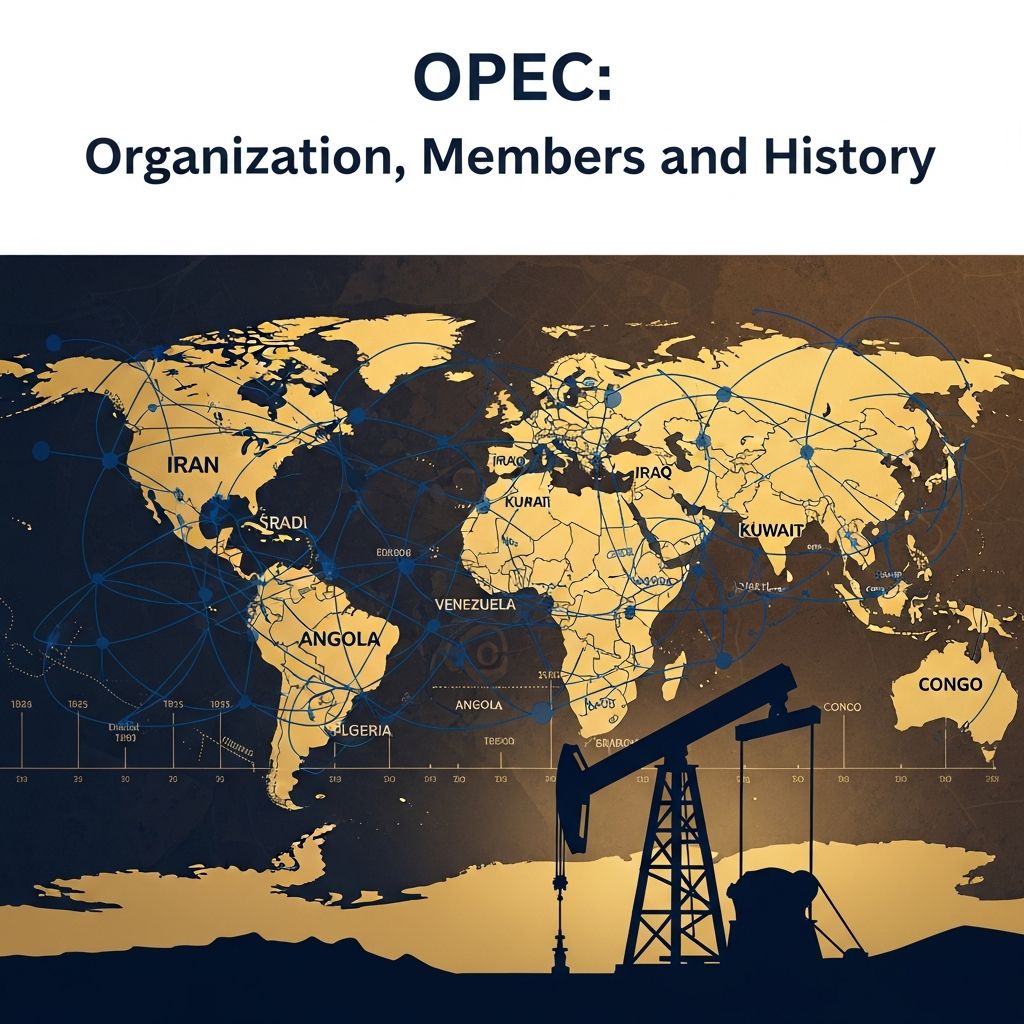
Understanding OPEC: Organization, Members, and Global Influence
The Organization of the Petroleum Exporting Countries, commonly known as OPEC, stands as one of the most influential international organizations in the global economy. Founded in 1960, OPEC represents a coalition of oil-producing nations working collectively to coordinate petroleum policies and stabilize oil markets. With 13 member countries controlling approximately 40 percent of the world’s annual oil production and nearly 80 percent of proven global oil reserves, OPEC wields considerable economic and political power in international relations.
What Is OPEC?
OPEC is a permanent intergovernmental organization established to coordinate and unify the petroleum policies of its member countries. The organization’s primary objective centers on securing fair and stable prices for petroleum producers while ensuring an efficient, economic, and regular supply of petroleum to consuming nations and a fair return on capital investment. Unlike profit-driven corporations, OPEC functions as a cooperative body where member nations maintain sovereignty over their own oil policies while working toward collective goals.
The organization operates as an international cartel, meaning it is a coalition of independent parties formed to promote mutual interests through coordinated market strategies. OPEC distinguishes itself from traditional cartels by being officially recognized as an intergovernmental organization with transparent objectives and regular diplomatic engagement with consuming nations worldwide.
The Founding and Early History of OPEC
OPEC’s establishment on September 14, 1960, in Baghdad represented a pivotal moment in global energy politics. The organization’s five founding members—Iran, Iraq, Kuwait, Saudi Arabia, and Venezuela—gathered to create a unified response to declining oil prices and diminishing control over their own petroleum resources. At that time, major Western multinational oil companies, known collectively as the “Seven Sisters,” dominated global oil production and maintained significant control over pricing structures.
The founding nations sought to reclaim sovereignty over their natural resources and counter the oligopoly established by these dominant Anglo-American oil firms. By nationalizing oil production and coordinating output targets, these five countries aimed to stabilize prices and secure fair compensation for their petroleum exports. The original OPEC agreement was formally registered with the United Nations Secretariat on November 6, 1962, following UN Resolution No. 6363, providing the organization with official international recognition.
Membership Expansion and Current Members
Since its founding, OPEC has expanded significantly to include thirteen member nations representing diverse regions including the Middle East, Africa, and South America. The organization’s membership has evolved over decades, with some nations joining while others departed.
Current OPEC Member Countries:
– Algeria- Angola- Congo (Republic of the Congo)- Equatorial Guinea- Gabon- Iran- Iraq- Kuwait- Libya- Nigeria- Saudi Arabia- United Arab Emirates- Venezuela
These thirteen member states collectively represent a formidable presence in global energy markets. Saudi Arabia, often considered the organization’s de facto leader, holds the largest proven reserves among OPEC members and frequently influences production decisions through its market dominance.
Former OPEC Members
Several nations have held OPEC membership at various points in the organization’s history. Angola, Ecuador, Indonesia, and Qatar are former members who withdrew for various political, economic, or strategic reasons. Indonesia, for instance, suspended its membership in 2016 due to becoming a net oil importer, though it rejoined in 2016. Ecuador suspended its membership twice, first in 1992 and again in 2020. These membership changes reflect the dynamic nature of global energy markets and changing national circumstances.
OPEC’s Organizational Structure
OPEC maintains a formal organizational structure designed to facilitate coordination among member states and implement collective decisions. The organization’s headquarters is located in Vienna, Austria, serving as the central administrative hub for all operations and decision-making processes.
Key Organizational Components:
– Conference of Ministers: The supreme authority making major policy decisions, comprising oil ministers from each member country- Board of Governors: Coordinates implementation of Conference decisions and oversees administrative functions- Secretary-General: The organization’s chief executive responsible for day-to-day management and international representation- Secretariat: The administrative body supporting the organization’s operations and providing technical expertise
Member states coordinate petroleum policies at regular conferences, typically held twice annually, and emergency sessions when global market conditions demand immediate attention. Oil ministers from each member country lead their respective delegations, bringing technical expertise and governmental authority to negotiations. This ministerial-level engagement ensures that decisions reflect the highest political commitments of member governments.
OPEC’s Strategic Functions and Objectives
OPEC operates with several interconnected strategic functions designed to serve both producer and consumer interests. The organization’s stated mission encompasses multiple objectives that shape its policy decisions and international engagement.
Primary Functions:
– Stabilizing global oil prices to eliminate harmful and unnecessary price fluctuations- Ensuring efficient and regular petroleum supply to consuming nations- Securing fair prices that provide adequate returns for petroleum producers- Coordinating member countries’ petroleum production policies- Providing technical and economic assistance to member nations- Protecting producer interests against market exploitation by multinational corporations
By coordinating production levels among members, OPEC influences global oil supply, which directly impacts worldwide energy prices. This coordination mechanism allows member countries to respond collectively to market disruptions, preventing dramatic price swings that could destabilize global economies.
OPEC’s Impact on Global Oil Markets
Since its inception, OPEC has fundamentally reshaped global energy economics and international relations. The organization’s influence became particularly evident during major historical events that demonstrated its market power and geopolitical significance.
The 1973 Oil Embargo
One of the most significant demonstrations of OPEC’s power occurred in 1973 when the organization, led by Saudi Arabia, implemented an oil embargo against Western nations supporting Israel during the Yom Kippur War. OPEC members reduced oil production dramatically, restricting supplies to the United Kingdom, United States, and other allied nations. This production cut resulted in a steep increase in oil prices and created widespread panic in consuming nations, leading to gas shortages and economic disruption. The embargo highlighted OPEC’s capacity to leverage petroleum as a political weapon and demonstrated its ability to influence global geopolitics through energy policy.
Price Stabilization During Economic Crises
More recently, OPEC has utilized its coordinated production capacity to stabilize markets during unexpected global disruptions. During the COVID-19 pandemic in 2020, unprecedented lockdowns and travel restrictions caused dramatic reductions in oil consumption worldwide. Recognizing the threat to petroleum prices and producer revenues, OPEC agreed to reduce production collectively, stabilizing prices by decreasing supply during the crisis. This response prevented the catastrophic price collapses that could have devastated member economies dependent on petroleum revenues.
The Evolution to OPEC+
In late 2016, OPEC initiated a strategic expansion of its collaborative framework by forming OPEC+, a larger alliance incorporating non-OPEC oil-producing nations. This expansion reflected changing global energy dynamics and the emergence of new significant oil producers outside the traditional OPEC membership.
OPEC+ incorporates ten additional oil-producing countries working in coordination with OPEC members to influence global crude oil markets more effectively. Russia serves as the most prominent non-OPEC member within this alliance, along with Kazakhstan, Azerbaijan, Mexico, Oman, and several other producers. Canada, Egypt, and Norway participate as observer states, maintaining involvement while retaining operational independence.
The creation of OPEC+ represented a response to falling crude oil prices during the mid-2010s, partly driven by massive increases in United States shale oil production since 2011. By expanding the coalition to include these additional producers, OPEC strengthened its capacity to coordinate global supply and maintain price stability in an increasingly competitive energy market.
OPEC’s Reserve Holdings and Production Capacity
OPEC’s dominance in global energy markets stems largely from its control over vast petroleum reserves. The thirteen member countries collectively hold approximately 79.4 percent of the world’s proven oil reserves, granting them extraordinary long-term market influence. This concentration of reserve ownership ensures OPEC’s continued relevance in global energy markets for decades to come, regardless of short-term market fluctuations or technological developments.
Beyond reserves, OPEC members account for roughly 40 percent of annual global oil production, positioning the organization as the single largest supplier to international petroleum markets. This production dominance enables OPEC to respond to market conditions by adjusting member output, implementing production cuts during price declines or expanding production when market conditions warrant increased supply.
Challenges and Controversies Surrounding OPEC
Throughout its history, OPEC has faced substantial criticism from consuming nations, particularly the United States, which characterizes the organization as an economic threat. American presidents from Gerald Ford to Donald Trump have publicly criticized OPEC as a cartel manipulating oil prices to the detriment of American consumers and the broader global economy.
Energy independence movements in developed nations seek to reduce reliance on OPEC petroleum through renewable energy development, domestic production expansion, and conservation initiatives. The growth of shale oil production in the United States and technological advances in renewable energy represent ongoing challenges to OPEC’s market dominance and pricing influence.
Future Outlook for OPEC
OPEC’s future role in global energy markets remains subject to significant uncertainties. The global transition toward renewable energy sources, electric vehicle adoption, and climate change policies threaten long-term petroleum demand. Simultaneously, geopolitical tensions among member states, sanctions against member countries, and internal disputes over production quotas periodically destabilize the organization’s decision-making processes.
Despite these challenges, OPEC maintains its position as a crucial actor in global energy markets. The organization’s capacity to coordinate policy among diverse nations with varying political systems and economic interests demonstrates the vital importance of petroleum in the contemporary world economy.
Frequently Asked Questions About OPEC
Q: When was OPEC founded and by whom?
A: OPEC was founded on September 14, 1960, in Baghdad by five nations: Iran, Iraq, Kuwait, Saudi Arabia, and Venezuela. These founding members sought to coordinate petroleum policies and counter the dominance of multinational oil companies.
Q: How many members does OPEC currently have?
A: OPEC currently has 13 member countries spanning the Middle East, Africa, and South America. The membership includes the five founding nations plus eight additional countries that joined at various times throughout the organization’s history.
Q: What percentage of global oil production does OPEC control?
A: OPEC members account for approximately 40 percent of the world’s annual oil production and control roughly 79.4 percent of proven global oil reserves, making the organization the dominant force in international petroleum markets.
Q: What is OPEC+ and how does it differ from OPEC?
A: OPEC+ is an expanded alliance formed in 2016 that includes OPEC’s 13 members plus 10 additional oil-producing nations, most notably Russia. OPEC+ coordinates production decisions to enhance market stability and influence global oil prices more effectively.
Q: Where is OPEC’s headquarters located?
A: OPEC’s headquarters is located in Vienna, Austria, where the organization coordinates its administrative operations and hosts regular ministerial conferences for member nations.
Q: How does OPEC influence global oil prices?
A: OPEC influences global oil prices by coordinating production levels among member countries. By adjusting supply through production cuts or increases, OPEC can stabilize prices and respond to global economic disruptions.
References
- What is OPEC | Definition and Meaning — Capital.com. 2025. https://capital.com/en-int/learn/glossary/opec-definition
- OPEC – Wikipedia — Wikimedia Foundation. 2025. https://en.wikipedia.org/wiki/OPEC
- What are OPEC and OPEC+? How do they influence oil prices? — World Economic Forum. November 2022. https://www.weforum.org/stories/2022/11/oil-opec-energy-price/
- Organization Of The Petroleum Exporting Countries (OPEC) — JODI (Joint Organizations Data Initiative). 2025. https://www.jodidata.org/about-jodi/partners/opec.aspx
- OPEC | Membership, Organization, History, & Facts — Britannica. November 12, 2025. https://www.britannica.com/topic/OPEC
- OPEC in a Changing World — Council on Foreign Relations. 2025. https://www.cfr.org/backgrounder/opec-changing-world
Similar Articles








Read full bio of medha deb