OpCo: Understanding Operating Company Structures
Master the fundamentals of OpCo structures and their role in corporate organization.
What Is an OpCo (Operating Company)?
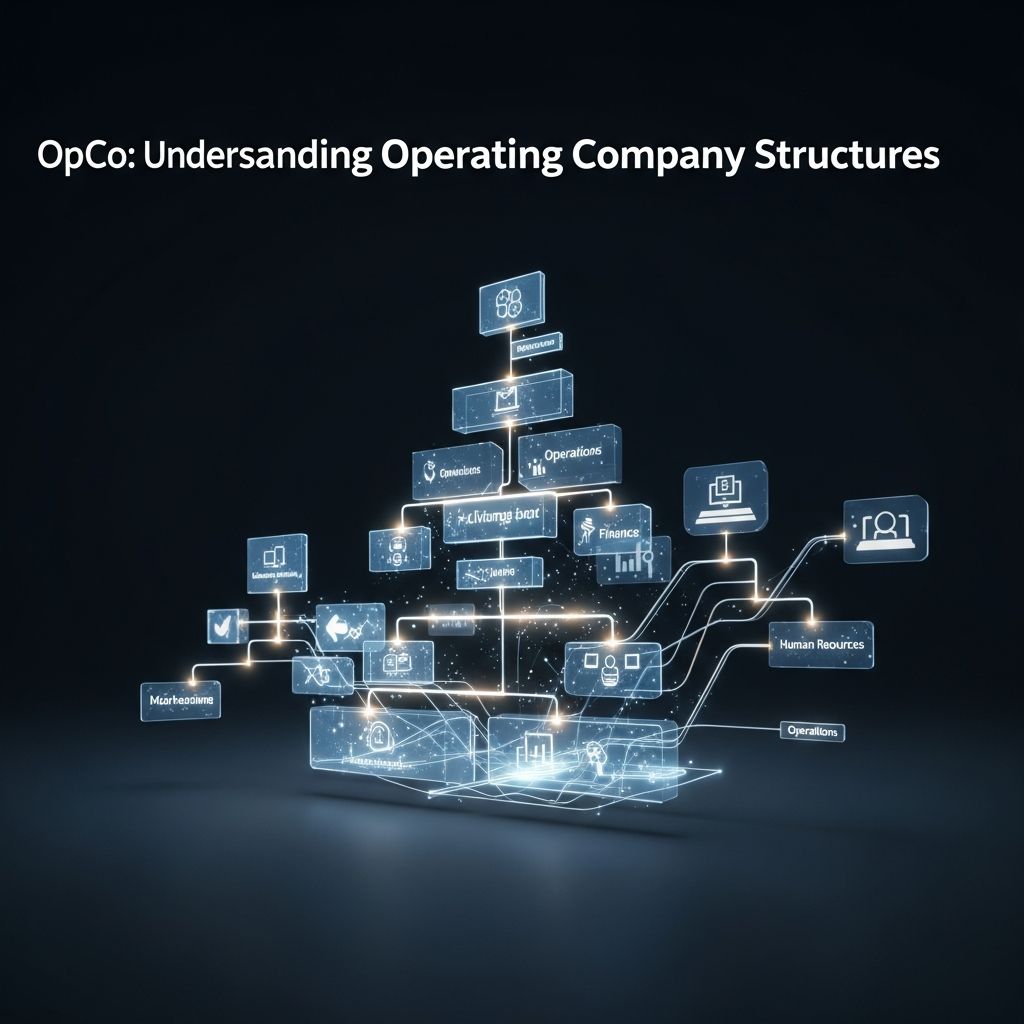
An OpCo, or operating company, is a subsidiary established by a parent company to handle the day-to-day operations of a business. Unlike its parent entity, which may focus on strategic planning and financial management, an OpCo is the frontline operational unit responsible for generating revenue and delivering products or services directly to customers. This organizational structure has become increasingly popular among large corporations seeking to optimize their business operations and manage risk effectively.
The OpCo serves as the “boots on the ground” entity within a corporate structure, maintaining direct involvement with customers, employees, and operational assets. By separating operational functions from strategic oversight, companies can create a more efficient and flexible organizational framework that allows for better resource allocation and risk management.
Core Functions and Responsibilities of an OpCo
An operating company typically handles several critical business functions that keep the organization running smoothly:
- Production of goods or services: The OpCo manages manufacturing, production facilities, or service delivery operations.
- Marketing and sales: Creating demand and converting potential customers into paying clients falls under OpCo responsibilities.
- Customer service: Maintaining customer relationships and handling support inquiries is a core OpCo function.
- Research and development: Innovation and product improvement efforts are typically managed at the OpCo level.
- Human resources management: Hiring, training, and managing the workforce that executes daily operations.
These functions work in concert to create the operational backbone of the business, ensuring that the company’s value proposition reaches customers efficiently and effectively.
Key Benefits of the OpCo Structure
Organizations adopt OpCo structures for several compelling reasons that enhance their overall business performance and risk management:
Limited Liability Protection
One of the most significant advantages of establishing an OpCo is the legal protection it provides to the parent company. By organizing operations through a subsidiary, the parent company achieves limited liability protection. If the OpCo faces legal challenges, financial difficulties, or operational crises, the parent company’s assets remain generally shielded from direct liability. This separation creates a legal firewall that protects parent company shareholders and stakeholders.
Enhanced Focus and Operational Efficiency
OpCo structures enable management to concentrate exclusively on core business activities without the distraction of strategic or financial concerns typically handled at the parent level. This laser-focused approach leads to greater operational excellence, faster decision-making at the operational level, and improved efficiency in executing business processes.
Strategic Flexibility and Diversification
Parent companies can establish multiple OpCos for different business segments, product lines, or geographical locations. This flexibility allows organizations to enter new markets, test new business models, or enter into joint ventures without jeopardizing the entire corporate structure. Each OpCo can be tailored to the specific requirements of its market segment or geographic location.
Tax Advantages
Depending on the specific legal and financial context, OpCo structures can provide significant tax benefits. These may include favorable tax treatment of inter-company transactions, deductions for legitimate business expenses, and the ability to optimize tax liability across multiple jurisdictions through appropriate structuring.
OpCo vs. Holding Company: Understanding the Distinction
While both OpCos and holding companies are components of sophisticated corporate structures, they serve distinctly different purposes within an organization:
| Characteristic | OpCo (Operating Company) | HoldCo (Holding Company) |
|---|---|---|
| Primary Function | Day-to-day operations and revenue generation | Strategic oversight and financial management |
| Direct Customer Contact | Yes, actively engaged with customers | No, operates behind the scenes |
| Asset Ownership | Holds operational assets | Holds equity of OpCos |
| Key Responsibilities | Production, sales, customer service, R&D | Acquisitions, mergers, financial decisions |
| Operational Involvement | Directly involved in daily business | Strategic and policy-level involvement |
The holding company, also referred to as a parent company or umbrella company, serves as the financial and strategic apex of the corporate structure. It focuses on broader strategic initiatives such as acquisitions and mergers, financial management, investment decisions, and overseeing multiple OpCos. The HoldCo acts as a financial umbrella that owns and manages the OpCos but maintains a strategic distance from their daily operations.
HoldCo/OpCo Structures in Detail
A HoldCo/OpCo structure represents a sophisticated organizational model where a holding company owns and manages a series of operating companies, often diversified across different countries or dedicated to specific corporate projects. In this arrangement, the HoldCo typically holds nothing other than the equity of its constituent OpCos, while the OpCos themselves hold the operational assets and, normally, any secured debt.
Asset Location and Debt Structuring
In traditional HoldCo/OpCo structures, secured debt is typically housed where the assets actually reside—at the OpCo level. This placement reflects lender preferences, as creditors naturally want to be positioned closest to where actual asset value exists. This structuring has important implications for creditor recovery in distressed scenarios.
Upstream Guarantees
An upstream guarantee is a mechanism where the OpCo guarantees the debt held by the HoldCo. This guarantee provides HoldCo lenders with unsecured claims at the OpCo level, effectively positioning them closer to the asset base. While guarantees can theoretically be structured in various ways, upstream guarantees typically give HoldCo lenders assurance that, despite their debt residing at the HoldCo level, they maintain claims that are pari (equal in priority) with other unsecured OpCo debt.
OpCo/PropCo Structures: Separating Operations from Property
A specialized variant of the OpCo structure is the OpCo/PropCo model, which separates a company’s trading business (OpCo) from its property-owning business (PropCo). This structure is particularly valuable for property-heavy businesses and industries where real estate represents significant value.
How OpCo/PropCo Structures Work
In a typical OpCo/PropCo arrangement, a company transfers its property to a property holding vehicle (PropCo), usually a Special Purpose Vehicle (SPV). The OpCo then operates the business and leases the property from the PropCo. Legally, the property owner (PropCo) and tenant (OpCo) are separate entities, though they typically remain under common ownership and management.
Key Benefits of OpCo/PropCo Separation
The primary advantage of this structure is risk segregation and asset protection. Property assets are shielded from the operational risks of the underlying business. If the OpCo becomes insolvent, faces litigation, or experiences financial difficulties, the property assets remain protected from its liabilities. This separation is particularly valuable for retail chains, hotels, manufacturing facilities, and other property-intensive operations.
Common OpCo/PropCo Models
Among the most common structures is the sale and leaseback arrangement. Here, the OpCo sells its property to the PropCo, which subsequently leases the property back to the OpCo. This model provides multiple benefits: it crystallizes value for the trading business, enables PropCo debt structuring to be optimized separately, and maintains operational continuity through the lease arrangement.
Debt Structuring in OpCo/PropCo Models
PropCo debt is typically secured against property on a medium-to-long-term basis, such as commercial mortgages. Lenders evaluating PropCo structures focus primarily on property value, rental coverage, and tenant creditworthiness. Meanwhile, OpCo debt reflects the underlying business performance and stability.
Practical Applications Across Industries
OpCo structures manifest differently across various business sectors. In retail operations, the OpCo runs stores and manages employees while the PropCo owns the retail properties and leases them back. In hospitality, a hotel OpCo provides services and manages guest experiences, while the PropCo owns the property assets. Manufacturing operations similarly see the OpCo overseeing factory floors and production lines, with the PropCo holding the industrial real estate.
Tax Considerations in OpCo Structures
OpCo/PropCo structures can have significant tax implications, particularly regarding shareholder benefits and income allocation. When an OpCo incurs capital expenditure to enhance a PropCo asset, value effectively transfers from OpCo to PropCo, which may represent a constructive distribution to shareholders. Within group structures, such distributions to corporate shareholders are typically exempt from taxation, whereas non-group structures may trigger income tax at dividend rates. Additionally, if shareholders also serve as OpCo directors, tax authorities may argue that employment benefits have arisen, potentially creating income tax and National Insurance liabilities.
Frequently Asked Questions About OpCo Structures
Q: What is the primary difference between an OpCo and a HoldCo?
A: The primary difference lies in function and involvement. An OpCo (operating company) handles day-to-day business operations and directly generates revenue through products or services. A HoldCo (holding company) owns the equity of OpCos and focuses on strategic decisions, financial management, and oversight rather than operational activities.
Q: Why would a company establish an OpCo structure?
A: Companies establish OpCo structures for several reasons: to gain limited liability protection that shields parent company assets from operational risks, to improve operational focus and efficiency, to enable strategic flexibility through multiple OpCos for different business segments or geographies, and to potentially access tax advantages through appropriate structuring.
Q: What are the advantages of an OpCo/PropCo structure?
A: OpCo/PropCo structures provide asset protection by separating property holdings from operational risks, enable optimized debt structuring for property and operational components separately, protect property assets from OpCo insolvency or litigation, and allow for improved financial management of real estate-intensive businesses.
Q: How does an upstream guarantee work in a HoldCo/OpCo structure?
A: An upstream guarantee occurs when the OpCo guarantees the debt of the HoldCo. This guarantee gives HoldCo debt holders unsecured claims at the OpCo level, effectively positioning them closer to the asset base and providing them with recovery rights pari with other unsecured OpCo creditors.
Q: Can an OpCo/PropCo structure exist without a HoldCo?
A: Yes, an OpCo/PropCo structure does not require a HoldCo, though one is frequently present. The HoldCo can provide overall strategic oversight and control when multiple entities are involved, but OpCo and PropCo can function together under direct common ownership without a separate holding company structure.
Q: What should lenders focus on when evaluating an OpCo/PropCo structure?
A: When assessing OpCo/PropCo structures, lenders typically evaluate the OpCo’s stability, management quality, and underlying business performance. For the property assets themselves, lenders focus on property value, rental income coverage ratios, and tenant creditworthiness to ensure debt service capacity.
References
- OpCo Explained – Manager Glossary — Roel Timmermans. Accessed November 2025. https://www.roeltimmermans.com/manager-glossary/opco-explained
- What is Structural Subordination? HoldCo / OpCo Structures — Restructuring Interviews. Accessed November 2025. https://restructuringinterviews.com/blogs/restructuring/structural-subordination
- OpCo/PropCo Structures — Market Financial Solutions. Accessed November 2025. https://www.mfsuk.com/opco-propco-structures/
- OpCo/PropCo Structures in Practice — BDO UK. Accessed November 2025. https://www.bdo.co.uk/en-gb/insights/tax/tax-support-for-professionals/opco-propco-structures-in-practice
Similar Articles








Read full bio of Sneha Tete