One-Stop Shop: Definition, Examples & Business Model
Explore the one-stop shop business model and how it revolutionizes customer convenience.
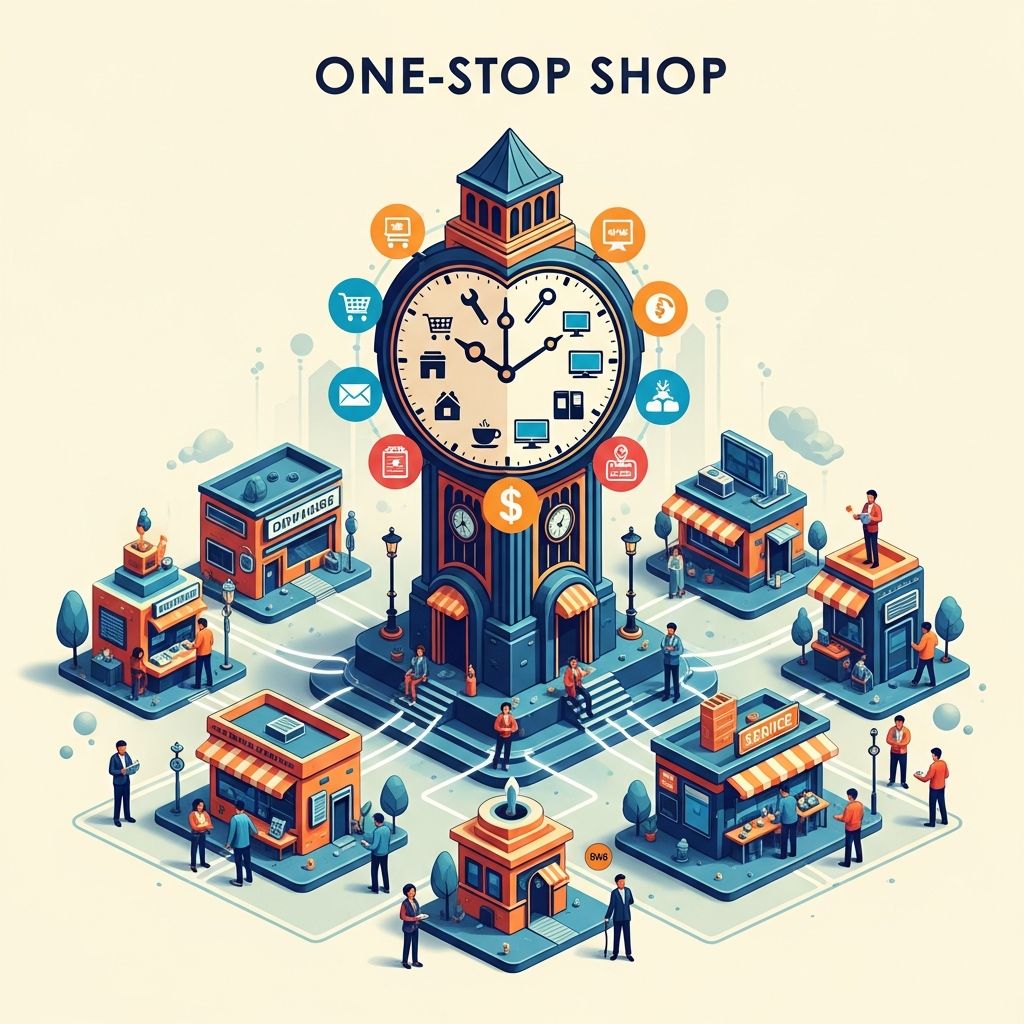
What Is a One-Stop Shop?
A one-stop shop refers to a retail business or service operation that offers a wide variety of products or services under a single roof. This business model consolidates multiple offerings in one convenient location, eliminating the need for customers to visit several different stores or service providers to meet their diverse needs. The concept has evolved far beyond traditional retail and now encompasses government services, digital platforms, and specialized service centers.
The term originated in the United States during the late 1920s and early 1930s, emerging as a revolutionary approach to retail commerce. It became popularized with the rise of department stores and large-scale retailers that recognized the value of offering customers comprehensive shopping experiences in centralized locations. Today, the phrase has become widespread slang describing everything from websites and mobile applications to television networks and physical establishments where customers can find most or all of what they need in one place.
Understanding the One-Stop Shop Business Model
The one-stop shop business model operates on several core principles designed to maximize customer convenience and operational efficiency. At its foundation, the model seeks to attract more customers by offering breadth of selection, competitive pricing, and streamlined service delivery. By consolidating related products and services, businesses can leverage economies of scale and scope, which translates into cost advantages and improved profitability.
The primary value proposition of a one-stop shop involves providing customers with convenient access to diverse offerings without requiring them to travel between multiple locations. This convenience factor directly influences customer satisfaction and loyalty. Additionally, the model enables cross-selling opportunities, where customers shopping for one category of products or services may discover and purchase complementary items or services, thereby increasing average transaction values and overall revenue.
Key Characteristics of the Model
One-stop shops typically share several defining characteristics. They maintain large physical or digital spaces that house diverse product categories or service offerings. They operate with competitive pricing strategies to attract price-conscious consumers seeking value. They implement self-service or streamlined service systems to enhance efficiency. They utilize data and information technology to manage inventory, customer relationships, and service delivery. They focus on customer experience optimization, ensuring that navigation and purchasing processes are straightforward and intuitive.
Historical Origins and Evolution
The one-stop shop concept revolutionized retail commerce beginning in the 1930s. Michael J. Cullen, founder of King Kullen Grocery Company, is widely recognized as the pioneer of this business model. In 1930, King Kullen opened its doors with the motto “pile it high, sell it low,” offering customers a comprehensive range of food items at significantly reduced prices. This innovative approach not only saved customers time and money but also created unprecedented cross-promotion and upselling opportunities within a price-conscious consumer base.
Cullen’s inspiration drew from established retailers like Macy’s and The Great Atlantic & Pacific Tea Company (A&P), which had begun expanding their retail spaces. However, Cullen recognized the transformative potential of combining self-service retail concepts with the one-stop shop model. This combination proved remarkably successful; by the time of Cullen’s death in 1936, King Kullen had expanded to 17 stores, demonstrating the model’s viability and market appeal.
The subsequent evolution of the one-stop shop model led to the emergence of supermarkets as we know them today, followed by the expansion of the concept into non-grocery retail sectors. Department stores, discount retailers, and specialty chains all adopted variations of the model. In recent decades, the model has transcended physical retail and expanded into financial services, government administration, digital platforms, and professional services.
Real-World Examples of One-Stop Shops
Numerous companies have successfully implemented the one-stop shop business model across various industries, demonstrating the versatility and effectiveness of this approach.
Supermarkets and Retail Chains
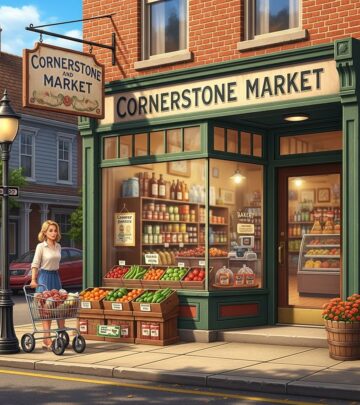
Supermarkets represent the quintessential example of the one-stop shop model. These establishments offer customers thousands of products across multiple categories—groceries, prepared foods, health and beauty items, household goods, and more—all under one roof. The convenience factor has made supermarkets the preferred shopping destination for millions of consumers worldwide.
Best Buy
Best Buy exemplifies the one-stop shop model in consumer electronics retail. Beyond selling an extensive variety of electronics and appliances, the company offers the “Geek Squad” service, providing technical support, repairs, and installation services. This integration of products and services creates a comprehensive technology solution center for customers.
Merrill Lynch
Merrill Lynch pioneered the financial supermarket concept during the 1980s, fundamentally democratizing access to investment services. By consolidating investment banking, wealth management, brokerage services, and financial advisory services, Merrill Lynch brought sophisticated financial products previously available only to wealthy elites to average Americans, revolutionizing the financial services industry.
Toys R Us
Founder Charles Lazarus successfully transplanted the one-stop shop model to the toy industry. Toys R Us offered a vast variety of toy products at lower prices within large-format stores, becoming the first toy supermarket. This strategy enabled the company to benefit from significant economies of scale and scope, allowing it to undercut competitors on pricing and attract substantial customer bases. At its peak, Toys R Us operated more than 2,000 stores across more than 30 countries worldwide.
Advantages of the One-Stop Shop Model
The one-stop shop business model delivers substantial benefits to both businesses and consumers.
For Customers: The primary advantage is convenience. Customers save time and effort by meeting multiple needs in a single location rather than making numerous separate trips. This convenience translates into improved customer satisfaction and increased loyalty. Additionally, one-stop shops typically offer competitive pricing due to economies of scale, providing customers with better value. The variety of offerings enables customers to discover and purchase complementary products they might not have found elsewhere.
For Businesses: The model enables companies to achieve significant economies of scale and scope. By consolidating operations across multiple product or service categories, businesses can optimize supply chains, reduce overhead costs per unit, and improve operational efficiency. The model facilitates cross-selling and upselling opportunities, increasing average customer transaction values and overall revenue. Large customer bases generated by convenience attract investment and facilitate market expansion. The diverse revenue streams reduce dependency on any single product or service category, improving business resilience.
Challenges and Considerations
While the one-stop shop model offers considerable advantages, it presents certain challenges and limitations. Managing diverse product or service categories requires complex operational systems, sophisticated inventory management, and skilled workforce across multiple domains. The model may dilute brand identity when attempting to serve too many customer segments simultaneously. Smaller, specialized competitors may offer superior product quality or service expertise within specific categories. The large-scale operations require substantial capital investment and infrastructure development. Competition from online retailers and specialized e-commerce platforms has challenged traditional brick-and-mortar one-stop shops.
Government Applications and Public Administration
Beyond commercial retail, the one-stop shop concept has been successfully adapted to government service delivery. Many jurisdictions have established government one-stop shops to improve citizen access to public services and enhance administrative efficiency.
Brazil’s Poupatempo centers, established in São Paulo in 1997, exemplify this approach. These centers consolidate multiple government services, enabling citizens to renew driver’s licenses, obtain permits, and access other services without visiting multiple government offices. The success of Poupatempo has inspired similar initiatives throughout Brazil and influenced one-stop shop models globally.
Australia’s Centrelink agency, Canada’s Service Canada at the federal level (along with provincial initiatives like ServiceOntario and Services Québec), and the United Kingdom’s Jobcentres all employ the one-stop shop model for government service delivery. In Portugal, the government operates Citizen’s Shops (Loja de Cidadão), which issue identity cards, passports, and handle tax and healthcare-related services.
The United States pioneered virtual one-stop shops through 3-1-1 services, introduced by municipalities including Baltimore, Chicago, and New York City during the late 1990s and early 2000s. New York City’s 3-1-1 service handles 30,000 calls daily, providing information on 6,000 government benefits and services in 180 languages from a single source, exemplifying the model’s digital adaptation.
The Future: Beyond One-Stop Shops
Stephen Goldsmith, former mayor of Indianapolis, has proposed an evolution beyond traditional one-stop shops called “no-stop shops.” Rather than requiring citizens to visit centralized locations, no-stop shops would centralize citizen data, enabling governments to provide services proactively based on anticipated individual and household needs. This approach leverages advanced e-government technology to bring services to citizens when most needed, further reducing friction and enhancing service delivery.
Frequently Asked Questions
Q: What is the primary goal of a one-stop shop business model?
A: The primary goal is to provide customer convenience by consolidating multiple products or services in a single location, thereby increasing customer satisfaction, loyalty, and business revenue through cross-selling opportunities and operational efficiency.
Q: How do one-stop shops achieve competitive pricing?
A: One-stop shops achieve competitive pricing through economies of scale and scope. By consolidating operations and purchasing in large volumes, they reduce per-unit costs, enabling them to offer lower prices while maintaining profitability.
Q: Can the one-stop shop model be applied to service industries?
A: Yes, the model is highly adaptable to service industries. Examples include financial supermarkets, government service centers, and companies like Best Buy that combine product sales with professional services.
Q: What challenges do one-stop shops face in the digital age?
A: One-stop shops face competition from specialized online retailers and e-commerce platforms. They must adapt by developing strong digital presence, omnichannel capabilities, and personalized customer experiences to remain competitive.
Q: Are there any drawbacks to using one-stop shops for consumers?
A: While one-stop shops offer convenience, some consumers may prefer specialized retailers offering superior expertise or quality in specific categories. Large stores can be overwhelming to navigate, and pricing at individual category levels may not always be competitive with specialized retailers.
Q: How has technology influenced the one-stop shop concept?
A: Technology has expanded the one-stop shop concept into digital spaces. Online platforms, mobile applications, and omnichannel retail strategies now enable customers to access diverse products and services virtually, transcending physical location limitations.
References
- One-stop shop — Wikipedia. Accessed 2025. https://en.wikipedia.org/wiki/One-stop_shop
- One-stop-Shop: The Business Model — Learning Loop. Accessed 2025. https://learningloop.io/plays/business-model/one-stop-shop
- History of Supermarkets — United States Department of Agriculture. https://www.usda.gov
- E-Government and Sustainable Development — United Nations Department of Economic and Social Affairs. https://www.un.org/en/desa
Similar Articles








Read full bio of medha deb